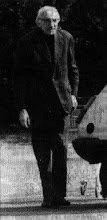
‘I am not a religious man, but I cannot help seeing every problem from a religious point of view.’ This remark of Wittgenstein’s indicates a doubleness or ambivalence in his relation to religion: he was drawn towards it and at the same time he was unable, or unwilling, to participate in it. There is a delicacy and hesitation here that is also manifest in his three Lectures on Religious Belief, lectures on which I shall base my account of his thought here. [Wittgenstein, Lectures and Conversations on Aesthetics, Psychology and Religious Belief, ed. Cyril Barrett (Oxford: Blackwell, 1987). Hereinafter referred to in the text as LC.] The published version of the lectures was not written by Wittgenstein himself. It is edited from notes taken down by his students, which he neither saw nor checked. As the editor, Cyril Barrett, points out, it is even doubtful if he would have approved of their publication, at least in their present form. Nevertheless, it is here that some part of the value of the notes resides. The notes were made during lectures delivered in the summer of 1938 to Wittgenstein’s students in Cambridge, who sometimes make objections or suggestions as to what Wittgenstein should say. His refusal to accept what they propose and argue for tells us a good deal about how he went about philosophising, and also about the kinds of mistake even the best of his students were inclined to make.
The first of the three lectures sets a problem of interpretation before us. To begin with, Wittgenstein considers a number of religious utterances, not about God, but about the afterlife, or the Last Judgement, such as this: ‘An Austrian general said to someone; “I shall think of you after my death, if that should be possible.” We can imagine one group who would find this ludicrous, another who wouldn’t.’ (The lecture notes the fact that during the First World War, when he was a soldier, Wittgenstein saw consecrated bread being carried in chromium steel. This struck him as ludicrous.) Again, Wittgenstein imagines someone asking him if he believes in a Last Judgement: 'Suppose that someone believed in the Last Judgement, and I didn’t, does this mean that I believe the opposite to him, just that there won’t be such a thing? I would say: “not at all, or not always.”' In the same kind of vein, he goes on: 'Suppose I say that the body will rot, and another says, “No. Particles will rejoin in a thousand years, and there will be a Resurrection of you.”
If some said: “Wittgenstein, do you believe in this?” I’d say: “No.” “Do you contradict the man?” I’d say: “No.” . . .
Would you say: “I believe the opposite”, or “There is no reason to believe such a thing”? I’d say neither. (LC 53)
It seems clear from this that, for Wittgenstein, the religious man and the atheist talk past one another.
What we shall see, I think, is that, so far as Wittgenstein is concerned in these lectures, when the religious person says ‘I believe in God’ and the atheist says ‘I don’t believe there is a God’, they do not affirm and deny the same thing. Religious discourse is commonly viewed, by atheists, and others, as a pre-scientific or primitive discourse which has somehow, through human folly and superstition, survived into the age of computers and advanced technology. Wittgenstein clearly believes no such thing. He is trying to get us to change our picture of what religious discourse is; he wants us to come to see it under a different aspect from that dictated to us by the presuppositions of a certain idea of what science is and what demands it makes on us. Wittgenstein’s picture is not that the religious person makes a claim, and the atheist asserts its negation. However, it is important to say that, in setting the issue out in this way, Wittgenstein is not trying to make a case for religion per se: the opposition between what the atheist might say, as opposed to the religious man, is meant to bring us to see, in the sense of seeing something in a new light, of grasping a new conception, how religious language has its place in our lives.
The opening lecture provides a number of pointers in this direction. Wittgenstein looks first, as an object of comparison, at how we might deal with an empirical question. Here, the appropriate response is often not to say ‘I believe’ or ‘I don’t believe’, but to say, ‘probably not’ or ‘probably yes’, or ‘Possibly. I’m not sure’. Wittgenstein uses the example of someone’s saying ‘There is a German plane overhead’ (the lectures were given in the summer of 1938). If Wittgenstein were to reply, ‘Possibly, I’m not so sure’, one would be inclined to say that he and his interlocutor were fairly near. With respect to the Last Judgement, however, things are different: 'Suppose someone were a believer, and said: ‘I believe in a Last Judgement’, and I said ‘Well, I’m not so sure. Possibly.’ You would say there is an enormous gulf between us' (LC 53).
Wittgenstein brings out the significance of this difference by summarising the exchange in the following way: 'It isn’t a question of my being anywhere near him, but on an entirely different plane, which you could express by saying: "You mean something altogether different, Wittgenstein". The difference might not show up in any explanation of the meaning' (LC 53). To say that the difference between a religious and a non-religious use of language might not show up in any explanation of the meaning of what was said runs counter to many of our usual presuppositions in this area, and in this the remark seems to typify Wittgenstein’s approach here.
His next step is to characterise religious beliefs partly by what he calls their unshakeability. He refers again to the man who has a belief in the Last Judgement: 'Suppose someone made this guidance for his life: believing in the Last Judgement. Whenever he does anything, this is before his mind. In a way, how are we to know whether to say he believes this will happen or not?
Asking him is not enough. He will probably say he has proof.
But he has what you might call an unshakeable belief. It will show, not by reasoning, or by appeal to ordinary grounds for belief, but by regulating for his whole life' (LC 53-4). What Wittgenstein means by ‘unshakeable belief’ in this context comes out in his following remarks: 'This is a very much stronger fact—foregoing pleasures, always appealing to this picture. This in one sense must be called the firmest of all beliefs, because the man risks things on account of it which he would not do on things which are far better established for him. Although he distinguishes between things well-established and not well-established' (LC 54). At this point, one of Wittgenstein’s students, Cassimir Lewy, intervenes: ‘Surely, he would say it is extremely well-established.’ Wittgenstein’s response is to say: ‘he may use “well-established” or not use it at all. He will treat this belief as extremely well-established, and in another way as not well-established at all’. Wittgenstein goes on to suggest that ‘There are instances where you have a faith—where you say “I believe”—and on the other hand this belief does not rest on the fact on which our ordinary everyday beliefs normally do rest’ (LC 54).
In order to get these remarks in perspective, one needs to acknowledge the extent to which Wittgenstein’s method in philosophy was to drive, not only others, but himself to self-examination and improvement—to drive others by driving himself. This is a matter of individual freedom and negotiation, whereby specific individuals negotiate and re-negotiate the meanings of their words. ‘Our method’ is grounded in a conception of meaning which emphasises individual freedom in the activity of concept-formation. We are thus free to adopt – or to discard – forms of representation. Wittgenstein rejected the notion that, as Waismann has it, ‘philosophy is an exercise of the intellect and that philosophical questions can be settled by argument, and conclusively if one only knew how to set about it’ [Friedrich Waismann, How I See Philosophy (London; Macmillan, 1968), pp. 21-2. Hereafter referred to in the text as HISP]. This refusal to settle things by argument can be seen in these remarks, where Wittgenstein seems concerned to put off any definition of what religious discourse is, or must be. And it seems clear that in order to bring this about he is involving himself in the issues at hand and drawing on his own religious position. In these lectures, Wittgenstein presents himself as a non-believer, and yet, from other posthumous writings, including the text published as Culture and Value, we know that he had a profound respect for religious belief, and that he thought a great deal about religious belief, especially Christianity (he had been brought up as a Roman Catholic). He also held Kierkegaard in high regard, especially the Concluding Unscientific Postscript.
So it would seem clear, then, as Hilary Putnam has indicated, that when Wittgenstein speaks of the ‘unshakeability’ of religious belief, he is not saying that a genuine religious faith is always and at every moment free from doubt [Hilary Putnam, Renewing Philosophy (Cambridge, Mass., and London: Harvard University Press, 1992), p.145. I am deeply indebted to Putnam’s discussion throughout these lectures.] Kierkegaard spoke of faith as a state to be repeatedly re-entered, not as a state in which one can permanently stay. It would seem, however, that Kierkegaard – like Wittgenstein – would certainly assent to the view that religious belief ‘regulates for all’ of the believer’s life, even though his religious belief may alternate with doubt. In this respect, a religious belief can be said to differ from an empirical belief. If I confidently believe that some course of action is the right way to set about completing a project, say, fixing my car, I will begin on fixing my car in that way. If something leads me to have doubts, I will stop what I am doing, and investigate the problem before going on, or doing things in an entirely different manner. Such an approach makes no sense when posited of a religious belief.
Perhaps I can make this clearer by drawing on an example that Wittgenstein proposes: 'Suppose you had two people, and one of them, when he had to decide which course to take, thought of retribution, and the other did not. One person might, for instance, be inclined to take everything that happened to him as a reward or punishment, and another person doesn’t think of this at all.
If he is ill, he may think: "What have I done to deserve this?" This is one way of thinking about retribution. Another way is, he thinks in a general way whenever he is ashamed of himself: "This will be punished".
Take two people, one of whom talks of his behaviour and of what happens to him in terms of retribution, the other one does not. These people think entirely differently. Yet, so far, you can’t say they believe different things'.
Wittgenstein then goes on to make it clear why you can’t say of the two people that, though they think entirely differently, you can’t say they believe different things. 'Suppose someone is ill and he says: ‘This is a punishment’, and I say: ‘If I’m ill, I don’t think of punishment at all’. If you say: ‘Do you believe the opposite?’—you can call it believing the opposite, but it is entirely different from what we normally call believing the opposite.
I think differently. I say different things to myself. I have different pictures.' He then goes on to amplify the point: 'It is this way: if someone said: "Wittgenstein, you don’t take illness as a punishment, so what do you believe?"—I’d say: "I don’t have any thoughts of punishment".
There are, for instance, these two entirely different ways of thinking first of all—which needn’t be expressed by one person saying one thing, another person saying another' (LC 54-5).
What Wittgenstein means to bring out, I think, by the example of the man who thinks of his life in terms of retribution, and the one who doesn’t, is that our lives may be organised around very different pictures. What he is meaning to do is to get us to look at religion and the way we use religious language, at the role and place religion and the language of religion have in our lives, and see them as having more to do with the kind of picture that we organise our lives around, than it has to with expressions of belief. As Wittgenstein says, in relation to this example: ‘What we call believing in a Judgement Day or not believing in a Judgement Day—The expression of belief may play an absolutely minor role’ (LC 55).
Friedrich Waismann, in his commentary on Wittgenstein’s philosophy, has written: ‘if I were asked to express in one single word what is [philosophy’s] most essential feature I would unhesitatingly say: vision. At the heart of any philosophy worth the name is vision, and it is from there it springs and takes its visible shape. When I say ‘vision’ I mean it: I do not want to romanticize. What is characteristic of philosophy is the piercing of that dead crust of tradition and convention, the breaking of those fetters which bind us to inherited preconceptions, so as to attain a new and broader way of looking at things’ (HISP 32). The aim of such a way of thinking is to give a new direction to thought itself, and to open windows on the not-yet-seen. What is decisive is a new way of seeing. It is just such a new way of seeing that Wittgenstein sought to achieve. When he began philosophy, it was held by many philosophers that the nature of such things as hoping, thinking, meaning, intending and understanding, could be discovered by introspection, while others thought that answers could be reached by experiment. Wittgenstein changed the whole approach, by suggesting, and backing up his suggestion with many and differing examples, that what these words mean shows itself in how they are used—the nature of understanding shows itself in grammar, not in experiment or metaphysical speculation. Waismann, who knew him well, reports that this was at the time quite a revelation and ‘came to him, as far as I can remember, suddenly’ (HISP 38-9).
The quoted passages give some sense of the spirit in which Wittgenstein went about bringing about such a renewal of vision—in these lectures, the renewal of his students’ vision. For example, he draws a contrast between the basis on which one forms empirical beliefs and the basis upon which one forms religious beliefs. ‘Reasons look entirely different from normal reasons’ in the case of religious belief. ‘They are, in a way, quite inconclusive’ (LC 56). He contrasts two cases: first, there is a person who can foresee the future and make forecasts for years ahead. This person believes on the basis of what we might call scientific evidence that something that fits the description of a Last Judgement will in fact happen. The other is someone who has a religious belief, and ‘A religious belief might in fact fly in the face of such a forecast, and say “No. There it will break down”’ (LC 56). Wittgenstein says that if a scientist told him that there was going to be a Last Judgement in a thousand years, and that he had to forego all pleasures because of such a forecast, that he, Wittgenstein, ‘wouldn’t budge’. But for the man whose belief in such a forecast was religious, and not scientific, things would be different: ‘[Such] a man would fight for his life not to be dragged into the fire. No induction. Terror. That is, as it were, part of the substance of the belief’ (LC 56).
So how does Wittgenstein try to get us to see religious language? He has set up, in this first lecture, a number of contrasts, including those between the atheist and the believer, between empirical or scientific statements and those of religion, and between what one might call justifiable belief and a different kind of belief, such as perhaps one finds in religion. One needs to note here that Wittgenstein is not offering any theory of religion or of religious language, nor does his method come to any definite conclusion, any decisive definition of the issues at stake. There are in the philosophy of religion a number of ways that one might discuss and categorise religious language. For example, one might say that religious language and empirical discourse are simply incommensurable, or incompatible, with one another. The non-religious person simply can’t understand the religious person. Or again, one might say that the religious and the non-religious person can understand each other, but that the non-religious person is using language literally, while the religious believer uses language in non-literal way, perhaps emotively, or to ‘express an attitude’ or feeling. One might equally well say, amplifying the last point, that ordinary discourse is ‘cognitive’, that is, concerned with statements of fact about the world, while the religious person is making use of some kind of ‘non-cognitive’ language. What Wittgenstein is after is to avoid saying any of these things, and to suggest why all these approaches, in their different ways, are misguided.
To see why he thinks so, I return to the example mentioned earlier, in which Wittgenstein imagines two people, the first of whom says ‘I believe in a Last Judgement’, while the second (whom Wittgenstein seems to think of as himself) says ‘Well, I’m not so sure. Possibly’. Here Wittgenstein says: ‘It isn’t a question of my being anywhere near him, but on an entirely different plane, which you could express by saying: “You mean something altogether different, Wittgenstein”’ (LC 53). As Putnam has pointed out, this looks like the view according to which religious and non-religious discourse are simply incommensurable with one another: they are just incompatible [Putnam, op.cit., p. 150]. Indeed, one might reinforce such an impression by citing the famous words from the beginning of the Philosophical Investigations (§43), where Wittgenstein wrote: ‘For a large class of cases—though not for all—in which we employ the word “meaning” it can be defined thus: the meaning of a word is its use in the language’. If one ignores—as is usually done—the qualification ‘though not for all’, and ascribes to Wittgenstein the conception that meaning can always be defined as use, then it is only too natural to read this seeming ‘theory of meaning’ back into the passage from the Lectures on Religious Belief. Then one can argue that he is saying that the religious and the non-religious person are using words in a different way. On this view, the words ‘I believe in the Last Judgement’ (or the Incarnation of Christ, etc) have a different meaning for someone who can speak of the Last Judgement as a matter of ‘probability’ and for a religious believer. But Wittgenstein does not say this. According to the notes of the lecture, it is Wittgenstein’s imaginary interlocutor who says ‘You mean something altogether different, Wittgenstein’. Wittgenstein himself responds to his imaginary interlocutor by saying: ‘The difference might not show up at all in any explanation of the meaning’. The interlocutor is, in effect, presupposing a view or theory of ‘meaning as use’ that is often ascribed by commentators to Wittgenstein himself. The real Wittgenstein, however, is reminding his interlocutor that in this instance we don’t have to think of the word ‘meaning’ in that way, and that the difference in these two uses is not something we have to see as a difference in meaning.
Towards the end of the first lecture, Wittgenstein points out that as an educated man who has read the religious classics (and, as we know, has thought deeply about them) there is a very good sense in which he knows what the religious person means, although there is another sense in which he is inclined to say ‘I [don’t] even know whether to say I understand him or not’ (LC 58). Wittgenstein continues: 'If Mr. Lewy [Cassimir Lewy, one of the students present at the lectures] is religious and says he believes in a Judgement Day, I won’t even know whether to say I understand him or not. I’ve read the same things as he’s read. In a most important sense, I know what he means' (LC 58). Wittgenstein is warning us against supposing that talk of ‘meaning the same’ and ‘not meaning the same’ will clarify anything here. So what then is he saying? Perhaps it is something like this: that religious discourse can be understood in any depth only by understanding the form of life to which it belongs. To say this is to echo Philosophical Investigations §19: ‘to imagine a language means to imagine a form of life’. What this amounts to is clarified in part by Wittgenstein’s use of the term ‘language-game’: ‘Here the term “language-game” is meant to bring into prominence the fact that speaking a language is part of an activity, or of a form of life’ (PI, §23). Wittgenstein gives this example, in Part Two of Philosophical Investigations, regarding the possibility of an animal being hopeful: 'One can imagine an animal angry, frightened, unhappy, happy, startled. But hopeful? And why not?
A dog believes his master is at the door. But can he also believe his master will come the day after tomorrow?—And what can he not do here?—How do I do it?—How am I supposed to answer that?
Can only those hope who can talk?—How am I supposed to answer this?
Can only those hope who can talk? Only those who have mastered the use of a language. That is to say, the phenomena of hope are modes of this complicated form of life. (If a concept refers to a character of human handwriting, it has no application to beings that do not write.) (PI, p.174) A few pages later, he insists that ‘What has to be accepted, the given, is—so one could say—forms of life’ (PI, p. 226).
This point is emphasised by Stanley Cavell, in a gloss on the question of what Wittgenstein means to be saying here. Cavell writes: ‘What has to be accepted, Wittgenstein says, is forms of life’. It may worth noting before going on further that, while Cavell puts his emphasis on ‘accepted’, Wittgenstein’s italics fall on ‘form of life’. Cavell, I think, wants to bring home to us here that a form of life and its acceptance are inseparable, an emphasis that accords with the spirit of Philosophical Investigations §242, where the following remark occurs: ‘It is what human beings say that is true and false; and they agree in the language they use. This is not agreement in opinions but in forms of life’. Cavell writes: ‘What has to be accepted, Wittgenstein says, is forms of life. This is not the same as saying that our lives as we lead them—in particular, for Wittgenstein, our lives of theory—must be accepted. What it says, or suggests, is that criticism of our lives is not to be prosecuted in philosophical theory, but continued in the confrontation of our lives with their own necessities. He also says that language, and life, rests on conventions. What he means is, I suppose, that they have no necessity beyond what human beings do. He does not mean, for example, that we might convene and decide or vote on what our human forms of life shall be, choose what we find funny or whether we shall continue finding loss and comfort where we do. If we call these arrangements conventional, we must also call them natural. The thought was perhaps expressed by Pascal when he said of human beings, ‘Custom is our nature.’ It is from such an insight that Wittgenstein and Kierkegaard explicitly avoid explanations of our lives and concentrate on descriptions of them as they are, together with the alternatives which present themselves at given moments. Or perhaps we should say: for them a philosophical explanation takes the form of a description, unlike explanations in science’ [Stanley Cavell, Themes out of School (Chicago and London: The University of Chicago Press, 1988), p. 224.]
In the light of this understanding of the phrase ‘forms of life’, one can make some suggestions as to what Wittgenstein has in mind with respect to the form of life with which religious language is informed. On the basis of his remarks thus far in the Lectures on Religious Belief, what appears to characterise that form of life is not the expressions of belief that accompany it, but a way—a way that includes words and pictures—but is far from consisting only in words and pictures—of living one’s life, of regulating all one’s decisions. Cavell mentions Kierkegaard, and what Kierkegaard and Wittgenstein have in common is the idea that understanding the words of a religious person properly—whether you want to speak of understanding their ‘meaning’ or not—is inseparable from understanding a religious form of life. And this is not a matter developing a theory, but of understanding a human being, a human person.
To take this onward a little, one might note that Wittgenstein has said in the course of his lectures that the religious person ‘uses a picture’, and so it seems important that we get clear as to how we are to take this idea. It might, for instance, seem that in talking about the use of pictures in this context Wittgenstein is, at least implicitly, endorsing some kind of ‘non-cognitive’ view of religious language, that is, that the religious person uses language, not to say something that is true or false, but to express an attitude or feeling or emotional outlook. (For example, it has been held in the discussion of ethics initiated by ‘emotivists’ like C.L. Stevenson that the literal meaning of ‘it is good’ is identical with its emotive meaning, the positive attitude it expresses.) That this is a view that Wittgenstein strongly repudiates is, I hope, clear. For him, religion is not a feeling. Belief in God is not a feeling. There is little or no sense in asking, as one might ask about a feeling, whether someone’s belief in God has been going on all the time, or when it started or when it stopped. This, then, is why it is so pre-eminently worthwhile looking at what he has to say about pictures and the use we make of them. It is a discussion crucial to his understanding of religious language.
During the course of the second lecture, Wittgenstein talks about the painting by Michelangelo of God creating Adam:
Take ‘God created man’. Pictures of Michelangelo showing the creation of the world. In general, there is nothing which explains the meaning of words as well as a picture, and I take it that Michelangelo was as good as anyone can be and did his best, and here is the picture of the Deity creating Adam.
If we ever saw this, we certainly wouldn’t think this the Deity. The picture has to be used in an entirely different way if we are to call the man in that queer blanket ‘God’, and so on. (LC, 63)
The painting by Michelangelo of God creating Adam only has the meaning it has in the context of a certain kind of significant use, that is, as part of an activity, or form of life. And yet what is involved in understanding the painting is not necessarily an interpretation. The following remarks come from late in the third lecture: 'Suppose someone, before going to China, when he might never see me again, said to me: ‘We might see one another after death’—would I necessarily say that I don’t understand him? I might say [want to say] simply, ‘Yes. I understand him entirely’ (LC, 71).
At this juncture, Wittgenstein’s student, Lewy, interjects: ‘In this case, you might mean only that he expressed a certain attitude’. Wittgenstein’s reply is: 'I would say No, it isn’t the same as saying “I’m very fond of you”’—and it may not be the same as saying anything else. It says what it says. Why should you be able to substitute anything else?
Suppose I say: "The man used a picture."
"Perhaps now he sees he was wrong." What kind of remark is this?
"God’s eye sees everything"—I want to say of this that it uses a picture.
I don’t want to belittle him [the person who says it]' (LC, 71).
Another student, Yvor Smythies, intervenes here to oppose Wittgenstein, saying: ‘This isn’t all he does—associate a use with a picture.’ Wittgenstein’s reply is: ‘Rubbish’—not the most encouraging of responses. He goes on to repeat his point that the man could not just as well have said something else. At the same time, he admits that it is perfectly true that there are certain kinds of picture that can be replaced by another. For example we could under certain circumstances have one projection of an ellipse drawn rather than another. But, in this case, there is nothing else that can do quite what this picture can do: ‘The whole weight may be in the picture’ (LC, 71). H econtinues: 'When I say he’s using a picture I’m merely making a grammatical remark: [What I say] can be verified only by the consequences he does or does not draw.
If Smythies disagrees, I don’t take notice of this disagreement.
All I wished to characterize was the conventions [sic] he wished to draw. If I wished to say anything more I was merely being philosophically arrogant' (LC, 72).
To say the religious person is using pictures is simply to describe what we can see for ourselves. Religious people do employ pictures, and they draw certain consequences from them, but not the same consequences that religious and non-religious people alike draw when they are using similar pictures in other contexts. If one says of someone that he has an eye, then one is probably prepared to say that he has an eyebrow. 'But when I speak of the Eye of God, I am not prepared to speak of the eyebrow of God.'
But perhaps the most significant thing here is not so much what Wittgenstein says, as the limits that he places on his own observation, the limits to ‘philosophical arrogance.’ Pictures are important in life. The whole weight of a form of life may lie in the pictures that are inseparable from that form of life (a major theme of On Certainty). In Culture and Value, Wittgenstein comments ‘It is true that we can compare a picture that is firmly rooted in us to a superstition; but it is equally true that we always eventually have to reach some firm ground, either a picture or something else, so that a picture which is at the root of all our thinking is to be respected and not treated as a superstition’ [Culture and Value, ed. G.H. Von Wright, with Heikki Nyman, trans. Peter Winch (Oxford: Blackwell, 1988), p. 83e.]. The very next remark is: ‘If Christianity is the truth then all the philosophy that is written about it is false.’ This goes wholly against the common misconception that Wittgenstein was against pictures as such. There are, of course, those pictures that have philosophers in their grip, bewitching them. However, he speaks in other contexts of pictures as being good ways of explaining the meanings of words (a point he makes during his discussion of Michelangelo, as well as elsewhere), and he also wishes to insist that they may also have ‘weight’—that they may be ‘at the root of all our thinking’. For Wittgenstein, such a conception of pictures can illuminate religious language (as well as language more generally) and bring us to see it in a new light. So it is in these terms that one might want to consider the question of ‘truth’: of the right or wrong way of thinking about, of worshipping, God. Perhaps one could compare this with the right way or the wrong way of playing a piece of music. Or again, thinking of death as something important, awesome, is not the same as being afraid for one’s life.
Friday, 26 September 2008


Wednesday, 24 September 2008
WITTGENSTEIN AND THE LANGUAGE OF RELIGION III
I have been discussing Wittgenstein’s way of looking at pictures, and especially at the various ways in which pictures are used in the context of religious language. I have also raised the question as to whether religious language can be described as ‘non-cognitive’. The traditional realist—metaphysical—account of non-cognitivism and religious language is to say that ordinary descriptive terms like ‘my brother’ and ‘America’ and ‘the Parthenon’ all refer to something, but words used in the religious contexts Wittgenstein discusses do not refer to anything. That is, the realist would say that when Wittgenstein is speaking of the Eye of God or the Last Judgement he isn’t actually referring to anything at all.
In the third of his lectures on religion, Wittgenstein interrupts his discussion of explicitly religious language and experience to consider what it is for a thought to be about ‘my brother in America’. At the same time, he speaks about referring per se, about words that can be thought of as ‘referring’ and ‘designating’. Now, although the discussion of reference may look like a digression, it is, I think, central to his account of religious language. During the discussion, he does not, however, take any examples from religion; the only example he uses is thinking about ‘my brother in America’. The issue which the discussion is intended to clarify—and to dissolve—is the notion that, as Hilary Putnam has it, ‘in ordinary language we have pictures (and, of course, words) and uses of pictures and words and something beyond the pictures and words, while in religious language we have only pictures and words and uses of pictures and words’. [Hilary Putnam, Renewing Philosophy (Cambridge, Mass., and London: Harvard University Press, 1992), p. 159.]
Wittgenstein is struck by the fact that he can think of his brother in America without there being any causal interaction between him and his brother taking place now. He can’t see or speak to his brother directly, for example. So how can he think about him if he isn’t there, before him? In fact, we don’t usually think about reference as a causal relation at all (unless we are in the grip of some kind of causal theory of meaning). Our natural temptation, when philosophising about these matters, is to think that the intentionality of our words is something given in the experience of thought itself. (One can see here the intrusion of a picture derived from the so-called Augustinian picture, whereby the object designated by a word is the meaning of that word—words are names, designating objects.) Wittgenstein puts the issue this way: ‘If you are asked: "How do you know that it is a thought of such and such?" the thought that immediately comes to mind is one of a shadow, a picture. You don’t think of a causal relation. The kind of relation you think of is best expressed by "picture", "shadow," etc’ (LC, 66). Wittgenstein then goes on to talk, in ways familiar from the Philosophical Investigations, about how we simultaneously tend to think of thoughts as mental pictures and to ascribe to them powers that no actual picture could possibly have:'The word ‘picture’ is even quite all right—in many cases it is even in the most ordinary sense, a picture. You might translate my very words into a picture.But the point is this, suppose you drew this, how do I know it is my brother in America? Who says it is him—unless it is here ordinary similarity? What is the connection between these words, or anything substitutable for them, with my brother in America? The first idea [you have] is that you are looking at your own thought, and are absolutely sure that it is a thought that so and so. You are looking at some mental phenomenon, and you say to yourself ‘obviously this is a thought of my brother being in America’. It seems to be a super-picture. It seems, with thought, that there is no doubt whatever. With a picture, it still depends on the method of projection, whereas here it seems that you get rid of the projecting relation, and are absolutely certain that this is a thought of that. (LC, 67)
In Philosophical Investigations §680 Wittgenstein considers the case of cursing someone and meaning him. ‘When you tell me that you cursed and meant N. as you did so it is all one to me whether you looked at a picture of him, or imagined him, or uttered his name, or what. The conclusions from this fact have nothing to do with these things’ (PI §680). If meaning were some kind of process like picturing it would make sense to ask how one meant that person when one cursed him. And yet the question makes no sense: it makes no sense to ask how one meant the man whom one cursed, for meaning is not an activity or act, which one might engage in or perform in different ways, and at which one might be more or less successful. One might indeed say that cursing was effective only when one had a clear image of the man or spoke his name out loud. But still we would not say, ‘The point is how the man who is cursing means his victim’. In uttering a sentence like ‘I am thinking of my brother in America’ and meaning what one said, one means, usually at least, what the sentence one uttered means. One is speaking seriously, not joking or quoting. And yet that does not mean that one is engaging in multiple acts of meaning, nor yet in a continuous activity of meaning. Mental images or pictures are irrelevant to word meaning, and equally irrelevant to whether a speaker understands the words he uses or hears.
To give another example, deriving from Frege, if not Kant: the sentence ‘the cat is on the mat’ consists of exactly the same words as the mere list, ‘the’, ‘cat’, ‘is’, ‘on’, ‘the’, ‘mat’. Yet the sentence has a truth value, in an appropriate situation, while the list has no truth value. What constitutes the difference between the sentence and the list? As Wittgenstein drew to our attention time and time again, what makes it the case that a sentence can have reference and truth value, while a mere list of words has neither reference nor truth value, is that we use sentences in very different ways from how we use mere lists. Referring enters into our lives in any one of a variety of ways. Thus I may repeat the word ‘cat’ over and over, but in doing so I will not be referring to cats, whereas if I use the word in certain ways, and in certain contexts, this will be referring to cats.
In his account of referring in the third lecture, Wittgenstein speaks of the referring use of language as a ‘technique of usage’. He suggests that the illusion of intrinsic intentionality, that is, the illusion that reference is some kind of mysterious inner event or thing that exists while we think and about which nothing can be said, is due to the fact that we pay attention only to our subjective experience and not to the technique of using the word. Suppose that we say that the thought we have is some kind of process in the mind, and the thought is ‘my brother is in America’, how are we to say what the connection is between this thought and the brother in America?
Is thinking of something like painting or shooting at something?
It seems like a projection connection, which seems to make it indubitable, although there is not a projection relation at all.
If I said ‘My brother is in America’—I could imagine there being rays projecting from my words to my brother in America. But what if my brother isn’t in America?—then the rays don’t hit anything. (LC, 67)
Wittgenstein reduces the notion of there being rays, that is, some kind of mysterious connection, between the thought and what is thought about, to absurdity here. The strong hold of the idea of there being some sort of mysterious connection between our words and what they refer to is due to the idea that one can say: ‘Well, I know what I mean’. It is as though I could look at something happening while I am saying what I have it in mind to say, something which is entirely independent of what comes before or after what is actually said. ‘It looked as though you could talk of understanding a word, without any reference to the technique of usage [or, perhaps better, use]. It looked as though Smythies said he could understand the sentence, and that we then had nothing to say’ (LC, 68). One has to see that Wittgenstein is speaking here out of a highly complex and dynamic conception of grammar, of the kinds of lives we lead with language. It is a conception according to which it makes no sense for us to try to ‘explain’ language in terms of rules, of grammar. Speaking in a lecture given in Cambridge in the Lent Term of 1931, he refers to the logical rule of inference, dealing with how one proposition follows from another, and says of it: 'It is a rule of grammar dealing with symbols alone, it is a rule of a game. Its importance lies in its application; we use it in our language. When we talk about propositions following from one another we are talking of a game. Propositions do not follow from one another as such; they simply are what they are. We can only prepare language for its usage [use]; we can only describe it as long as we do not regard it as language. The rules prepare for the game which may afterwards be used as language. Only when the rules are fixed can I use the game as a language'. [Wittgenstein’s Lectures, 1930-1932, ed. Desmond Lee (Oxford: Blackwell, 1982), p. 57.]
As two recent commentators, James Guetti and Rupert Read, have pointed out, ‘What is remarkable here is the insistence that "language" is not even language until it is used, that whatever our "preparations" are—whatever purely grammatical considerations may be anterior to the employment of [the] same—we do not so much as regard these as language until they are used. And, most important, we cannot take language as language—that is, use it—and continue to describe it: which . . . means that while we are explaining, justifying, drawing-out, or otherwise considering grammatical relations, these are just not active linguistic rules’.[James Guetti and Rupert Read, "Acting from Rules", International Studies in Philosophy 28:2 (1996), 53-54.] The same may be said of the grammar of referring. It makes no sense to look for necessary and sufficient conditions that will determine in advance whether or not a particular use of words is or is not a ‘referring’ use. There are many varying ways of using words to refer, and it makes no sense to try to find some position from which they can all be surveyed or laid down in advance.
It is in Philosophical Investigations that Wittgenstein decisively undermines the presupposition that one can only use a word if one possesses a necessary and sufficient condition for its application. He takes the word ‘game’ as an example. In the case of this word, we don’t have necessary and sufficient conditions laid down for its use. To quote Putnam, ‘[w]e have some paradigms—paradigms of different kinds—and we extend the word ‘game’ to new contexts because they strike us as having similarities to cases where we have used the word before’. Putnam, op. cit., p.167.] To do this is, Wittgenstein says, a ‘natural reaction’. In a famous simile, he speaks of the kind of resemblance there is between different games as being like the resemblance there is between the different members of a family. He also uses the image of a rope. The rope is made up of fibres, but there is no one fibre running the entire length of the rope. There are only overlapping fibres. Analogously, one can say there are similarities between games, but there is no one feature common to all games. This conception of games is a good example of how a new, and striking, picture can open our eyes to new aspects of language, of language that already lies open to view. What this amounts to is summarised by Cavell: ‘it makes no sense at all to give a general explanation for the generality of language, because it makes no sense at all to suppose words in general might not recur, that we might possess a name for a thing (say "chair" or "feeding") and yet be willing to call nothing (else) "the same thing"’. [The Claim of Reason (Oxford: Oxford University Press, 1982), p. 188.]
In other words, Wittgenstein was not just making an empirical point about games, that in addition to words like red, which apply to all things which are similar in a particular respect, there are words like game which are not all similar in some one respect. As his further development of the analogy between games and language—in the conception of the ‘language-game’—makes clear, his primary interest was not in words like game, but in words like language and proposition and reference. The language-game of referring does not have an ‘essence’; there isn’t some one thing that can be called referring. Like the fibres of a rope, there are overlapping similarities between one sort of referring and another, and that is all. Because of this, Wittgenstein is not puzzled, as many philosophers have been, about how we can refer to abstract entities. Thus, there might seem to be a puzzle about how we can refer to a number, for example. Do we even know that there is such an object at all? For Wittgenstein, the use of number words is simply a use that is different from the use of words like ‘cow’ or ‘cat’. As we see from the opening section (§1) of Philosophical Investigations, we should stop thinking about ‘five’ as an ‘object’ or ‘abstract entity’, and attend to how the number word ‘five’ is used.
The pertinence of all this to a consideration of religious language can now, perhaps, be seen. Just as questions as to whether religious language is commensurable or compatible with other kinds of language, or whether it is cognitive or non-cognitive, have no purchase on the issues at stake, so with the question as to whether religious language refers or not. The way religious language works is both like and unlike ordinary cases of reference. There is no essence of reference. To refer to one’s brother in America is one kind of reference; to speak of God, ‘in Whom we live and move and have our being’, is not like this at all. On this showing, and assuming that there is something in it, it would seem true to say that, at the very least, Wittgenstein is engaged in showing us what religious language is not—in showing us how not to approach it.
I would like to develop this last point a little further. I shall do by drawing on the work of one of Wittgenstein’s most able commentators and translators, Peter Winch. In an essay entitled ‘Meaning and Religious Language’, Winch considers the position, advocated by certain philosophers of religion, that praying to God makes sense only if it is presupposed that God exists. There is the ordinary practice of talking to people and making requests of them, and the rationality of this practice is clearly not in question. Our ordinary practice can, of course, be criticised on particular occasions, as when the person addressed does not exist, or is no position to hear the request, or can do nothing about fulfilling it. For a philosopher who takes the view that one must presuppose the existence of God before the notion of prayer can be made intelligible, praying is to be treated as a special case of our general practice of making requests, and so on, and therefore to understand it is to understand it in a way that is similar to the way we understand those ordinary practices. The method of establishing God’s existence or non-existence may be a peculiar one, but that can taken as a separate issue.
Winch wishes to contest this position. He wants to say that there is a difference in grammar between ‘asking something of God’ and ‘asking something of another human being’. Here, in this account of ‘requesting’ and asking’, Winch is following the method of Wittgenstein, who drew attention to distinctions of a similar kind in relation to ‘referring’. Winch says: 'I mean that there is a difference not merely in the method it is appropriate to use in the two cases or in the nature of the requests it is appropriate to make, though both these things are true. I mean that what constitutes asking (and also answering) is different; or that the point of prayer (presupposed in any discussion of the rationality of particular cases of prayer) can only be elucidated by considering it in its religious context; that it cannot be elucidated by starting simply with the function ‘making requests to ‘x’, substituting ‘God’ for ‘x’, and then asking what difference is made by the fact that God has different characteristics from other xs. ‘Making requests of x’, that is, is not a function which retains the same sense whether ‘God’ or some name or description of a human being is substituted for ‘x’'. [Peter Winch, Trying to Make Sense (Oxford: Blackwell, 1987), p. 119.
Winch’s point is that it is certainly wrong to say that the existence of the addressee is presupposed in the one case and not in the other. But this does not mean that the existence of the addressee is presupposed in both cases. One should rather say that the question of ‘existence’ does not arise in the one case in the way it can arise in the other, anymore than the question of the existence of metres can arise in the case of someone wondering how tall a certain person is. The question simply makes no sense here. What the questioning of God’s existence amounts to is something quite different from what is involved in questioning the existence of a man. My ceasing to ask anything of someone I believe to exist no longer is a consequence of my ceasing to believe in that person’s existence. Ceasing to see any point in continuing to pray to God is an aspect of ceasing to believe in God. As Winch puts it, ‘there are internal connections between ceasing to believe in God’s existence and ceasing to see any point in prayer’ of a sort which do not hold between ceasing to believe in a human being’s existence and ceasing to make requests of him. (An internal relation [or connection] between two things can be defined as a relation that could not fail to hold, since it is given with or is (partly) constitutive of the terms (objects or relata) which make it up, as in the case of white’s being lighter than black. One might also put it this way: an internal property is a property a thing could not fail to have, because it is essential to its being the thing it is.) [Hans Glock, A Wittgenstein Dictionary (Oxford: Blackwell, 1996), p. 189. One might consider Socrates to be wise or not. But one could not even conceive of him without thinking of him as a human being.] This is not to say that seeing a point in praying is identical with belief in God. But, as Winch points out, ceasing to see any point in prayer is one form which ceasing to believe in God may take. It is one aspect of that loss of belief. Thus certain attitudes towards prayer need not be seen as an external consequence, or result, or effect, of the belief or lack of belief in God.
As did Wittgenstein, Winch considers Michelangelo’s painting of the creation of Adam. When Michelangelo represented the creation did he presuppose that something like this event had actually taken place? When we respond to the painting in a way which respects the religious ideas which it expresses, what kinds of consideration are relevant for us? 'Well, one might speak here of how the power of God the Father and Adam’s dependence are, on both sides, inseparably linked with love. God’s power is not simply combined with his love; it is his love. And likewise with Adam’s dependence on and love for his Creator: they are one.' [Winch, op. cit., p. 121.]
For Winch, the point of the representation has to be seen in the way in which worship and love are combined—internally connected, one might say—in the life of a believer. It is here that the picture is related to reality—not by reference to an external event, depicted in the painting. Winch insists that the kind of connection the painting has with reality is wholly different from what we might see in, say, a diagram of an accident presented with an insurance claim. The crucial difference shows in the kind of question it is right to ask in the one case as contrasted with the other.
The point is not that there cannot or should not be any relation or confrontation between a person’s religious convictions and the understanding of the world he has in other circumstances. But this does not mean that the confrontation with reality that a religious man undertakes is to be expressed in terms of ‘evidence for God’s existence or non-existence’. Reality makes itself felt in how we use language—both in our ordinary dealings with the world and in the case of religious language—in terms of the factual circumstances in which language is applied. This is to repeat the point made earlier, that language is not even language until it is used in a context, that whatever our preparations are—whatever purely grammatical considerations may be anterior to the employment of language—none of these rules or grammatical considerations are part of language until they are used in language. This is to say that the reality which the word ‘God’ expresses is to be found in the conditions of its application. Winch quotes Simone Weil: ‘The Gospel contains a conception of human life, not a theology’. And: ‘Earthly things are the criterion of spiritual things’. She continues: ‘Only spiritual things are of value, but only physical things have a verifiable existence. Therefore, the value of the former can only be verified as an illumination projected on to the latter’. [Quoted in Winch, op. cit., p. 122. For a rather different view of these matters, see Brian R. Clack, An Introduction to Wittgenstein’s Philosophy of Religion (Edinburgh: Edinburgh University Press, 1999), pp. 73-4.]
To return to a point made earlier: the force of this latter comment appears only if we see how the grammar of our language—the role of a concept, say, in our use of language—is inseparable from the actual use of that language. Thus the grammar of the function ‘x loves his children’ is altered when ‘my brother’ or ‘God’ respectively is substituted for ‘x’. What would count as an explanation of the sense of the one—‘my brother loves his children’—is of a different kind from what would count as an explanation of the sense of the other—‘God loves his children.’ As Winch indicates, what would be relevant to the genesis of a doubt about the one is very different from what would support a doubt about the other. This is the case even though the two uses of the word ‘love’ are connected: one would hardly be able to speak about God’s love for his children if one could not speak about the love of human fathers for their children. Conversely, our notion of what human love is will alter if the notion of God as a loving father comes to occupy a central place in our thought. Thus, in the painting by Michelangelo of Adam’s creation, it is perfectly intelligible for us to say that what we see in the painting is that God’s power and love are combined into a single whole. God’s power here is his love. And similarly for Adam—his dependence on his Creator is his love for him. To see this is to see the painting’s ‘relation to reality’, and perhaps in so doing we can experience, or undergo, an alteration in our vision such that we can get free of the need, or compulsion, or urge, to see the painting as being a depiction of some other ‘realm of reality’ distinct from that to which empirical structures belong. And analogously to that change in vision, we can perhaps come to see that religious uses of language are not descriptions of an ‘order of reality’ distinct from the earthly life with which we are familiar.
If we want to understand the way a system of ideas is related to reality, we had best proceed by examining the actual application in life—in contexts of significant use—of these ideas, rather than, as it were, fastening our attention on the peculiar nature of the ‘entities referred to’ by them. Such an approach may appear more persuasive if we can come to recognise how it coheres with certain of Wittgenstein’s remarks concerning what it might be to see language as emerging from instinctive behaviour. In Zettel §545, he writes: ‘Being sure that someone is in pain, doubting whether he is, and so on, are so many natural, instinctive kinds of behaviour towards other human beings . . . Our language-game is an extension of primitive behaviour. (For our language-game is behaviour.) (Instinct.)’ [ Zettel, ed. G.E.M. Anscome and G.H. Von Wright, trans. G.E.M. Anscombe (Oxford: Blackwell, 1981), §545.
This suggests that our primitive behaviour is, from the start, a language-game. We are, so to speak, born into language, into the language-game. It is not incumbent on us to see the language-game as being the result of reflection, or ratiocination. A similar attitude is evident in On Certainty: 'You must bear in mind that the language-game is so to say something unpredictable. I mean: it is not based on grounds. It is not reasonable (or unreasonable). It is there – like our life'. (OC §559)
In this context, it would make no sense to ask, ‘From what did it emerge?’ and even less sense to ask, ‘From what did language emerge?’ The question of the origin of language is not, at least in this context, intelligible. Language is not the outcome of reasoning, or of the transcendental capacity of reason. But nor does Wittgenstein say that it was the outcome of instinct, or that it emerged from instinct. Nor does he speak of any development from something prior to a language-game (Sprachspiel). The primitive reactions—that is, the natural, instinctive behaviour towards other human beings—have their importance within the language-game, the Sprachspiel. They show up, as it were, in the character they have by being certain moves within it. He says: ‘The origin and the primitive form of the language game is a reaction, only from this can more complicated forms develop./Language—I want to say—is a refinement. "In the beginning was the deed."’ [Philosophical Occasions, ed. James Klagge and Alfred Nordmann (Indianapolis and Cambridge: Hackett, 1993), p. 395. ‘In the beginning was the deed’ is from Goethe’s Faust I, opening scene in the Studierzimmer.]
The language-game is in its beginning already the language-game, the deed. There is nothing prior to it. Language can be seen as a refinement on primitive reactions, which are already language-games. Remarks of this kind, it should be emphasised, are not factual claims or statements about language, nor do they try to lay out a theory about the origin of language itself—they are reminders only, ways of looking—no more than that.
This conception, or vision, of language as being from the beginning a ‘deed’, is, I think, crucial. In any event, it is against the background of these remarks on the matter, remarks that are (I should perhaps emphasise again) purely transitional and therapeutic, that I would like to return to Wittgenstein’s account of what it is to follow a rule, in order to bring out further—and, I hope, pertinent—aspects of it. As a first point, it is important to note that, though one may list the rules of a game, one cannot explain what playing a game is by any such listing. Playing a game is ‘a part of our natural history’ (PI §25), and until one is an initiate of this human form of activity, even the preliminary procedure—the human gesture, the human deed—of ‘citing a rule’ can mean nothing. Just as there is no one set of characteristics which everything that we call ‘games’ shares, so there is no one characteristic shared by all the activities we call ‘being determined by rules’. [I am drawing here on Stanley Cavell’s discussion of rules and rule-following in ‘The Availability of Wittgenstein’s Later Philosophy’ in his book, Must We Mean What We Say? (Cambridge: Cambridge University Press, 1989).
Language has no essence (PI §66). Following a rule is a practice (PI §202), as is playing a game. And what are the rules for following a rule? There are none, and yet, as Cavell puts it, it can be done correctly or incorrectly—which just means that it can be done or not done. And whether it is done or whether it is not done cannot therefore (logically) be a matter of rules. It is a matter of what Wittgenstein has called ‘forms of life’. This is what Wittgenstein is appealing to when he writes: ‘If I have exhausted the justifications I have reached bedrock, and my spade is turned. Then I am inclined to say: ‘This is imply what I do’. (PI §217). ‘What has to be accepted, the given, is—so one could say—forms of life.’ (PI p. 226)
It thus makes no sense to say either that there is, or that there is not, a ground of mutual intelligibility between human beings. In a passage from a later work, taking up precisely this question of what the ground or foundation of human reason might be, Cavell offers the following remarks: ‘Am I saying that human reason has, or that it has not, a foundation? . . . Am I saying that explanations come to end somewhere, each in its time and place, to be discovered philosophically, let us say, time after time, place by place? . . . I can put my question this way: Is the issue one of a leap [not of faith but, let us say, of reason] from a ground that is itself implied or defined by the leap? Or is the leap from grounds as such, to escape the wish for such definition [as if reason itself were a kind of faith]?’ [Stanley Cavell, "The Division of Talent", Critical Inquiry 11:4 (1985), 530-531.]
Cavell’s idea is, it would seem, that the ground from which one leaps or steps (in speaking, or, more narrowly, in the practice, the action, of following a rule) is itself implied or defined, retrospectively, as it were, by that very leap. It is not that in order to speak intelligibly we must locate ourselves upon some given ground of the possibilities of sense, on some already given ground made up of logical or grammatical rules. The idea is that to speak intelligibly is to define the ground from which we are speaking; it is that in speaking we are, in that very act, articulating the position that we are assuming and from which we speak. This is very close to what Lacan has called the act: the act is a move that defines its own conditions; it retroactively produces the grounds that justify it. As John Forrester puts it: ‘the true reason for deciding only becomes apparent once the decision has been taken’ (The Seductions of Psychoanalysis (Cambridge: Cambridge University Press, 1990), p. 198, cited by Slavoj Žižek, For they know what they do (London: Verso, 1994), p. 191). There is no mediating structure—of forms, system, structure, rules—that justifies my position in speaking, nor need I seek, philosophically, that is, for any such mediating structure to act as the ground of my intelligibility. Thus, for each one of us, it must be that, if I am to speak intelligibly, I must articulate my point or position; I must draw a connection between what I say and what is before me—whether this be what I have to say about God, or about any other phenomenon, person, or experience, that concerns me, or even about previous remarks of my own or of someone else. In speaking, I project behind me and before me the ground of my intelligibility. There are no grounds other than this for our mutual intelligibility and acknowledgement, one of another.
To conclude, I would like to consider some remarks of Wittgenstein’s on ritual. Wittgenstein had a special interest in J.G. Frazer’s massive and magisterial The Golden Bough, completed in 1915. He wrote notes on it, and these were edited and first published in 1967 by Rush Rhees. The remarks in Part II probably come from sometime after 1948, towards the end of Wittgenstein’s life, and in them he considers, amongst other things, the Beltane or May-Day fire-festivals celebrated by Scottish children in the eighteenth century. Frazer tells us that the traces of human sacrifice were particularly clear and unequivocal in them. These traces are to be seen from the way the festival would develop towards its close, when the master of the feast would produce a large cake baked with eggs and scalloped around the edge. It was divided and distributed to those present. There was one special piece of cake, and whoever received it was called the Beltane carline, a term of great reproach (‘carline’ means ‘witch’ in Old Norse and in Middle English). Part of the company would try to put this person into the fire, but others interposed to save him. In some villages, he was laid flat, and the company made as if to quarter him. Wittgenstein wonders whether what we find sinister in the festival is something to do with the festival itself, or whether we shall find it sinister only if the conjecture that it originated in human sacrifice has been well established: ‘I believe it is clearly the inner nature of the modern practice itself which seems sinister to us, and the familiar facts of human sacrifice only indicate the lines along which we should view the practice. When I speak of the inner nature of the practice, I mean all the circumstances under which it is carried out and which are not included in a report of such a festival, since they consist not so much in specific actions which characterise the festival as in what one might call the spirit of the festival; such things as would be included in one’s description, for example, of the kind of people who take part in it, their behaviour at other times, that is, their character; the kinds of games they otherwise play. And one would then see that the sinister quality lies in the character of these people themselves’ [Philosophical Occasions, p.145]
A few pages later, he writes: ‘The fact that lots are drawn by the use of a cake is particularly horrible (almost like betrayal with a kiss), and that it strikes us this way is again of fundamental importance for the investigation of such practices. ‘When I see such a practice, or hear of it, it is like seeing a man speaking harshly to someone else over a trivial matter, and noticing from his tone of voice and facial expression that this man can on occasion be terrible. The impression that I receive here can be very deep and extraordinarily serious’ [op.cit., p.147]. He sums up his response here in the following way: ‘. . . what I see in these stories is . . . acquired through the evidence, including such evidence as does not appear to be directly connected with them,—through the thoughts of man and his past, through all the strange things I see, and have seen and heard about, in myself and others’ [op.cit., p.151].
Wittgenstein is responding to the murky world of the sinister and obscene rituals of eighteenth century Scotland, a country which had been ravaged by civil war and foreign invasion, resulting in forced expulsions of the rural population, land clearances and land grabbing. The rituals described by Frazer in this section of his book are to be seen as the shadowy doubles of the legal power relations recently imposed upon the conquered nation by the victorious power, Hanoverian England. The rituals are, in effect, so many forms of enjoyment (jouissance). While the rituals apparently transgressed and subverted the power of the English legal disposition, they were actually serving as the fantasmatic background to that power, as its ultimate support. There is thus something paradoxical and uncanny about the activities Frazer describes, which Wittgenstein picks up in the word ‘sinister’, a word, like ‘carline’, that suggests that what he saw attaching to the practices was evil.
Wittgenstein’s responsivenss to what is at stake here is evident from an extraordinary conversation Tania Pascal recalls having with him. She remembers how he picked up a volume of Grimm’s tales and read out ‘with awe in his voice’
Ach, wie gut ist, daß niemand weiß,
daß ich Rumpelstilzchen heiß!
'"Profound, profound"’, he said.’ She adds that, though she liked the tale of Rumpelstiltskin, and understood that the dwarf’s strength lay in his name being unknown to humans, she could not share Wittgenstein’s vision. ‘To watch him in a state of hushed, silent awe, as though looking far beyond what oneself could see, was an experience next only to hearing him talk.’ [Cited by Cora Diamond, The New Wittgenstein, ed. Alice Crary and Rupert Read (London: Routledge, 2000), p. 171.] The question is like that posed by Lohengrin: why can the dwarf exert his power only so long as his name is unknown? Rumpelstiltskin is destroyed—split in two—the moment his identity is publicly revealed. The reason is that the dwarf functions as a spectral apparition that cannot sustain its disclosure in the public domain of speech. No sooner is he named than he is divided in language, split between his symbolic identity and what is in him more than himself. Rumpelstiltskin’s evil is unapproachable and terrible, as Cora Diamond has made clear, and as such irreducible to psychological or moral judgement. Wilhelm Grimm himself spoke of the evil in his tales as something terrible, black and wholly alien that one cannot even approach [OP.CIT., P.166]. When, in the notes on Frazer, Wittgenstein refers to the sinister and dark it is something of this order that he has in mind. Stanley Cavell has said of what Wittgenstein calls forms of life that ‘Human speech and activity, sanity and community, rest upon nothing more, but nothing less, than this’.
It may need to be emphasised in closing that there are no grounds for imputing relativism (or scepticism) to Wittgenstein. As Cavell has made clear again and again, and Putnam in the article on which I have drawn earlier in this paper, relativism shares with scepticism the demand for some overarching metaphysical justification for our lives with language. In Putnam’s words, ‘[s]omething in us both craves more than we can possibly have and flees from even the certainty that we do have’ [Putnam, op.cit., p.178]. We find ourselves in the grip of a fantasy which we cannot traverse. To invoke the notion of fantasy is, of course, to invoke psychoanalysis, and it is precisely in this context (of Lacanian analysis) that Slavoj Žižek has addressed the distinction between ‘subjective’ and ‘objective’ certainty as Wittgenstein sets it out in On Certainty. ‘Subjective’ certainty has to do with certainty subjected to doubt, and it concerns those situations where the usual criteria of ignorance and knowledge apply. However, ‘[t]he attitudes and beliefs that constitute "objective certainty" are not submitted to test and doubt. . . . It is superfluous and wrong [nonsensical?] even to say that "objective certainty" concerns things about which "we undoubtedly know they are true"’ [Slavoj Zizek, For they know what they do (London: Verso, 1994), p. 150.] From a Lacanian point of view, what Wittgenstein calls ‘objective certainty’ corresponds to what Lacan calls ‘the big Other’, the field of the symbolic which we have always already accepted, the field which is internal, as it were, to our language-games. For someone not to believe in the big Other, and to be excluded from it, is, as Lacan argued throughout his career, to be in the condition of the psychotic. Now, while Wittgenstein clearly understands this condition of psychotic disbelief in the place language can have in our lives, as his examples show, his crucial concern is with what appears as an irreducible gap separating ‘objective certainty’ from ‘truth’. While he insists that although a language game is only possible if one trusts something, he also wants to say that ‘it is not that on some points men know the truth with perfect certainty. But perfect certainty is only a matter of their attitude’ [On Certainty, trans. Denis Paul and G. E. M. Anscombe (Oxford: Blackwell, 1979), §404].
As Norman Malcolm has put it, regarding this remark: ‘Being perfectly certain (i.e. objectively certain) of something — in the sense of regarding it as unintelligible that one might be wrong — is an attitude, a stance, that we take towards various matters; but this attitude does not necessarily carry truth in its wake’ [Norman Malcolm, Wittgenstein: Nothing is Hidden (Oxford: Blackwell, 1988), p. 216.
Our forms of life float, as it were, in empty space, or, as Lacan would have it, there is an irreducible distance between the Symbolic and the Real. In Zizek’s words, ‘we cannot pinpoint any positive, determinate fact that would call “objective certainty" into question since all such facts always-already appear against the unquestioned background of "objective certainty"’. In other words, the irreducible distance that Wittgenstein brings out here is a gap made evident ‘by means of a radical discontinuity between certitude and "truth"; of positing a certainty which, although unquestionable, does not guarantee its "truth"’ [Zizek, op. cit., p. 152.] It is in this way that one can make out how radically misconceived—how fantasmatic—are charges of relativism (or scepticism) when levelled against Wittgenstein.
Monday, 8 September 2008
LACAN WITH WITTGENSTEIN 3
As for the analytic discourse, it is distinguished by advancing into this field in a way that is distinct from what is, I would say, found embodied in Wittgenstein’s discourse, that is, a psychotic ferocity, in comparison with which Ockham’s well-known razor, which states that we must admit only notions that are necessary, is nothing. (Lacan, Seminar XVII, p.62)
Psychosis is an essay in rigor. In this sense, I would say that I’m a psychotic. I’m a psychotic for the single reason that I’ve always tried to be rigorous.
(Lacan, 24 November 1975, at Yale)
François Roustang, in his book Lacan, de l’équivoque à l’impasse of 1986, which appeared in English translation as The Lacanian Delusion in 1990, addresses the development of Lacan’s idea of the Real. Roustang sees it as the impossible, the impossible being understood in the sense of that which it is impossible to symbolise. This being so, he says, it would seem unlikely that such a Real could have anything to do with the Real addressed by science: ‘it is hard to see how this Real-become-impossible could conceivably be the object of a mathematical interpretation’ (Roustang, trans. Greg Sims, 74). Nonetheless, for Lacan, according to Roustang, ‘the impossibility of mathematicizing and logicizing the object of psychoanalysis actually reveals the very essence of mathematics and psychoanalysis’ (p. 74).
I want to consider what this claim might amount to in the light of a comparison between Lacan’s Seminar XX, Encore (1972-1973) and Wittgenstein’s Tractatus. To begin with, the focus of my attention will on Lacan’s formulae of sexuation, and the commentary on them proposed by Joan Copjec in her book Read My Desire (MIT, 1995), ch. 8, and subsequently developed by Slavoj Zizek, especially in Tarrying with the Negative (Duke University Press, 1993), chapter 2. [Zizek discusses the issues elsewhere: for example, in For they know what they do (Verso, 1991), pp.121ff, and Interrogating the Real (Continuum, 2006), pp.64ff.] I should say that the following few paragraphs derive wholly from Copjec’s and Zizek’s work, and are no more than a truncated restatement of a position they have given a full account of.
Lacan’s formulae may be found on page 78 of Bruce Fink’s translation of Seminar XX (Norton, 1999). It is to the formulae written in symbolic notation in the two rectangular boxes at the top that Copjec initially turns her attention, arguing that their proper significance emerges on their being mapped onto Kant’s antinomies of reason (Critique of Pure Reason B 454-88). Of Kant’s four antinomies it is the first and the third that she considers most pertinent to her purposes. An antinomy is a fallacy—or, as Lacan would have it, an impasse—that allows us to derive both a proposition and its negation from the same premise. As Roger Scruton points out, for Kant antinomies are not the same thing as contradictions; in the case of the first mathematical antinomy, for example, both of the propositions which constitute it are false, being based on a false assumption. Scruton is clear on the matter: ‘Kant’s point is that, in deriving each side of an antinomy, the same false assumption must be made. The purpose of his “critique” is to root out this false assumption and to show it to stem from the application of one of reason’s “ideas”. The ‘idea’ or assumption involved in cosmology, for example, is that we can think of the world in its “unconditioned totality”’ [Kant (OUP, 1988), p.49]. For Kant, ‘antinomies result from the attempt to reach beyond the perspective of experience to the absolute vantage-point from which the totality of things (and hence the world “as it is in itself”) can be surveyed’ [Kant, p.50].
Kant divides the antinomies into two groups: ‘mathematical antinomies arise when categories are applied to the universe as a Whole (the totality of phenomena which is never given to our finite intuition), whereas dynamical antinomies emerge when we apply categories to objects that do not belong to the phenomenal order at all (God, soul)’ [Zizek, Tarrying, p.54]. In the first mathematical antinomy, the first antinomy that Copjec considers, the thesis states that the world has a beginning in time and a limit in space, while the antithesis asserts that the world has no beginning in time and no limit in space (A426-7/B454-5). The third antinomy (A444-5/B462-3), the dynamical antinomy that Copjec selects as most appropriate to her purposes, is concerned with causality and freedom: the thesis asserts that ‘causality according to the laws of nature is not the only causality operating to originate the world’. A causality of freedom [a cause of all causes] is necessary to originate the causality of nature. The antithesis states that ‘there is no such thing as freedom, but everything in the world happens solely according to the laws of nature’ [Copjec, p.228].
Copjec and Zizek read the antinomies in terms of Lacan’s formulae of sexuation, and the formulae of sexuation in terms of the antinomies. (Whether or not Lacan had Kant in mind when writing/speaking on sexuality in Seminar XX is not the issue: the claim is that the structure of the Kantian antinomies and Lacan’s forms of argument mutually illuminate each other.) Copjec aligns the first mathematical antinomy with the female (or top right) side of Lacan’s formulae, and the male (or top left) side with the third antinomy, the dynamical antinomy relating to causality. What is of significance is the different logic of the two kinds of antinomy. Zizek sets this out: ‘Mathematical antinomies are antinomies of the “non-all” of the phenomenal field: they result from the paradox that, although there is no object given to us in intuition which does not belong to the phenomenal field, this field is never “all”, never complete. Dynamical antinomies, on the contrary, are antinomies of universality: logical connection of the phenomena in the universal causal nexus necessarily involves an exception, the noumenal act of freedom which “sticks out,” suspending the causal nexus and starting a new causal series “spontaneously,” out of itself’ [Tarrying, p.55]. The objects under consideration also differ radically: ‘the universe as a Whole’ is the totality of phenomena, whereas ‘God’, the ‘soul’, ‘freedom’ and so on, are noumenal entities beyond phenomena [p.55].
Accordingly, the solutions to the two kinds of antinomy also differ radically. In the case of the mathematical antinomy, both the thesis and the antithesis are false (contraries), ‘since the very object to which the thesis attributes finitude and the antithesis infinitude does not exist’. This amounts to saying that ‘the universe as the Whole of phenomenal reality is a self-contradictory entity: it speaks of “reality,” i.e. it uses transcendental categories constitutive for the field of possible experience, yet simultaneously it reaches beyond possible experience, since the universe in its entirety can never be the object of our finite experience’ [Tarrying, p.55]. In the second case, that of the dynamical antinomy, where the disputed object (God, soul, freedom) is not conceived as an object of possible experience, that is, as part of reality, ‘it is possible for both the thesis and the antithesis to be true’ [Tarrying, p.55].
The ‘masculine’ and the ‘feminine’ are not biological categories. They arise as effects of the logic of the signifier, and are manifest as a result of the speaking being’s submission to language. It is these effects that are manifest also in the differences between the two types of antinomy. On the ‘feminine’ side, there is no exception (notEx.notFx: there is no x which is not submitted to the function F – the phallic function). From this a certain negation follows, that is, notAx.Fx: not-all x is submitted to the function F. The ‘masculine’ side concerns the universal (Ax.Fx: all x are submitted to the function F – the phallic function), which implies the existence of an exception (Ex.notFx: there is at least one x that is excepted from the function F). Zizek links the formulae with the antinomies thus: ‘The first two (“mathematical”) antinomies are “feminine” and reproduce the paradoxes of the Lacanian logic of “not-all”; whereas the last two (“dynamical”) antinomies are “masculine” and reproduce the paradoxes of universality constituted through exception’ [Tarrying, p.57]. Lacan concludes that it makes sense to say that the sexual relation does not exist.
Copjec, and, following her, Zizek , effect a Lacanian translation of the (first) mathematical antinomy into the two formulae of the ‘feminine’ side of the sexuation formulae. The antithesis on the infinity of the universe has to be read as a double negation, not as a universal affirmation. If we take the function F as ‘to be preceded by another phenomenon in time’, we get: there is no phenomenon which is not preceded by another phenomenon in time (there is no x which is not submitted to the function F – the phallic function). Lacan’s formula is: notEx.not Fx, which should not to be read as a positive assertion, i.e. ‘all x are submitted to the function F’. The thesis on the finitude of the universe is to be read as ‘not-all x are submitted to the function F’ (i.e. all phenomena are not infinitely divisible and/or preceded by other phenomena). This appears in Lacan’s notation as: notAx.Fx, a formula that should not be read as: ‘there is one x which is exempted from the function F’. The idea of ‘not-all’ (pas-tout), as presented here by Lacan, does not mean that in the case of woman some positive entity is being excluded from the symbolic order. ‘Not-all woman is submitted to the phallic signifier’ does not imply that there is something in her which is not submitted to it: ‘there is no exception and “woman” is this very nonexistent “nothing” which nevertheless makes the existing elements “not-all”’ [Tarrying, p.58].
The third dynamical antinomy relating to cause and effect displays the structure of the ‘masculine’ paradoxes of sexuation: ‘all x are submitted to the function F’ (everything in the universe is caught in the universal network of causes and effects: Ax.Fx) on condition that there is one x which is exempted from this function: Ex.notFx. As Zizek has it, the exception says that ‘freedom is possible; there is an element which escapes the universal chain of causes and is capable of starting autonomously, out of itself, a new chain’ [Tarrying, p.57]. The primal father of Freud’s Totem and Taboo is Lacan’s example of the ‘masculine’ exception, an exception that founds the law based on the acceptance of castration and governing the social interchange between the sons.
I want to suggest that the Tractatus (TLP) may be seen against the background of these considerations also. That Lacan had a keen interest in the Tractatus is clear from his remarks in Seminar XVII. However, my intention is to see what light (if any) the discussion of the antinomies and Lacan’s ‘translation’ of them casts on Wittgenstein’s remarks on logical form, initially with regard to section 6 of TLP. At TLP 6, the general form of a proposition is given as the general form of a truth-function. A truth-function is a proposition resulting from the application of a truth-operation, the operation being an application of the operator N, the formula for which is given in TLP 6. All propositions are generated by means of an operation: Ax.Fx, in Lacan’s notation. There is, however, an exception, the tautology. A clear explication of how the operation is carried out to generate propositions, with the exception of the tautology (TTTT)(p,q), is set out by Severin Schroeder in Wittgenstein (Polity Press, 2006), on pages.72-75, and particularly on page 73, note 25. On Schroeder’s account, in order to generate a tautology in the mode of the Tractatus it is necessary first to generate a contradiction by means of repeated applications of the N operator to propositions p and q, and then to negate the operation of negation. This procedure is expressed by the formula in TLP 6.01.The exception, the tautology, can be marked as Ex.notFx in Lacan’s formulae. This is followed immediately by 6.02, where numbers are derived as exponents of an operation. Since the propositions are countable, this amounts to saying that there is no proposition that is not the result of the application of an operation. There are no exceptions, or in Lacan’s notation: notEx.notFx. In other words, ‘nothing that is a proposition fails to be subject to logical operations’ [Juliet Floyd, ‘Wittgenstein’s Philosophy of Logic and Mathematics’, Oxford Handbook of Logic and Mathematics (OUP, 2005), p.95].
As with the mathematical antinomy, so here: the incoherence, the nonsense, of the assumption that there is such a thing as the general form of the proposition becomes evident. Just as the notion of the world has been given no significance in Kant’s account of the antinomies, so, in the context prepared for it in TLP, the notion of the general form of the proposition similarly fails to make sense. The general form of the proposition is conceivable in relation to an absolute totality of propositions, which is graspable only as a whole, independent of my particular perspective on it. But there is no phenomenon that is not an object of possible experience, and what holds for phenomena holds also for propositions. There is no limit on phenomena in the phenomenal realm, since, as we have seen, there is no exception. However, the absence of a limit on the set of phenomena does not lead to the conclusion that phenomena are therefore infinite—we need to recognise that notions of finitude and infinitude have no grip in this context. As Copjec puts it, we have to acknowledge the fact that ‘[all phenomena] are inescapably subject to conditions of space and time and must therefore be encountered one by one, indefinitely, without the possibility of reaching an end, a point where all phenomena would be known. The status of the world is not infinite but indeterminate’ [Read My Desire, p.221]. This means that not-all phenomena are a possible object of experience: notAx.Fx. Propositions are encountered only in a context of significant use. Just as, for Lacan, the woman does not exist, so we may say the proposition does not exist. There is no such thing as the essence of the proposition, and so there can be such thing as the essence of language.
The idea of the indeterminate bears directly on what Kant and Wittgenstein mean by the limits of thinking. Kant’s essential point, according to Copjec, is that ‘our reason is limited because the procedures of our knowledge have no term, no limit; what limits reason is a lack of limit’ [Read My Desire, p.223]. That does not mean, however, that the negation of the world, or of universal reason and its pretensions to speak of the totality of phenomena, implies that what we may be said properly to know are finite, particular phenomena. ‘For in this case, we simply supply reason with an external limit by supposing a segment of time, the future, that extends beyond and thereby escapes reason. This eliminates from reason its internal limit, which alone defines it’ [Read My Desire, p.223]. The nature of this internal limit can be seen from the following passage, where Kant notes that what the first antinomy offers is ‘an indirect proof of the transcendental ideality of phenomena’: ‘This proof would consist in the following dilemma. If the world is a whole existing in itself, it is either finite or infinite. But both alternatives are false (as shown in the proofs of the antithesis and thesis respectively). It is therefore also false that the world (the sum of all appearances) is a whole existing in itself. From this it then follows that appearances in general are nothing outside our representations—which is just what is meant by their transcendental ideality’ (A506-7/B534-5) [cited by Copjec, p.223]. The logic of this passage would appear ‘flawed if the negation contained in the penultimate statement were taken as a limitation of all phenomena, or of the world, to particular phenomena’ [Read My Desire, p. 223]. That is, one can draw the conclusion—that phenomena are nothing apart from our representations of them—only if one takes the penultimate statement—that the world, the sum of all appearances, the content of all phenomena, is not a whole existing in itself—as an indefinite judgement.
What the idea of indefinite judgement involves is ‘not the negation of a copula such that “all phenomena” is completely cancelled and eliminated, leaving its complement—some or particular phenomena—to command the field, but rather the affirmation of a negative predicate’ [Read My Desire, p.224]. To avoid the antinomies that result from the idea of the world we have to affirm ‘that the world is not a possible object of experience’, and yet we must do so ‘without pronouncing beyond this on the existence of the world’. It is in this way that reason may be seen as limited by nothing other than its own nature (its dependence on the merely regulative idea of totality), as internally limited [Read My Desire, p.224]. For another, more blatant, example of indefinite judgement we may look to the cinema or literature of horror—to the vampire. The vampire is not dead, nor is he alive. He is undead. He ‘exists’ courtesy of the affirmation of a negative predicate.
In order to be able to say intelligibly that a thing exists, it also necessary to be able to say that it does not exist. It is the possibility of a proposition being true or false that in TLP Wittgenstein associates with that proposition having sense (Sinn). The exception to this, the propositions of logic, the tautologies, say nothing: they are without sense (sinnlos). It would seem, then, that the ‘propositions’ of TLP, concerning, for example, the fact that no proposition fails to be subject to logical operations, are neither propositions with sense nor propositions of logic: neither Sinn nor sinnlos, they are Unsinn—non-sense. In TLP, Kant’s cosmological antinomies would appear to have been turned through, and folded back upon, language as such. There is, therefore, no metalanguage: if there is no proposition that is not subject to logical operations, there is no outside, no beyond, from which language as a whole can be surveyed and understood as such: ‘The “God’s-Eye View”—the view from which absolutely all languages are equally part of the totality being scrutinized—is forever inaccessible’ [Hilary Putnam, Realism with a Human Face (Harvard, 1992), p.17].
For Lacan, it is here that the ethical force of the Tractatus is to be located. ‘There is no other metalanguage than all the forms of knavery, if we thereby designate these curious operations derivable from the fact that man’s desire is the Other’s desire. All acts of bastardry are based on the fact of wishing to be someone’s Other, I mean someone’s big Other, in which the figures by which his desire will captivated are drawn. Thus this Wittgensteinian operation is nothing but an extraordinary parade, the detection of philosophical skulduggery’ [Seminar XVII, trans. Fink, p.61]. Wittgenstein writes in the Preface to TLP: ‘In order to draw a limit to thought we should have to be able to think both sides of this limit (we should therefore have to be able to think what cannot be thought). The limit can, therefore, only be drawn in language and what lies on the other side of the limit will be simply nonsense’. In this context it becomes clear what Wittgenstein means when he insists (4.112) that a philosophical work consists essentially of elucidations. It is a matter of bringing us really to see that if it is simply nonsense—einfach Unsinn—to think there is that which lies beyond the limit of thought, it is also nonsense to think there is that which lies within the limit of thought. The notion of a limit to thought is empty, void.
I suggest that this position is comparable to that argued for by ‘resolute’ readers of Wittgenstein, such as Cora Diamond, James Conant and Rupert Read. In his essay ‘The Search for Logically Alien Thought’ [Philosophical Topics 20:1 (Fall, 1991), 115-180], Conant characterises the end and purpose of the activity of elucidation that characterises TLP as follows: ‘All that we are left with is the realization that we were subject to an illusion of thought. . . what happens is—if the elucidation succeeds in its aim—we are drawn into an illusion of occupying a certain sort of perspective. . . From this perspective, we take ourselves to be able to survey the possibilities that undergird how things are with us, holding our necessities in place. From this perspective, we contemplate the laws of logic as they are, as well as the possibility of their being otherwise. We take ourselves to be occupying a perspective from which we can view the laws of logic from sideways on. The only “insight” the work imparts therefore is the one about the reader himself: that he is prone to such illusion’ [157].
According to Conant, the fundamental idea in TLP is ‘we cannot make mistakes in logic (5.473). There is no proposition not subject to logical operations, and it is the purpose of the logical apparatus set out in TLP to make this ‘truth’ evident. I have wanted to suggest that the structure of argument involved here may be said to exemplify the Lacanian ‘logic’ of the ‘not-all’. I want to suggest further that this same mode of thought may have a bearing, not only on how we may wish to see the relations between propositions (operations), but also on how we might understand Wittgenstein’s treatment of another pseudo-concept, that of the internal form, the logical or syntactic form, of the proposition per se.
‘Everything which is possible in logic is also permitted’ (5.473). Pertinent to this thought is the context principle as developed in TLP, i.e. the thesis that no word is possessed of syntactic character, no sign can be a symbol, unless it is itself a proposition or the component of a proposition. It underpins Wittgenstein’s discussion of what is nonsensical about nonsensical propositions. ‘The sentence is nonsensical because we have failed to make an arbitrary determination of sense, not because the symbol is in itself unpermissible’ (5.473). ‘We cannot give a sign the wrong sense’ (5.4732), that is, there is no such thing as illegitimately constructed propositions. The same point is made in the Investigations: ‘When a sentence is called senseless, it is not as it were its sense that is senseless’ (500). Conant writes: ‘This does not mean that we cannot give these words a sense, but only that we have (as yet) failed to do so’ [158]. One example of an illogical sentence given in TLP is ‘Socrates is identical’ (5.473). As it stands, this sentence fails to say anything: it is the combination as subject and predicate of what are not subject and predicate. We have (as yet) failed to give any meaning to ‘identical’. ‘Thus the reason why ‘Socrates is identical’ says nothing is that we have given no meaning to the word ‘identical’ as adjective. For when it appears as a sign for identity, it symbolises in an entirely different way—the signifying relation is a different one: the two symbols have only the sign in common, and that is an accident’ (TLP 5.4733). ‘Socrates is identical’ (a proposition, a propositional symbol) lacks sense insofar as it has a meaningless part, a part to which no meaning has been given. It is not nonsense because it expresses or represents a logically impossible sense, or category error. The propositional symbol ‘Socrates is identical’ does not represent a nonsense because of what ‘identical’ means (its being a relation word): it lacks a sense because no meaning has yet been given to one of its components, the adjectival symbol ‘identical’. [On this, see: Colin Johnston, ‘Symbols in Wittgenstein’s Tractatus’, European Journal of Philosophy 15:3 (2007), 367-394.] The string of words (marks on the page, signs) ‘Socrates is identical’, when considered apart from practice, means nothing. One may think that the distinction in TLP between ‘syntax’ and semantics’ is—on the basis of these considerations—a distinction whose only purpose is to bring us to see that this is so.
The context principle is implicitly at work throughout TLP, and it can be seen from the outset, informing the opening remarks. Just as the unit of the world is the fact and not the thing, ‘so the unit of syntax is the proposition and not the name. Signs are in syntactic use only within propositions: the logico-syntactic use of a sign, the use of a sign as the sign of a symbol, is a use essentially within propositions. As things (objects) occur in the world only within facts, so syntactic elements—symbols—occur in language only within propositions’ [Johnston, 384]. For a name to be a name it must have its place in a language, that is, a system of symbols whose structure mirrors that of reality. One result of the context principle so understood is that there can be no illogical propositions. That is, it makes no sense to take an illogical proposition to be an illegitimate combination of sub-propositional elements. For, as Johnston points out, ‘if there are sub-propositional symbols—sub-propositional logical elements as opposed to mere signs—only within what is already a proposition, then there can be no such illegitimate construction. There can be nothing illegitimate in logic (syntax), for there is logic (syntax) only within what is already legitimate’ [384].
There being no symbol not subject to it, the context principle may be said to be the means by which we come to recognise the very propositions that state it as pseudo-propositions, pure nonsense. Or, in Conant’s words, ‘Our guiding idea—the idea that “we cannot make mistakes in logic”—turns out itself to be a piece of nonsense. For if the sentence “we can make mistakes in logic” turns out to be nonsense, then so does its denial. But in order to make sense of either of these sentences we have to make sense of “the possibility of illogical thought.” Each rung of the ladder depends on its predecessors for support. The collapse of one rung triggers the collapse of the next. We are initiated into a structure of thought which is designed to undermine itself’ [Conant, ‘Alien Thought’, 158].
In the Tractatus, Wittgenstein tells us that his propositions serve as elucidations inasmuch as anyone who understands him (Wittgenstein) eventually recognises them as nonsensical. To reach this point, one must have ‘climbed out through them, on them, and over them’ (6.54). The reader is not called on to understand his sentences, but to understand him—and the activity on which his sentences show him to be engaged, the activity of elucidation. The activity of elucidation is irreducibly contingent, an activity in which error and illusion are immanent to truth. Wittgenstein’s introduction of himself allows us to see him responding to a lack encountered in the Other with a prior lack of his own; in effect, 6.54 articulates itself around what Lacan calls separation. So far from positing the Other as hiding some ‘hidden treasure’ (agalma, the object-cause of desire)—some ineffable meaning—Wittgenstein wishes to bring us, his readers, to experience this hidden kernel, this secret, as something the Other is already missing. ‘Whereof one cannot speak, thereof one must be silent’. As with the statement that we cannot make mistakes in logic, there is in this statement (TLP 7) only an illusion of something being forbidden. Zizek’s comment on the last remark of TLP is as follows: ‘The paradox of this “nothing”, of this pure semblance, is, of course, the very paradox of the object-cause of desire in the Lacanian sense of the objet petit a’ [Interrogating the Real, p.120]. I suggest that we may see here something at least of what a therapeutic reading might amount to, as that is understood on a resolute approach to Wittgenstein. To cite Zizek once more: 'Is this not the traversing of the fantasy [la traversée du fantasme], this experience of place in relation to the fantasmatic object, in the moment when, recalling the formula of Mallarmé, "nothing takes place but the place [rien n'aura pas eu lieu que le lieu]"'? [Interrogating the Real, p.46].
I began by citing Roustang to the effect that for Lacan the impossibility of mathematicizing and logicizing psychoanalysis actually reveals the very essence of mathematics and logic. If Lacan’s ‘logic’ of pas-tout casts any light on the Tractatus—and vice versa—it seems clear that the essence of logic is that it has no essence. The thinking (thinking as opposed to thought) exhibited in the Tractatus is such that it is not captured by the logic of Frege, Russell or that of the Tractatus itself. It may be that the 'un-logic', the nonsense, the Unsinn, of Lacan does more justice to it.
[I should point out that this way of thinking has been vigorously contested by Alain Badiou. See, for example, ‘Silence, solipsisme, sainteté: L’antiphilosophie de Wittgenstein’, Barca: Poesie, politique, psychanalyse 3 (1994), 13-53, and ‘Les langues de Wittgenstein’, Rue Descartes 26 (December, 1999), 107-116.]
Subscribe to:
Posts (Atom)