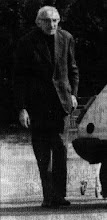
These are some remarks on the poetry of Donald Davie, whose Collected Poems, edited by Neil Powell, were published by Carcanet in 2002.
In an essay of 1959 (reprinted in The Poet in the Imaginary Museum), Donald Davie presented himself, and those contemporaries associated with him in ‘The Movement’, in a light at once harsh and unforgiving. What underpinned his remarkably brutal self-exposure was the question of tone. The thing that stuck in his craw was what he came to see as the peculiarly deprecating and ingratiating mode of voice in which the poetry of the group had presented itself to the educated readers of its time. As Davie icily remarks, what in effect the poets of the Movement had succeeded in doing was to replace a poetry of self-expression (the poetry of Dylan Thomas and Edith Sitwell) with one no less egregious, namely, a poetry of ‘self-adjustment’—a poetry dedicated to getting on the right terms with the reader and to hitting off the right attitude towards him. Davie came to see the poetry he had written during the 1950s as an act of public and private therapy, in its own way another and no less contemptible mode of self-expression. His work, and that of those associated with him, was guilty of what during the 1960s and onwards he was to regard as the cardinal sin: the failure to respond creatively to the world as such. For the English poets of the 1950s, he believed, the world out there, in its quiddity, was accessible, if at all, only by way of an overweening irony, at once self-defensive and self-deprecating, which denied the world its integrity and otherness. Things in themselves were permitted no impact upon the poet unless submitted to categories and attitudes he himself had already imposed upon them. As Davie puts it: ‘This imperiousness towards the non-human goes along with excessive humility towards the human, represented by the reader’. To make the manipulation of ‘tone’ the central preoccupation of poetry was to deny the ontological in the interests of the social. The refusal, characteristic of English poetry from Yeats, Auden and Empson to the Movement, and on to Thom Gunn and others, to accept the reality of ‘alien modes of being’ was taken by Davie to be symptomatic of a deeper malaise: the catastrophic failure to acknowledge the reality of being as such. Awareness of this failure was to remain for Davie throughout his life a touchstone of what he saw as the peculiar deadness lying at the heart of English culture and mentality. Davie noted it especially in the willingness of modern English poets (including Hardy) to sell poetry short and in the diminished expectations and philistinism of the culture as a whole.
What Davie’s Collected Poems reveal is a constant struggle to overcome these failures, as he saw them, within himself.
Worry hedges my days
Like a roil of thick mist at the edge of a covert
Fringing a tufted meadow. In that field
Monuments of art and sanctity
Arise in turn before
The clouded glass of my eye.
Last year two churches of St Francis
Were piled up there, at the lowest verge of Assisi.
This poem, ‘On Not Deserving’, from Poems of 1962-1963, is suggestive in its ambiguities. There is in place a ‘roil’ of thick mist obscuring the edge of a covert which is compared to the ‘worry’ hedging the poet’s days. The first line implies that worry not only limits or sets bounds to the speaker’s days, it also allows him to hedge his bets and to trim, to hold to the middle course and avoid extremes. ‘Roil’, which as a verb means to rile, vex or annoy, or to make water muddy or unclear by stirring, has become a substantive, a displacement of use which effects precisely the blurring of boundaries essential to the poet’s strategy here. Furthermore, the boundary or edge in question is the edge of a covert, itself a hiding-place, a thicket hiding game. The field thus delimited by the poem is of uncertain definition. However, it is here that ‘Monuments of art and sanctity’, invoking the transcendence of Yeats’s ‘Monuments of unageing intellect’ and the humility of St Francis, are said to ‘arise’, and ‘arise in turn’. ‘Turn’ evokes ‘verse’ and ‘before’ points to what comes next, which is, as we pull over the line end: ‘The clouded glass of my eye’. Here, the poem is showing itself for what it is, a ‘turn’—a turn that clarifies what it clarifies with respect to an eye whose glass is ‘clouded’. To clarify is thus an obscuring. The opacity of the situation is marked in the last line by the spatial deictic ‘there’, suspended before the caesura and pointing back to the equally unfocussed temporal marker of the previous line—‘Last year’. Just as the poem seems poised to impose its images on the world, so, in the same gesture, the flat, almost paratactic phrasing seems on the ‘verge’ of withdrawing them, as too overweening an importunity. What is piled up is piled up at ‘the lowest verge of Assisi’, a phrase that fails to point to anything, except perhaps itself, engaged in the act of pointing. The speaker is not ‘deserving’, not worthy—of what, we don’t know—on the evidence of the very act he has just performed. He has accomplished his own failure, and, as it were, by pleading his innocence established his guilt. The poem’s lack is the possibility of its being.
‘The Hill Field’ (Events and Wisdoms (1964)) is a more extended and complex piece in the same vein:
Look here! What a wheaten
Half-loaf, halfway to bread,
A cornfield is, that is eaten
Away, and harvested.
How like a loaf, where the knife
Has cut and come again,
Jagged where the farmer’s wife
Has served the farmer’s men,
That steep field is, where the reaping
Has only just begun
On a wedge-shaped front, and the creeping
Steel edges glint in the sun.
See the cheese-like shape it is taking,
The sliced-off walls of the wheat
And the cheese-mite reapers making
Inroads there, in the heat?
It is Brueghel or Samuel Palmer,
Some painter, coming between
My eye and the truth of a farmer,
So massively sculpts the scene.
The sickles of poets dazzle
These eyes that were filmed from birth;
And the miller comes with an easel
To grind the fruits of earth.
This poem, like the first I quoted, refers to other writing. The reference here is to ‘The Solitary Reaper’. The poem also refers to itself, as the singular act of composition that it is. That is, in referring to itself, it simultaneously refers us to another writing. This is to stress, not intertextual reference in general, but rather the singularity of the act of referral itself. What Davie has here constructed is a poem that is open and closed at once. Because of the uncertainty of context this play of reference creates, an uncertainty concerning who is saying what to whom, the poem’s tone—its explicit ‘address’ to the reader—can no longer be understood as it was by Davie in 1959. That this is so can be seen at the beginning of the opening line. The imperative, ‘Look here’, serves to confirm the identity of this text (or, at any rate, of this phrase) by moving outside or beyond itself, in order to point to itself from the position of an other, the reader who is addressed by words that apparently refer only to the event of the poem itself—the event of the poem’s depicting what is depicted by it. (This ‘event’, it would seem, is the poem’s ‘wisdom’.) The phrase, ‘Look here’, can of course also be read as an expostulation. The status of the poem’s beginning is thus rendered immediately problematic.
This point may be made clearer with respect to the image of the field which is in play here, as in ‘On Not Deserving’, and which fulfils much the same role in this poem as it did in that. The image of the field is what the poem is in the process of constructing, and part of what the image is an image of is the process whereby it is being constructed. In effect, what the poem shows is itself as it emerges from, or is engendered by, the process of being said. As a critic, Davie had elaborated on this kind of symbolist configuration in essays on Eliot, Pound, Mallarmé and Pasternak, some of which were written prior to or during the composition of the poetry of this collection. Thus, in ‘The Hill Field’, as with many other poems he wrote during the same period, one can see the poet developing a complex modernist poetry based on that of the earlier masters, but as it were transposed into what looks like the minor key of a poet who also has his eye on Hardy, a poet who was, according to Davie, unlike Eliot and the other major modernists in that he failed to transform or displace ‘quantifiable reality or the reality of common sense’. In ‘The Hill Field’, symbolist techniques are present, and signalled as such. ‘Wheaten’ is reduced to ‘eaten’ as the ‘half-loaf’ of the field set up by the poem is reduced by the removal, or harvesting, of the letters ‘wh‘. In stanza three, ‘the wedge-shaped front’ is there on the page, shown in the shape constructed by the way the words ‘and creeping’ in line 3 protrude beyond the second and fourth lines. The apostrophe ‘how’, beginning at line 5, is only revealed to be an apostrophe, rather than a question, by the end of line 12. The opening ‘See’ of line 13 looks like another apostrophe, but by the end of line 16 it is seen in retrospect to be a question. The palpability of the words is further emphasised by sound: ‘ee’ provides a kind of basic pattern, through which other vowels intertwine in a series of complex variations.
More generally, the poem doubles back on itself, as though it were referring to itself referring to itself. It separates itself from itself and by so doing opens a gap within its structure across which reference can operate. This is signalled and effected by the temporal displacement at the opening, whereby the cornfield is presented as already the loaf it has not yet become, a loaf baked before the harvest is gathered in. It is in this temporal shifting that we see what gives rise to the various metaphors of violation carried by words like ‘knife’, ‘cut’, ‘cheese-mites’ and the ‘sickles’ (inevitably evoking ‘versicles’) that occur throughout the text. By means of a folding or turning back of time on itself, something that occurs only in the order of writing, the end is enabled to precede the beginning, and the beginning to come after the end. The device results in so profound a rupturing or undoing of intelligible order that, as Davie describes it, in an essay on syntax and music, there remains to the reader only one order of time which he can trust: ‘the one time the tales takes in the telling, the time which the poem takes to be spoken or read’. This foregrounding of the device, or ostranenie, is a procedure central to the poetry of Pasternak, as Davie’s essays and book on him make abundantly clear, and it is central also to his own:
Most poems, or the best,
Describe their own birth, and this
Is what they are – a space
Cleared to walk around in.
('Ars Poetica')
The ramifications of this reach very far. A word that has special privilege in Davie’s earlier poetry is ‘edge’, and there are others related to it, like ‘knife’, cut’, ‘sculpture’, ‘stone’ and words and names associated with art more generally. ‘Edge’ seems to have the same role here as ‘blanc’ in Mallarmé. Like Mallarmé’s writing (or Pasternak’s), Davie’s is a writing of spacing—in the sense that it foregrounds spatio-temporal differing—and words like ‘edge’ or ‘cut’ or their substitutes refer to the very spaces or cuts that make possible the series of which they are themselves members. (One may be inclined to see something paradoxical here, comparable to the problem arising when we consider the set of all sets that are not members of themselves. Is this set a member of itself? If it is then it is not. If it is not then it is.) The edge thus understood is what gives to the poem the conditions both of the possibility of meaning and of its impossibility. Thus, in ‘The Hill Field’, the names of the artists, Brueghel and Samuel Palmer, constitute a movement of undecidability: they mark what makes the poem possible and what stands outside, or transcends, that possibility, inasmuch as they mark what conditions it, ‘coming between/My eye and the truth of a farmer’. The final stanza takes this further: in acknowledging that the poet’s eyes were ‘filmed from birth’, a play is engendered on ‘from’ (inasmuch as ‘from’ may mean both ‘since that time’ and ‘due to’) that is repeated in the double genitive in the last line: ‘fruits of earth’ allows or constitutes a doubling which in turn allows (or calls forth) a play on ‘earth’ itself, a word resonant with implication and connotation. The complex play of meaning and counter-meaning at the end of the poem is thus shown to be an effect internal to the conditions of writing as such. For an instance of a poem that can be said to take this procedure to the limit, see the extraordinary ‘Bolyai, the Geometer’: it is a fully achieved symbolist poem in the mode of Pasternak.
And it is this excess, the excess of syntax over semantics, that Davie’s work continued to explore, throughout Events and Wisdoms and beyond. To align Davie in this way with an advanced modernism, may seem, despite Davie’s own critical clarification of these very modes of writing, perverse, wrong-headed. And yet, in ‘Sonnet’, a poem of the 1980s, Davie writes: ‘the scarp/Of language you would quarry, poet, whirls/Indeterminately shaped in/Helix on nebulous helix, not to be netted’. In ‘Thomas and Emma’, which, according to the editor, Neil Powell, is the last poem Davie wrote, in July 1995, two months before his death, he wrote:
Hyperbole, analogy, allusion
Build up what is no lie, although so wishful:
Conspiratorial, conjugal collusion.
The alliterations hark back to what ‘builds them up’ and suggest that the ‘collusion’, which is no lie, depends upon a poetic understanding of language that is hyperbolic, dependent upon analogy and allusive. I am not offering a modish characterisation or deconstruction of texts against the grain of an author who would have been resistant to readings of this kind. I am attempting rather to point to ways in which Davie came to see how the foundation of meaning in what is itself without meaning was inseparable from the vision his poetry gives us of what poetry, and so life, can or might be. It is here that his earlier self-castigation finds itself assuaged. In the enhanced sense his poetry shows of terms such as ‘between’, ‘before’, ‘after’, and so on, terms which resist being straightforwardly conceptualised or being turned into nouns, as well as in its sensitivity to the syntactic exploitation of the different values of words, a thematic or moral reading of the texts must give way to something else—something more ‘nebulous’, ‘not be netted’:
Moreover, space is encoded
to signify lapses of time.
(One verse-line under another;
this one after that one.)
The nearness of God is known as
an aching absence:
the room the reception-desk
cannot locate nor account for,
in a fictitious or
analogous space that does not
answer to or observe
the parameters of Newton,
any more than a page of verse does.
This, from a late poem, ‘Thou Art Near At Hand, O Lord’, is not an attempt to identify the language of modern poetry, with its predilection for negativity and a dialectic of lack, with that of negative theology. The lines serve only to suggest that the thematic or didactic, often seen as typical features of Davie’s poetry, may not be as easy to identify there as we might like to think. The play of wit and irony, the play, that is, of the sudden idea and its ironic realisation or separation out into paradox, allows Davie a writing at once playful and serious. Davie’s poetry is one of an interminable oscillation between meaning and the loss of it, between rapidity and the discursive. In this, Davie, the exponent of late Augustan order, is also the exponent of the romantic fragment, in which both creation and destruction are sustained. ‘He branches out, but only to collapse,/Imprisoned in his own unhappy knack,/Which, when unfailing, fails him most, perhaps’. Perhaps, for Davie, the truth of literature is captured in that ‘perhaps’.
Showing posts with label Donald Davie. Show all posts
Showing posts with label Donald Davie. Show all posts
Sunday, 26 July 2009


Tuesday, 13 January 2009
THE LETTER OF LORD CHANDOS
In 1901, the Austrian writer Hugo von Hofmannsthal wrote two works of prose, ‘Colours’ and ‘The Letter of Lord Chandos’. In ‘Colours’, Hofmannsthal sets out what he calls ‘the crisis of an inner disposition’, a ‘crisis’ which takes the form of an almost indescribable experience of what he calls ‘Next-to-Nothing’:
But how enumerate these occasional attacks of a Next-to-Nothing? . . . Now and again in the morning it happened, in these German hotel rooms, that the jug and wash-basin—or a corner of the room with the table and the clothes-rack—appeared to me so nonreal, despite their indescribable banality so utterly not real, ghostly as it were, and at the same time ephemeral, waiting, so to speak temporarily, to take the place of the real jug, the real wash-basin filled with water. . . . it was like a momentary floating above the abyss, the eternal void. . . . such an indescribable wafting of the eternal Nothing, the eternal Nowhere, a breath not of death but of Not-Life, indescribable. . . . all in all [things] took on an aspect, a peculiar ambiguous air so filled with inner uncertainty, malicious unreality: so transitory it lay there—with such ghostlike transitoriness. [Selected Prose, (New York: Pantheon, 1952), pp. 142-44.]
While in this state, the narrator enters by chance an art gallery, where he sees some paintings by Van Gogh. As he stares intently at the paintings, his earlier sense of the ghostlike quality of reality seems taken over, as it were, by the paintings themselves, in an oddly displaced experience exposing the narrator to the sheer existence of things, an experience made all the more curious by the fact that the substantial and voluptuous quality—the sensuous presence—of the things depicted seems, in some way, withdrawn from them:
And this innermost life was there, tree and stone and wall and gorge gave of themselves their innermost, almost casting it at me—not, however, the voluptuousness and harmony of their lovely inanimate lives, as sometimes, in days gone by, like a magic atmosphere it had flowed towards me from old paintings: no, only the impact of its existence, the ferocious wonder of its existence surrounded by incredibility, made a dead set at my soul. [Selected Prose, p.147.)
The experience is one of something taking place that is impersonal, neutral: the ‘loveliness’ of the old days gives way to what is quite other, whereby ‘ferocious wonder’ replaces the familiar and magic atmosphere flowing forth from older paintings with ‘an existence surrounded by incredibility’. In the narrator’s experience of the art of Van Gogh, the familiarity of the object disappears under the impact of its existence, and with that disappearance there emerges something that is there but not visible—the presence of an absence, the density of a void.
What Hofmannsthal undergoes in his engagement with Van Gogh’s art, as he describes the matter, is an experience of fascination or captivation. Emmanuel Levinas has contrasted this with ‘being-in-the world’, a life lived with concepts. A concept is the object grasped; the object becomes intelligible by way of the concept. In our actions, in our lives with words, we maintain a living relation with objects; we hold and understand them. However, ‘the most elementary procedure of art consists in substituting for the object its image. Its image, and not its concept’ [Collected Philosophical Papers, trans. Alphonso Lingis (Pittsburgh: Duquesne University Press, 1998), p. 3]. Art implies a blindness to concepts, inasmuch as art does not engender them. The image is not a concept; it takes hold over us, and instead of us grasping it, as with a concept, the image effects a reversal of intention and grasps us, thereby inducing in us a fundamental passivity. For this reason, Levinas regards the image as musical: possessed, ‘inspired’, when we hearken to music, ‘we become’, as T.S. Eliot puts it, ‘the music while the music lasts’. The passivity of our possession is made visible in the very magic, music and song that possess us.
This is the captivation of poetry and music. It is a mode of being to which applies neither the form of consciousness, since the I is there stripped of its prerogative of assumption, of its power, nor the form of the unconscious, since the whole situation and all its articulations are in a dark light, present. [Op. cit., p. 4]
To be confronted by an image, by the ferocious wonder of its existence, is to be no longer a being-in-the-world. It is to exist in a waking dream, in whose light habit, reflex and instinct operate no longer.
In ‘The Letter of Lord Chandos’, Hofmannsthal describes a similar standstill or fascination with respect to language, in which words are immobilised, thought and concept banished. The text purports to be a letter written to Francis Bacon by an Elizabethan nobleman, explaining why the writer has renounced all literary endeavour.
At first I grew by degrees incapable of discussing a loftier or more general subject in terms of which everyone, fluently and without hesitation, is wont to avail himself. I experienced an inexplicable distaste for so much as uttering the words spirit, soul, or body . . . the abstract terms of which the tongue must avail itself as a matter of course in order to voice a judgement—these terms crumbled in my mouth like mouldy fungi. [Selected Prose, pp. 133-34]
The distaste for abstract terms, for concepts, comes to a climax when Chandos, trying to reprove his daughter for lying, finds himself incapable of distinguishing between—or at any rate of communicating the distinction between—truth and falsehood. Gradually, these attacks spread ‘like corroding rust’, until familiar and humdrum conversation seems to him ‘ as indemonstrable, as mendacious and hollow as could be’. He is on longer capable of comprehending things with the simplifying eye of habit:
For me everything disintegrated into parts, those parts again into parts; no longer would anything let itself be encompassed by one idea. Single words floated round me; they congealed into eyes which stared at me and into which I was forced to stare back—whirlpools which gave me vertigo and, reeling incessantly, led into the void. [Ibid]
Chandos comes into contact with a fundamental passivity, wherein language is no longer the expression of a subjectivity, but a reversal of that, whereby he is exposed to language in its exteriority. The words that confront him are no longer words as signs or symbols but words in their existence as words, without meaning, on the hither side of signification. He seeks to rescue himself from his plight by seeking refuge in the Ancients, not in Plato, but in Seneca and Cicero, writers notable for ‘the harmony of their clearly defined and orderly ideas’. But to no avail.
These ideas, I understood them well: I saw their wonderful interplay rise before me like magnificent fountains upon which played golden balls. I could hover around them and watch how they played, one with each other; but they were concerned only with each other, and the most profound, most personal quality of my thinking remained excluded from this magic circle. [Ibid]
A terrible solitude afflicts him, as though he were locked in a garden surrounded by eyeless statues. As Donald Davie has noted, what Chandos goes through is a loss of faith in language as an instrument of articulation, as an instrument able to establish and sustain relationships. In effect, he has lost his faith in syntax: ‘[t]he only language he can trust is a language broken down into units of isolated words, a language which abandons any attempt at articulation, because that articulation seems to take place only inside a closed system—“they were concerned only with each other”’. [Articulate Energy, (London: Routledge & Kegan Paul, 1955), p. 4.]
At the same time, Lord Chandos describes another aspect of this transformation: as words lose their coherence, and objects become useless, he is drawn outside language into a new intimacy with things in themselves, with things in their existence. Maurice Blanchot puts it in the following terms:
a new contact forms with things’ intimacy, a presentiment of unknown relations, of another language, capable of expressing the infinite acceptance which the poet is when he becomes the refusal to choose—capable also of enclosing the silence that lies in the deepest recess of things. [The Space of Literature, trans. Ann Smock (Lincoln and London: University of Nebraska Press, 1989), p. 183]
Hofmannsthal in this way accedes to the demand or exigency of writing itself: it is a demand that ‘assigns to the artist—to the most irresponsible of men—the responsibility for what he cannot accomplish, and makes him guilty for what he cannot say, for what cannot be said’ [ibid]. Hofmannsthal himself writes:
I felt, with a certainty not entirely bereft of sorrow, that neither in the coming year nor in the following nor in all the years of this my life shall I write a book, whether in English or in Latin: and this for an odd and embarrassing reason. . . . [T]he language in which I might be able not only to write but to think is neither Latin nor English, neither Italian nor Spanish, but a language none of whose words is known to me, a language in which inanimate things speak to me and wherein I may one day have to justify myself before an unknown judge. [Selected Prose, pp. 140-1]
It is not surprising that, as Blanchot remarks, Kafka felt ‘The Letter of Lord Chandos’ to be kindred text. Kafka also, when he wrote, ‘felt judged from deep down in his words by that unknown tongue of which he was not the master, but for which he was responsible, and which, with torments and preposterous accusations, removed him more and more from the authority to write . . . and condemned him to a language whose understanding was refused him but whose justification was required of him’ [The Space of Literature, pp. 183-84]. The writer is drawn, by too strong a movement, into a space where truth is lacking, where limits and boundaries have disappeared, and where he is handed over to the immeasurable and the illimitable.
The exigencies to which Hofmannsthal, and Blanchot after him, attend, are complex and difficult to characterise. To make a beginning, I turn to a book by Levinas, Existence and Existents, published in 1947, which exercised a considerable influence over Blanchot in his earlier criticism, and which has features in common with his early novels, such as Thomas the Obscure (1941). Levinas asks us to imagine an event which is, we may believe, unimaginable. Let us imagine, he says, all things, being and persons, reverting to nothingness. There would be an experience, but not the experience of something. It would be an experience of the nothingness that remains, the silence of night and of nothingness, what Levinas calls the experience of the ‘il y a’, the ‘there is’. The ‘there is’ is like the third person pronoun in the impersonal form of the verb—‘it rains’, ‘it is night’—and it designates not the unknown author of an action, but characterises that action itself, which has no author. Levinas speaks of the ‘impersonal, anonymous, yet inextinguishable “consummation” of being, which murmurs in the depths of nothingness itself’ and which ‘we shall designate by the term there is. The there is, inasmuch as it resists a personal form, is “being in general”’ [Existence and Existents, trans. Alphonso Lingis (Pittsburgh: Duquesne University Press), p 52]. The there is derives neither from the exterior nor the inner world, or from any ‘being’ whatsoever. It transcends the inner and the outer, and makes the very distinction impossible. It is here, perhaps, that we may locate Hofmannsthal’s experience of inanimate things, as they speak to him, in an unknown and anonymous ‘language’.
One might be inclined to take the experience of the there is to be an experience of the night, but if it is it is not an experience of night as opposed to day. The night in question is what Blanchot has called ‘the other night’: in their common usage, day and the night that belongs to it are part of the world within which communication, meaning and understanding have their places, whereas the night of which Blanchot speaks, the night of the there is, is what emerges as an elsewhere, as a radical otherness, as a neutrality that is the realm neither of things not of concepts. When the forms of things are dissolved in the other night, the darkness of that night, a darkness which is neither an object nor has the quality of an object, becomes a kind of invading presence. The notion of experience is not, however, applicable in the context of this presence, since, according to Levinas, the darkness of the night excludes all that might present itself to mind or body. It is a darkness beyond or other than anything that might be possible; in the night, we are not confronted by anything that might, or might not, be. The darkness is the darkness of a nothing. And yet it is not a nothing to be identified with an idea of pure or transcendental nothingness. The place of which Levinas speaks is a place where there is no longer ‘this’ or ‘that’—there is no longer ‘something’—but nonetheless the nothing, the darkness, is in its turn a presence, an utterly unavoidable presence. It is not a presence that can take its place in a dialectic relation with absence, nor can it be grasped by thought. It is simply there, beyond mediation, beyond language. ‘Nothing responds to us but this silence; the voice of this silence is understood and frightens like the silence of those infinite spaces Pascal speaks of. There is, in general, without it mattering what there is, without our being able to fix a substantive to this term. There is is an impersonal form, like it rains, or it is warm. Its anonymity is essential’ [op. cit., pp. 52-53]. The well-worn opposition between the inner and the outer, the world of objects and the world of subjectivity, is thereby rendered irrelevant. The mind no longer faces an exterior world, since no such world exists. The self, the I, is submerged by the night, invaded and depersonalised by it. All things disappear and the I with them, leaving behind what cannot disappear, ‘the sheer fact of being in which one participates, whether one wants to or not, without having taken the initiative, anonymously’ [op. cit., p. 53].
The experience is one of horror and menace. Nothing approaches, nothing comes, nothing threatens; and yet this silence, this void empty of sensation, constitutes a mute and absolutely indeterminate menace. As Lord Chandos found, in the deepest recess of things, there is here, in this nowhere, an ambiguity and indeterminateness, where one thing can count as another. As things in their being are delivered over to us, so we are delivered over to things, and are exposed to them. The darkness does not simply change the way things appear to us: it reduces them to undetermined, anonymous being; and it so reduces us. Things strike us ‘as though they no longer composed a world, and were swimming in the chaos of their existence’ [op.cit., p. 54]. Levinas cites as examples the ‘hallucinatory’ poetry of Rimbaud, or the calm and smiling horror of de Maupassant’s tales, in which beings and things collapse into their materiality, whereby a terrifying presence accrues to their density, their weight and shape. For Levinas, it makes things appear to us in a night, ‘like the monotonous presence that bears down on us in insomnia’ [op cit., p. 55]. This is the ‘rustling’ of the il y a, and it is horror. Horror is in no sense an anxiety about death. The subject is stripped of its subjectivity, and in being so stripped loses the power to have a private existence: the self, the I, is depersonalised. Horror is this turning of the subjectivity of the subject, its particularity qua entity, inside out. Levinas describes the process as ‘a participation in the there is, in the there is which returns in the heart of every negation, in the there is that has “no exits.” It is . . . the impossibility of death, the universality of existence even in its annihilation’ [op. cit., p. 56]. The point Levinas is making here is crucial: to kill someone else, or to seek to die oneself, by risking one’s life, or by attempting suicide, is to seek an escape from being, to enter a realm in which negation and freedom can operate. Negation, by denying the world, allows us mastery over it, and hence freedom. As Simon Critcheley has noted, ‘[t]he work of negation, whereby the in-itself becomes transformed into the for-itself and the immediate mediated, is likened by Hegel to death. . . . the Subject produces itself through a relation with death; the life of the Spirit endures death and maintains itself in death’ [Very Little…Almost Nothing (London: Routledge, 1997), p. 53]. For Levinas, then, to experience horror is to experience, at the very heart of the negation that founds and sustains the world, a return of being, an event that makes it seem as though that negation had not taken place. The world—founded on negation—is itself in turn negated. For Levinas, as for Blanchot, the corpse is an especially pertinent icon of what is at stake: the corpse, the very embodiment of death’s negation, already bears within itself its own phantom; it presages its return. ‘The haunting spectre, the phantom, constitutes the very element of horror’ [Existence and Existents, p. 56].
Levinas finds in Shakespeare a potent exemplar of this position. It is the return of presence in negation, the impossibility of evading anonymous and incorruptible existence, that for Levinas constitutes the final depth of the tragedies, in which ‘[t]he fatality of the tragedy of antiquity becomes the fatality of irremissible being’ [op. cit., p. 57]. The spectres, ghosts and witches of the plays are not simply elements deriving from the folklore and shared iconography of the late sixteenth or early seventeenth centuries, or from the original material the dramas are derived from; they are what allow Shakespeare to move towards the limit between being and nothingness, where being insinuates itself even in nothingness. Hamlet recoils before the ‘not to be’, because he has a premonition of the return of being (‘to dye, to sleepe, perchance to Dreame’). Macbeth comes to experience in the apparition of Banquo’s ghost, of ‘its phantom return through the fissures through which one had driven it’ [ibid.], the impossibility of escape from existence. ‘The times have been/That, when the brains were out, the man would die,/And there an end; but now they rise again,/. . . And push us from our stools: this is more strange/Than such a murder is’ (III, iv, 78-83). The horror for Macbeth derives, not from fear, but from the shadow of being, ‘the profile of being [as it] takes form in nothingness’ [ibid]. What emerges from these considerations, Levinas wants to insist, is that the horror of the night, as an experience of the there is, neither reveals, nor derives from, the danger of death or pain. Nor does the pure nothingness revealed by Heidegger’s analyses of anxiety in Being and Time constitute the there is.
There is horror of being and not anxiety over nothingness, fear of being and not fear for being; there is being prey to, delivered over to something that is not a ‘something.’. . . . Horror carries out the condemnation to perpetual reality, to existence with ‘no exits’. [Existence and Existents, pp. 57-58]
Here, Levinas refuses the ontology of Heidegger, and, indeed, epistemology in general. The horror of the night, ‘the silence and horror of the shades’, is simply opposed to Heideggerian anxiety, the fear of being to the fear of nothingness. Anxiety, in Heidegger, is concerned with ‘being towards death’, in which death is somehow grasped and understood, mastered, while, for Levinas, the horror of the night is the horror of the impossibility of dying. There is no exit from the horror of the night, and the unavoidable demands of existence make no answer. Horror is the horror of immortality, the perpetuity of the drama of existence, the necessity of forever taking up its burden.
At this point, Levinas refers, in a footnote, to Blanchot’s novel, Thomas the Obscure, a text which, he insists, captures precisely that ‘presence of absence’, that negativity of ‘the other night’, and the dissolution of the self, the subject, in the night, which constitute the il y a. What is crucial is the sense the novel gives of the horror of being, of what Levinas calls the return of being at the heart of negation, the reality of irreality.
Soon the night seemed gloomier and more terrible to him than any night, as if it had in fact issued from a wound of thought which had ceased to think, of thought taken ironically as object by something other than thought. It was night itself. Images which constituted its darkness inundated him. He saw nothing, and, far from being distressed, he made this absence of vision the culmination of his sight. [Thomas the Obscure, trans. Robert Lamberton (New York: David Lewis, 1973), pp. 14-15]
This is fascination, or ecstasy, in the sense that the subject is evacuated, standing out beyond itself. And across the void thus opening up, sight and the object of sight mingle themselves together. What is seen imposes itself upon the gaze, and the eye’s own glance enters it as an image, as though the gaze were its own object. In this torsion of the subject, a torsion which is fascination, everything is withdrawn from the world, including the powers of language. ‘What fascinates us robs us of our power to give sense. It abandons its “sensory” nature, abandons the world, draws back from the world, and draws us along. It no longer reveals itself to us, yet it affirms itself in a presence foreign to the temporal present and to presence in space’ [The Space of Literature, p. 32]. Fascination is not a cognitive relation. As Gerald Bruns points out, ‘it deprives us of our concepts and leaves us powerless to grasp what we see. It is our seeing which is grasped and held: neutralized’. [See: Maurice Blanchot: The Refusal of Philosophy (Baltimore and London: Johns Hopkins, 1997), p. 60]. It is ‘solitude’s gaze’ and to enter into this gaze is to enter the impersonal and neutral space of the il y a. Writing is a movement into this space, since to write is to allow fascination to rule language, and the space of writing is that of the impossibility of dying. Thomas the Obscure is a shade, doomed not to rest but to wander through the pages of the text in a caricature of immortality. He cannot die. Thomas digs his own grave and hangs a stone about his neck as if to obliterate himself in the earth, and to become his own corpse, yet he continues to ‘exist’, to stand outside himself until the end. The condition is like that of a man who is hanging himself: after kicking away the stool on which he stood, he feels, instead of the leap into the void, only the rope which holds him around his neck, so that he is bound more than ever, bound as he had never been before, to the existence he had sought to leave. So Thomas ‘felt himself, at the moment he knew himself to be dead, absent, completely absent from his death’ [Thomas the Obscure, p. 36]. He was indeed dead, and yet rejected from the reality of death, and as he leaned over the void, he saw his image in the total absence of images. He saw the fascination of the il y a, and like a man waking up alive in his coffin (a theme familiar from Poe) he saw the impalpable air where he floated transformed into an air without air, ‘filled with smells of the earth, of rotten wood, of damp cloth’ [op. cit., p. 37]. Like Lazarus, he comes forth from the tomb, not resurrected, not risen, but dead, taken at once from life and from death. He walks, a painted mummy, in whom death itself has been resurrected.
This condition Levinas sees as characteristic of modern art, as is clear from his account of cubist painting:
The breakup of continuity even on the surface of things, the preference for broken lines, the scorning of perspective and of the “real” proportions between things, indicate a revolt against the continuity of curves. From a space without horizons, things break away and are cast towards us like chunks that have weight in themselves, blocks, cubes, planes, triangles, without transitions between them. They are naked elements, simple and absolute, swellings or abcesses of being. In this falling of things down on us, objects attest their power as material objects, even reach a paroxysm of materiality. Despite the rationality and luminosity of these forms when taken in themselves, a painting makes them exist in themselves, brings about an absolute existence in the very fact there is something which is not in its turn an object or a name, which is unnameable and can only appear in poetry. [Existence and Existents, p. 51]
The materiality in question here is not that of classical materialism, or of scientific determinism. What Levinas is pointing to is matter in its coarsenss, thickness, massiveness, wretchedness. He is concerned with the brute and implacable presence of things, with what is humble, bare and ugly. Matter in this sense is the very fact of the il y a. Hence, as Bruns notes, it is important not to miss the import of Levinas’s remark: ‘there is something which is not . . . an object or a name, which is unnameable and can only appear in poetry’. This ‘something’ is what lies at the heart of Blanchot’s concerns also. ‘Blanchot’s question is what sort of thing poetry would have to be in order to be that (and only that) in which this materiality of being, this anonymous, oppressive, invasive power of existence, this implacable density of the il y a, can appear’ [Maurice Blanchot: The Refusal of Philosophy, p. 61]. In The Space of Literature, Blanchot says that the writer ‘belongs to a language no one speaks, which is addressed to no one, which has no center, and which reveals nothing’ [The Space of Literature, p. 26]. But the question then arises as to what is it to belong to such a language, a language that is no longer a language, no longer used for expression or to make statements, no longer the language of negation or assertion. As Bruns remarks, this is ‘[a] language not for use: a language that can only be described by a kind of topology, not by grammar and rules’ [Maurice Blanchot: The Refusal of Philosophy, p. 62]. Though poetry may be made out of words, it is not a use of them. To belong to language understood in this way means to lose one’s subjectivity. To belong is not to belong, to belong nowhere, and to lose what we understand by position, and so to be deprived of perspective or standpoint. One is not free of the world, but deprived of it.
Kafka’s novels, and in particular The Castle, exemplify for Blanchot the exigency or demand of writing, thus conceived. A similar exigency or demand is manifest also in The Waste Land. Eliot places at the beginning of the poem an epigraph, from the Satyricon, that is very pertinent to the issues at stake here. Trimalchio claims to have seen the Sibyl hanging up in a bottle at Cumae (in a condition similar to the protagonist’s, in Beckett’s The Unnamable). Apollo had granted her request to live for as many years as there were grains of dust in her hand (‘I will show you fear in a handful of dust’), but she forgot to ask the god for eternal youth. Her one wish now is to die, and yet this is impossible. Trimalchio reports her state thus: ‘For I with these my own eyes have seen the Cumean Sibyl hanging in a jar; and when the boys said, ‘What do you want, Sibyl?’, she answered, ‘I want to die’. Hugh Kenner has noted that the passage from the Satyricon is given in ‘macaronic Latin, posterior to the best age, pungently sauced with Greek’ (the boys’ questions and the Sybil’s answer are in Greek [The Invisible Poet: T.S. Eliot (London: Methuen, 1965), p. 136]. He has also suggested that she is a figure of shifting identity, who functions much as the consciousness of the writer, and is to be associated with the fragmentary, the sibylline leaves. The Waste Land is, one might say, prefaced by a figure embodying the aesthetic of the poem to come, and it is an aesthetic of horror. The impossibility of dying is an extreme limit, as it were between life and death, an experience of the interminability of existence: here I lose the ability to die and the dead rise up from their graves. This condition is, for Blanchot, the condition of writing, and one may perceive a most powerful instance of it in The Waste Land. The experience is related, as we have seen, to the experience of the il y a, in which one experiences the horror of the absence of the world, of an absence of meaning in which I can no longer act or say, and where I myself disappear in the passivity of dying. Heidegger’s conception of the authentic death, as the origin of my knowledge, is changed into something quite other, into the experience of the impossibility of dying, an experience inseparable from the experience of the loss of subjectivity and so of the impossibility turning the world into a place of meaning. This is the space of non-origin, where I have lost the right to my own death, ‘that unique event which answers Rilke’s prayer: “O Lord, grant to each his own death”.’ [Quoted in The Space of Literature, p. 241.] What I find is that death exposes me to an anonymity in which it is not ‘I’ but ‘they’ who die. Men die always as other than themselves, at the level of the neutrality and impersonality of the They.
They die: he who dies is anonymous, and anonymity is the guise in which the ungraspable, the unlimited, the unsituated is most dangerously affirmed amongst us. Whoever experiences this suffers an anonymous, impersonal force, the force of an event which, being the dissolution of every event, is starting over not only now, but was in its very beginning a beginning again. And in its domain everything that happens happens over. From the instant “they die,” the instant is revoked. When someone dies, “when” designates not a particular date but no matter what date. Likewise there is a level of this experience at which death reveals its nature by appearing no longer as the demise of a particular person, or as death in general, but in this neutral form: someone or other’s death. Death is always nondescript. [Ibid]
‘I’ may hope that my death will prove the moment of my greatest authenticity, the moment towards which ‘I’ propel myself as towards the possibility that is my own-most, as to what is most proper to me, and which will secure me in the solitude of what I am, of the pure ‘I’. But the anonymity of death refuses this accomplishment: dying is intransitive and interminable, where what is intelligible is translated into something unspeakable and alien, and where the law has become absence or impossibility as such. Levinas writes: ‘The time of dying itself cannot give itself the other shore. In dying, the horizon of the future is given, but the future as the promise of a new present is refused: one is in the interval, forever an interval’ [Collected Philosophical Papers, p. 11]. It is as though death were never dead enough, as though it were prolonged in the horror of the interval, as in the horror of being buried alive. This is the experience of certain of Poe’s characters, and it is that of the Sybil.
It is the Sybil’s experience, the horror of her being unable to die, which informs the poem throughout its movement. We remember that Eliot had proposed initially to begin his text with a citation from Heart of Darkness, concerning the death of Kurtz, which makes explicit the connection between the poem’s writing and the sense of horror: ‘Did he live his life again in every detail of desire, temptation, and surrender during that supreme moment of complete knowledge? He cried in a whisper at some image, at some vision,—he cried out twice, a cry that was no more than a breath—“The horror! The horror!”.’ Like the Sybil, Kurtz experiences that interval, in which knowledge, the ‘supreme moment of complete knowledge’, is transformed by a slippage of language into ‘some image’, the very image of fascination itself, which works on him its effect of horror. By placing these two citations together, we may perhaps glimpse something of the strategy of the poem—to explore the dread of being held to existence without an exit. True horror arises from an ineluctable awareness of the irremissibility of existence, of immortality within life, from the dread of existence itself. The Sybil is the locus of that mode of consciousness which is appropriate to this space or region of language, where subjectivity is lost.
The Sybil is a prophet, as is Kurtz, in his own way, and Tiresias, that figure inseparable from the poem of whom Eliot writes in a note: ‘Tiresias, although a mere spectator and not indeed a ‘character’, is yet the most important personage in the poem, uniting all the rest. Just as the one-eyed merchant, seller of currants, melts into the Phoenician Sailor, and the latter is not wholly distinct from Ferdinand prince of Naples, so all the women are one woman, and the two sexes meet in Tiresias. What Tiresias sees, in fact, is the substance of the poem’ [The Waste Land: a facsimile and transcript, ed. Valerie Eliot (London: Faber and Faber, 1998), p. 148, n. 218]. In Eliot’s poem, the cognitive or expressive subject is dispersed in a fission of its inwardness, as though it were possessed, speaking, in the manner of a prophet, under inspiration, its breath taken from it. This is the condition of the ‘I’ of writing in The Waste Land, where what Tiresias sees is the condition of the poem’s existence, and, as it were, of his own existence in it. The consciousness constituted within and without Eliot’s text is the consciousness of an elsewhere, where that elsewhere is not a private, interior, subjective space; nor is it an imaginary space, the space of aesthetic differentiation. It is the space opened up by writing. One may set against the background of these claims Eliot’s citation in the Notes of Bradley’s remark, from Appearance and Reality, to the effect that ‘regarded as an existence which appears in a soul, the whole world for each is peculiar and private to that soul’ [op. cit., p. 149, n. 411]. The interior, private space of Bradley’s self is turned inside out, through the effect of iteration, in the very note that cites it. For the whole world to be peculiar and private to each soul that apprehends it would require that language similarly be private. For Bradley to say what he wants to say is therefore impossible, since the notion of a private language is unintelligible, as the fact of iteration, here instantiated, makes evident. We are, so to speak, required to understand what is not intelligible and to see sense in nonsense and vice versa. The inner world and the outer are thereby troubled in their relations, each undecidably moving through and beyond the other, in a play of uncertainty that affects in like fashion the relations between the Notes to the poem and the poem itself. Does The Waste Land comprise the ‘poetry’ and the Notes, added at publication to make up the book’s length, or not? The Notes are both internal to the poem (they are inside the book’s covers), and external to it, inasmuch as they stand apart from it and comment explicitly on it, from a point beyond it, while at the same time they also contain poetry, as does the ‘poem’ itself. The world of The Waste Land is the world of the non-identical: suspended between what is and what is not, it is linked to what is outside the world, to the ‘Unreal’ city and to that place where ‘We who were living are now dying/With a little patience’. The poem expresses ‘the profundity of this outside bereft of intimacy and repose—this outside that appears when even with ourselves, even with our death, we no longer have relations of possibility’. The Waste Land, with its multiple voices and persons, sets out the situation of one who has lost himself, ‘who can no longer say “me,” who in the same movement has lost the world, the truth of the world, and belongs to exile, to the time of distress when, as Hölderlin says, the gods are no longer and are not yet. This does not mean that art affirms another world, at least not if it is true that art has its origin, not in another world, but in the other of all worlds’ [The Space of Literature, p. 75]. It is rather that The Waste Land brings about a confrontation with the process from which all poems derive, with what Blanchot calls ‘the original point at which the work is inevitably lost, that always destroys the work, recreates endless idleness in the work, but with which too, if anything is to come of it, an ever more primal relationship has to be established’ [The Gaze of Orpheus, trans. Lydia David (New York: Station Hill, 19810, p. 195).
The ‘time of distress’ is precisely what Eliot invokes at the end of the poem, by way of juxtaposed fragments of literature and the Upanishads. The last words of the poem are ‘Shantih shantih shantih’ (a formal ending to an Upanishad, according to Eliot's note) and, as the text shifts from ‘Shantih shantih shantih’ to the gloss offered there (‘“The Peace which passeth understanding” is a feeble translation of this word [shantih]’), we can hardly fail to hear at the same time the word ‘shanty'—or rather, two words, one originating in nineteenth century French (chantez,) the other in nineteenth century North American (perhaps also in the Irish sean tig (toig) ‘old house’)—in which song and shack are combined. The text, like an old house, haunted and uncanny, opens a space of echo and redoubling, where it is not someone, some one person, but rather the unknown space itself which speaks, that speaks without speaking. It is as though the voice itself spoke, in the manner Conrad ascribes to the voice of Kurtz: ‘A voice! A voice! It was grave, profound, vibrating, while the man did not seem capable of a whisper’. ‘Shantih’ contrasts with the ‘feeble translation’, as the voice contrasts with the feeble whispers of the dying man. In this way, the text seems to turn back on itself, even as it withdraws from itself, inscribing itself as an interminable torsion, without beginning or end, or rather, as a torsion like that of the Moebius strip, whose end precedes its beginning and whose beginning comes after its end. This self-surpassing operation can be found throughout the poem, as its principle of movement, a principle that the last forty lines or so bring to the fore. Of these lines, beginning after ‘Then a damp gust/Bringing rain’, Kenner has remarked, in The Invsible Poet, that they recapitulate the poem in terms of the most ancient wisdom accessible to the West.
Then spoke the thunder
DA
Datta: what have we given?
My friend, blood shaking my heart
The awful daring of a moment’s surrender
Which an age of prudence can never retract
By this, and this only, we have existed
An ancient wisdom is evident and at the same time troubled somewhat here: the lines give not only a reminder of sexual surrender, or of the greater spiritual surrender attendant upon ascesis and self-abandonment, they give the very movement by which they are the lines, the writing, they are. Surrender and retraction open up the space in which to inscribe the limits of the human, a limit we can respond to only by forsaking the selves in terms of which response is possible. The existence of which the poem speaks is thus an existence exiled from itself: we are not there, we are elsewhere, and we never cease to be there. The present does not flee into the past, but remains open, an unfinished present, as if not part of a sequence.
By this, and this only, we have existed
Which is not to be found in our obituaries
Or in memories draped by the beneficent spider
Or under seals broken by the lean solicitor
In our empty rooms
Eliot evokes here an entrance into the passivity of time, outside the possibility of narrative, ‘disappearing through the lack of mediation between past and future when time is prolonged, incomplete and unceasing’ [Maurice Blanchot: The Refusal of Philosophy, p. 68]. Eliot’s invocation of the founding language of Europe, given as ‘DA’, the word prior to all words, and spoken by the thunder, bringing rain, is no less and no more than the other words and languages of the poem, the language of exile. As Blanchot says of Saint-John Perse (a translation of whose Anabasis Eliot first published in 1931), ‘[w]hen Saint-John Perse named one of his poems Exile, he named the poetic condition as well. The poet is in exile; …. The poem is exile, and the poet who belongs to it belongs to the dissatisfaction of exile. He is lost always to himself, outside, far from home; he belongs to the foreign, to the outside which knows no intimacy or limit’ [The Space of Literature, p. 237]. Exile thus characterised is inseparable from what Blanchot calls the experience of the passivity of dying, an experience ascribed in the poem to the Sybil, as well as to Tiresias, the experience of an afterlife lived in time. This between-time is the time of a neutrality, which Tiresias, ‘throbbing between two lives/Old man with wrinkled female breasts’, is the embodiment of: it is the time which the prophet, though blind, can see, the time of the ‘violet hour, the evening hour that strives/Homeward and brings the sailor home from sea’, lines that enact a syntactic displacement in which and by means of which the ‘hour’ comes to be, a time in and of language. It is this order of time that emerges at the moment when Orpheus turns to look at Eurydice, a moment alluded to in the line Eliot cites from de Nerval: ‘Le Prince d’Aquitaine à la tour abolie’. The speaker of El Desdichado assumes multiple personae, in the manner of the speaker of The Waste Land, and as Orpheus enters the shades to call back his love. The task of Orpheus here, as in the myth, is to bring Eurydice into the light, and his work is the production of beauty. As Simon Critchley puts it: ‘Orpheus must submit to the law of the underworld in order to produce the artwork. Thus, the presentation or unconcealment of the beautiful form in the daylight—what one can call, with Heidegger, ‘world’—can only be achieved by submitting to the prohibition against looking Eurydice in the face, by recognising that she can only be approached by turning away’ [Very Little….Almost Nothing, p. 42]. But in Blanchot’s reading of the myth, what is crucial is Orpheus’ gaze, the moment of his turning back to see Eurydice in the night, the transgression of that prohibition. Orpheus desires to see Eurydice in her concealment, as the darkness, as the essence of the night, the other night. As Critchley describes Blanchot’s account, Orpheus does not desire to make the invisible visible; he desires the impossible, ‘to see the invisible as invisible’ [op. cit., p. 43]. And it is this desire, which destroys his art, losing him Eurydice, that is also the source of his art. This act, the act of inspiration, is at once the ruination of the work and its impossible origin. Blanchot writes:
Does this mean that inspiration changes the beauty of the night into the unreality of the void, makes Eurydice into a shade and Orpheus into someone infinitely dead? Does it mean that inspiration is therefore that problematic moment when the essence of the night becomes something inessential and the welcoming intimacy of the first night becomes the deceptive trap of the other night? That is exactly the way it is. [The Gaze of Orpheus, p. 102]
Inspiration leads to the other night, in which one can neither sleep nor die: this night is the night of The Waste Land.
The issues at stake in this kind of writing may be illuminated by consideration of the poem’s temporality. It is when the events a poem narrates are the events that constitute its own unfolding that we are cast into what Blanchot calls a time before the world, before the beginning. A later poem, East Coker, opens with the words `In my beginning is my end', and it concludes: ‘In my end is my beginning’. Here, the work says what it says in the very gesture of saying what there is for it to say. The only happening in the poem is the happening of the poem itself: a world is described, and, in that same act of description or definition, created. Here, the act of creation turns back upon itself, becoming other than, and exterior to, itself. Hence it is possible neither to begin nor to end, since the words of the poem are already beyond themselves, elsewhere. As Eliot has it, in Burnt Norton: ‘the end precedes the beginning,/And the end and the beginning were always there/Before the beginning and after the end./And all is always now’. We cannot begin, since the beginning is always already begun, and we cannot come to an end, since the end is always already completed, in a time before the beginning. If, with Blanchot, we think of names on the Hegelian model, as effecting the murder or annihilation of the things they name, then the negation, by which the poem sustains itself and which in turn it sustains, must enter paradoxically into the poem, effecting its failure, and (in Blanchot's idiom) betraying the work of the poem to worklessness (désœuvrement). By this he means that the poem is split from itself, in a movement of double negation that turns it towards the outside, the exterior, beyond language and concept, where, as he puts it, there is no intimacy, no place to rest. `The work says the word beginning from a starting point - art - which is complicit with the futility of starting over', and so, like a tautology, the work says the nothing that is the condition of its simultaneous possibility and impossibility:
What are the roots that clutch, what branches grow
Out of this stony rubbish? Son of man,
You cannot say, or guess, for you know only
A heap of broken images . . .
The Waste Land, exemplary in this regard, is nothing other than what it constitutes itself as, namely `this stony rubbish', and the reader, caught within the language of the poem, unable to move beyond it, is, at the same time, exterior to it as it narrates the passage of its own negation:
A heap of broken images, where the sun beats,
And the dead tree gives no shelter, the cricket no relief,
And the dry stone no sound of water.
Blanchot's prose, which often reads like a rhapsodic commentary on The Waste Land, says of this mode of writing: ‘The work declares being - and says choice, mastery, form - by announcing art which says the fatality of being, says passivity, and formless prolixity’ [The Space of Literature, p. 244].
. . . I will show you something different from either
Your shadow at morning striding to meet you
Or your shadow at evening rising to meet you;
I will show you fear in a handful of dust.
The poem comes, not to an end, but upon a series of fragments: `These fragments I have shored against my ruins'. These ruins are the ruins of the kingdom, the wreck of its earlier kings, on whose fortunes I have pondered, `Musing upon the king my brother's wreck/And on the king my father's wreck before him'. The fragments I have shored against my ruins are in effect those very ruins themselves. They are the ruins of a realm in which, except for ruin, there is nothing sure. As Blanchot has appositely put it, ‘By turning itself into an inability to reveal anything, literature is attempting to become the revelation of what revelation destroys’ [The Gaze of Orpheus, p. 47].
In The Waste Land, conditions of possibility and impossibility are registered in successive reversals of syntax, which occur as the poem unfolds in the time of reading:
Under the firelight, under the brush, her hair
Spread out in fiery points
Glowed into words, then would be savagely still.
As we first approach them, coming around the end of the preceding line, the words ‘Spread out’ have the force of a verb, a past indicative; but, after we have reached ‘Glowed’ in the next line, they retroactively become a past participle, governed by ‘hair’. However, there is no question of deciding which reading is correct: the phrase has to be taken as both things at once--verb as we approach it, participle as we look back to it--in what is a sustained and ambiguous suspension that leaves us interminably divided between the two. Again, in the last line, ‘would’ hovers ambiguously between being a transitive verb, expressing the desire or wish that the hair be `savagely still', and an auxiliary, expressing a conditional statement, saying how the hair would be if such and such were the case. What this condition is or might have been or might yet be is not specified. What we can say is, with its language organised in this manner, the poem will never have completed its passage into the future; impotent to situate itself securely in time, it will exist in a quasi-eternal moment, unable to go beyond itself, unable to pass on. The opening section of Burnt Norton exemplifies this exactly, as it narrates the passage from past to future, and so back into the past, of the words that occur in it. This is to sustain a present in which the future is imminent, but never realised, a present stripped of what makes it the present, its passing. The linguistic events of the poem are the only happenings there are.
Footfalls echo in the memory
Down the passage which we did not take
Towards the door we never opened
Into the rose-garden. My words echo
Thus, in your mind.
Something has disappeared, as the writing, seeking to register what comes before, makes of it what comes after, undermining our usual understanding of temporal succession, and dispossessing words of the power to name, or state. Nonetheless, words may take from this dispossession a power of their own, an obscure power almost that of incantation, so that things become really other than they are. Words become ‘one moment in the universal anonymity, a bald statement, the stupor of a confrontation in the depths of obscurity’, and through the action of language itself, it becomes possible to achieve a passage beyond language and to enter upon the presence of things before the world exists, in what Blanchot calls ‘the lucidity of the depths of torpor’ [The Gaze of Orpheus, p. 47].
If we are to accord this way of thinking its due weight and seriousness, then we must recognize that Blanchot and Levinas have come upon states of mind and modes of experience that are accessible only by virtue of a specific employment of language, that typified by what is, in effect, post-symbolist poetry. And what this kind of experience gives onto, for Levinas, is the true horror, the horror of the uncanny and the fantastic. It is the return of being in negation, the impossibility of death, the universality of existence even in its annihilation. It appears to us in the obsessions and insomnias of the night, and it is fear of being, not fear for being, fear of death. In Levinas's words, ‘it is a density of the void, like a murmur of silence’, and it is beyond contradiction [Existence and Existents, pp. 63-64]. It is the condition described by Eliot in ‘The Hollow Men’: ‘Shape without form, shade without colour,/Paralysed force, gesture without motion’. And we find it also explored in Lucio Fulci's horror film, The Beyond.
Released by Fulvia Film (Rome) in 1981, the film takes up the motif of the gateway to hell from The Sentinel (Michael Winner, 1976) and living dead imagery based on Romero's first two zombie films. The story opens in Louisiana, 1927. A posse, bearing torches, rifles and chains, is rowing across a lake towards an isolated hotel. Inside the hotel, Schweik, an artist, is completing an indistinct landscape, littered with grey shapes, perhaps corpses. The men burst into the hotel and seize him, the leader of the group accusing him of being a warlock, or satanist, and beating him mercilessly across the face with a heavy chain. Ignoring his warnings, the men carry him to the hotel's cellar, crucify him, and throw acid over his head, watching him as he dissolves in agony. As this is happening, a young woman, Emily, is elsewhere in the hotel, reading from the book of Eibon, which contains ancient prophecies concerning the seven sacred gateways into hell. Schweik is then walled up. In 1981, Liza Merril arrives from New York to claim the hotel which she has inherited. Assisted by Martin Avery, she decides on its renovation. On a long causeway, resembling that between the Florida Keys, Liza meets Emily, who now is blind. Emily takes Liza to the house where she lives, and warns her to leave immediately. At the same time, Martha, the hotel's Mrs Danvers-like housekeeper, guides Joe, a local plumber, towards the far end of the hotel's cellar, which is flooding, to find out where the water is coming from. He knocks down the wall entombing Schweik's body, and is killed by a hand that reaches out and seizes him. Subsequently, two corpses are discovered. Mary Ann, Joe's wife, goes to the hospital mortuary to prepare her husband for his funeral, when she too is killed. She falls, and lies unconscious at the foot of a cupboard, on which stands a large bottle of acid. The bottle falls forward, spilling its contents over her head, which dissolves into a sea of bloody foam. Her daughter watches in fascinated horror, as the foam creeps towards her. Martin Avery dies in the town library. When he comes upon the original plans for the hotel, he falls from a high ladder, and is bitten to death by giant spiders. During his death agonies, the plans, of a vast and elaborate building, dissolve into the whiteness of the page. John McCabe, a doctor, who has become friendly with Liza, is increasingly puzzled by what is happening, and is especially perturbed by the fact that he has never heard of Emily, despite living many years in the town. He goes to her house, only to find it abandoned and in ruins. Here he discovers the book of Eibon and reads in it that the hotel stands on one of the seven gates to hell. In the hotel, Martha is cleaning the bathroom of room 39, Schweik's former room. She puts her hand into a bath of foul black water, and frees the plughole. As the water drains away, Joe arises from the water, rather as Schweik had done earlier in the cellar, after Joe's death. He drives Martha before him, until the back of her head is impaled on a large nail sticking out of the wall, a nail similar to those used in Schweik's crucifixion. She will join the undead. Schweik appears before Emily, summoning her back with him, presumably to hell, a summons she passionately refuses to obey. Her guide dog turns on her, and tears out her throat. Liza is set on by the dead in her hotel, and is rescued by McCabe. Together, they flee to the hospital, which they find strangely empty and unreal. They are pursued by `living' corpses from the morgue. They escape down to the basement, only to find that they are back in the cellar of the hotel. They pass through the holes in the walls, into a landscape that seems everywhere the same. It is the landscape of the painting Schweik completed at the time of his destruction, and it is the site of hell. Liza and McCabe appear to merge into the landscape, and the painting comes to dominate the screen.
As this summary should indicate, the plot is anything but concisely organised. Elements are pulled in from many sources, and strung together in a series of set-pieces, involving various degrees of violence and bodily mutilation. Of these, the opening sequences are the most striking, as Schweik is crucified by the posse and dissolved in acid. The score, by Fabio Frizzi, dominates the sound track, carrying over to the reading by Emily from the book of Eibon. The same musical motif recurs throughout, especially at moments of violent death, such as Mary Ann's and Martha's. The music, rather than the narrative, is the cohesive force in the film, through its repetitious insistence drawing the disparate narrative events together, and emphasising pace and rhythm at the expense of motivation or psychological insight. The effect is of visuals and music seeming to cohere in a unified sound-image. This is brought home at the end of the film, when Schweik's painting has come to fill the screen, accompanied by the throbbing musical score. It is precisely at this point that Liza and McCabe are recognised as having become part of Schweik's landscape, which he completed as the film began, a painting which does not simply depict hell, but is it. The film's end is established at a point prior to its beginning, and the organisation of its temporal development identified with that of a painting internal to it. The role of music and rhythm in achieving this effect of reversal, whereby the end becomes the beginning, and the exterior the interior, is similar to the role of rhythm in The Waste Land, where, as we have seen, words impose themselves on us, disengaging themselves from reality, and (we may want to say) making us part of them. For Levinas, rhythm understood in these terms is what constitutes the duration of the interval. Words in poetry impose themselves on us without us assuming them:
Or rather, our consenting to them is inverted into a participation. Their entry into us is one with our entry into them. Rhythm represents a unique situation where we cannot speak of consent, assumption, initiative or freedom, because the subject is caught up and carried away by it. [The Levinas Reader, p 132]
Levinas is speaking here as we saw Blanchot do earlier. He believes that in poetry the subject enters into its own representation, so that the self exists no longer, having become an anonymous or impersonal shadow of what it formerly was. What this means becomes clear if we think of the way the reader is captured by the incantatory movement of Eliot's writing: ‘. . .you are the music/While the music lasts’. Our consenting to the music, or the poetry, is inverted into a participation, in which initiative and freedom are lost. The condition is that of a waking dream. As Blanchot insists, this is a mode of being which is neither that of consciousness, since the self is stripped of the ability to assume its powers, nor that of unconsciousness, since the whole situation is there, in what Levinas calls a dark light, present. Blanchot identifies this condition with that of hell, though not the hell of traditional Christian torment. He makes this clear by citing a passage from Gershom Scholem's Major Trends in Jewish Mysticism on Kabbalistic speculation. Scholem argues that, after the Expulsion from Spain, religious thought attempted to overcome exile by pushing it to its limit, ‘enhancing its torments’ and ‘savoring its bitterness to the utmost’:
The horrors of Exile were mirrored in the Kabbalistic doctrine of metempsychosis, which now won immense popularity by stressing the various stages of the soul's exile. The most fearful fate the could befall any soul--far more ghastly than the torments of hell--was to be “outcast” or “naked”, a state precluding either rebirth or even admission to hell. . . . Absolute homelessness was the sinister symbol of absolute Godlessness, of utter moral and spiritual deprivation. [Cited in The Space of Literature, p. 70, from G.G. Scholem, The Major Trends of Jewish Mysticism (New York: Schocken Books, 1978), p.250]
Such absolute homelessness was, for the Kabbalists, the worst nightmare of the soul. Liza and McCabe are submitted to this fate, not in punishment of their sins, but by virtue of their being what they are, creations of the film. Fulci's hell is a revelation of the fact that art ‘describes the situation of one who has lost himself, who can no longer say “me”, who in the same movement has lost the world, the truth of the world, and belongs to exile’ [The Space of Literature, p. 75].
The disruption of tenses in a symbolist poem disrupts and discredits retrospectively the whole tense sequence of the poem, so that the reader has nothing to fall back on except the duration the poem takes in the reading. The symbolist poem is `a falling movement on the hither side of time, into fate' [Existence and Existents, p. 139]. A disruption of comparable order takes place in The Beyond, but it does so at the level of the image, not the word, when image and what is imaged become one, as the film concentrates at the end on Schweik's painting. This echoes a point basic to Levinas' conception of art. For him, the most elementary procedure of art is to substitute an image for an object. And an image is not a concept. `A concept is the object grasped, the intelligible object. Already by action we maintain a living relationship with a real object; we grasp it, we conceive it. The image neutralizes this real relationship' [The Levinas Reader, p. 132]. Like the Hegelian name, the image neutralises, annihilates, the object. The effect of Schweik's painting is to incorporate into the film the symbolist logic of the word, discrediting the narrative, and revealing its bondage to the inexorable duration of the interval. Seen in retrospect, the elaboration and spectacle of the film's many deaths reveal the film's fixity and subordination to a time impotent to go anywhere except interminably back to its beginning. A corpse rises from the foul water of the bath, in an obvious reminiscence of Clouzot's Les Diaboliques, and Martha steps back before a horror she is unable to escape. She is held by the fact of its presence, by the fact that it is dead and yet before her: confronting it `alive', she confronts a death that is not dead enough. For the viewer, this effect is reinforced by the Clouzot reference, inasmuch as the corpse seems summoned forth, not so much by the powers of hell or Schweik, as by the cinema itself. Death has become a sound-image, composed of elements we have seen or heard before, including the nails, the corpse rising from the black water, the music, the violation of the head, the moaning, as well as elements deriving from other films. These are the plastic elements which fix and immobilise the characters in time. The death we see is a death effected, not by motive or significant action, but by the image understood as Levinas and Blanchot understand it, as the site of a repetition, which the characters in the film and we, the viewers of the film, are equally impotent to resist. The housekeeper takes her place among the undead. Emily refuses the summons of her fate, and her death, her throat torn open by her guide dog, is the repetition of a similar episode in Suspiria.
Films of this type disengage us from the world, not in order to go beyond it, since this requires meaning, and the complexities of human action, but so that we may enter an interruption of time, similar to that effected in Eliot's poetry, where a quasi-eternal instant is created, aside from time, offering the horizon of a future which will never come. `Words, after speech, reach/Into the silence.' In this realm, the priority of the concept is displaced, and we find ourselves submitted to fate. This is not the fate of rational law or universal necessity, but of a present, where `all is always now', constituted by the eternally suspended future of poetic rhythm and the image. Fate has no place in life. The fate of art is that of the statue, suspended in an immobile instant, where, according to Levinas, `the power of freedom congeals into impotence. And here too we should compare art with dreams: the instant of the statue is a nightmare' [The Levinas Reader, p. 139]. The fate of art is also that of the narrative. The being of a character is immobilised in it, committing characters in novels and films alike to the infinite repetition of the same acts and experiences. Nothing in the narrative initiates life, and in The Beyond Fulci acknowledges the fact, immobilising death and forming it into a series. Death subordinate to repetition is impossible, and just as Liza and McCabe are fated to wander endlessly through the world of Schweik's hell so under Fulci's direction freedom congeals into impotence. The characters of The Beyond are fated to a death that is always the same, suspended in the fixity of the film, not only because the film can be seen over and over, but because they each experience in their dying the nightmare of the interval. The Beyond does not reproduce time; it has its own time, a time of fixity. Time cannot shatter this fixity, despite the fact that cinema unrolls in time, since it is the fixity of the interval, and the interval stands aside from time. In The Beyond, the work is lost; going beyond itself it unites with its origin, establishing itself in impossibility. Fulci has created a cinema out of an image of writing. He has taken narrative beyond itself, as a condition of its existing, and it is only because the being of the characters can be doubled into the beyond that he finds their actions worth narrating at all.
Seen in this light, the film is nothing other than a catalogue of notations of its own aesthetic, and it exhibits them everywhere, in the blind yet seeing eyes of Emily, the appearance and disappearance of the hotel plans, the hotel itself, the undead, and, most significantly, Schweik's painting. The characters become elements of its plastic composition, in a transformation that defines the aesthetic undertaking of the whole film. Characters constantly die into the beyond constituted by their images, a doubling we first see in the death of Schweik himself, who returns from the dead, still in the atrocious condition in which he died. Like the Lazarus of Blanchot, he is not resurrected into the sunlight; he remains in the tomb, and of the tomb, and is evil, lost. Similarly with the hotel: putrescence and rot pervade it, and the dead dwell there. As with the `old houses' in Suspiria and Inferno, the hotel exists suspended in the empty place between life and death, inseparable from an image of itself that has disappeared, and ultimately no character is possessed of the power to escape it. The degradation of the world represented in Fulci's film is in effect a degradation marking the reversal by which reality is removed, and replaced by the shadow of the image. All darkens into the shadow of the beyond, and this peculiar death of the shadow serves in Fulci's hands to undo the narrative from within, inverting it into what is at once an image of death and a dead image. This view of the film is supported by the longest Italian version of the film's title: ...E Tu Vivrai Nel Terrore! L'Aldilà. Reading this as `...And you shall live in terror! The beyond', it points towards the notion of a future conditional on the past, a terror beyond, beyond the grave, beyond the end and before the beginning, in which you shall live. This is the threat that for Levinas appears in the approach of the interval; there can be no retreat from it, but the approach never ends.
The Beyond has been seen as in many ways a failure, or so its detractors have been quick to insist, remarking on its haphazard and derivative narrative, and its often crude effects; however, I would argue that its concluding sequence acknowledges it to be a failure in a more profound and far-reaching sense. Liza and McCabe are lost in a place where to go forward is to go back, and where every beginning is simply a repeated end. `If all time is eternally present/All time is unredeemable': Eliot's words are an exact definition of Fulci's hell. And yet the film at its end pulls back, with a crane shot, away from the place of darkness, which the voice of Eibon tells us we are condemned forever to explore, into the painting, and finally away from that also. Here is the final ambiguity, that to dwell beyond, in the place outside, in the impossibility of the possible, is possible only at the cost of the impossible: to achieve this final ambiguity, for Fulci, as for a post-symbolist like Eliot, would be to achieve a condition of `complete simplicity/(Costing not less than everything)'.
But how enumerate these occasional attacks of a Next-to-Nothing? . . . Now and again in the morning it happened, in these German hotel rooms, that the jug and wash-basin—or a corner of the room with the table and the clothes-rack—appeared to me so nonreal, despite their indescribable banality so utterly not real, ghostly as it were, and at the same time ephemeral, waiting, so to speak temporarily, to take the place of the real jug, the real wash-basin filled with water. . . . it was like a momentary floating above the abyss, the eternal void. . . . such an indescribable wafting of the eternal Nothing, the eternal Nowhere, a breath not of death but of Not-Life, indescribable. . . . all in all [things] took on an aspect, a peculiar ambiguous air so filled with inner uncertainty, malicious unreality: so transitory it lay there—with such ghostlike transitoriness. [Selected Prose, (New York: Pantheon, 1952), pp. 142-44.]
While in this state, the narrator enters by chance an art gallery, where he sees some paintings by Van Gogh. As he stares intently at the paintings, his earlier sense of the ghostlike quality of reality seems taken over, as it were, by the paintings themselves, in an oddly displaced experience exposing the narrator to the sheer existence of things, an experience made all the more curious by the fact that the substantial and voluptuous quality—the sensuous presence—of the things depicted seems, in some way, withdrawn from them:
And this innermost life was there, tree and stone and wall and gorge gave of themselves their innermost, almost casting it at me—not, however, the voluptuousness and harmony of their lovely inanimate lives, as sometimes, in days gone by, like a magic atmosphere it had flowed towards me from old paintings: no, only the impact of its existence, the ferocious wonder of its existence surrounded by incredibility, made a dead set at my soul. [Selected Prose, p.147.)
The experience is one of something taking place that is impersonal, neutral: the ‘loveliness’ of the old days gives way to what is quite other, whereby ‘ferocious wonder’ replaces the familiar and magic atmosphere flowing forth from older paintings with ‘an existence surrounded by incredibility’. In the narrator’s experience of the art of Van Gogh, the familiarity of the object disappears under the impact of its existence, and with that disappearance there emerges something that is there but not visible—the presence of an absence, the density of a void.
What Hofmannsthal undergoes in his engagement with Van Gogh’s art, as he describes the matter, is an experience of fascination or captivation. Emmanuel Levinas has contrasted this with ‘being-in-the world’, a life lived with concepts. A concept is the object grasped; the object becomes intelligible by way of the concept. In our actions, in our lives with words, we maintain a living relation with objects; we hold and understand them. However, ‘the most elementary procedure of art consists in substituting for the object its image. Its image, and not its concept’ [Collected Philosophical Papers, trans. Alphonso Lingis (Pittsburgh: Duquesne University Press, 1998), p. 3]. Art implies a blindness to concepts, inasmuch as art does not engender them. The image is not a concept; it takes hold over us, and instead of us grasping it, as with a concept, the image effects a reversal of intention and grasps us, thereby inducing in us a fundamental passivity. For this reason, Levinas regards the image as musical: possessed, ‘inspired’, when we hearken to music, ‘we become’, as T.S. Eliot puts it, ‘the music while the music lasts’. The passivity of our possession is made visible in the very magic, music and song that possess us.
This is the captivation of poetry and music. It is a mode of being to which applies neither the form of consciousness, since the I is there stripped of its prerogative of assumption, of its power, nor the form of the unconscious, since the whole situation and all its articulations are in a dark light, present. [Op. cit., p. 4]
To be confronted by an image, by the ferocious wonder of its existence, is to be no longer a being-in-the-world. It is to exist in a waking dream, in whose light habit, reflex and instinct operate no longer.
In ‘The Letter of Lord Chandos’, Hofmannsthal describes a similar standstill or fascination with respect to language, in which words are immobilised, thought and concept banished. The text purports to be a letter written to Francis Bacon by an Elizabethan nobleman, explaining why the writer has renounced all literary endeavour.
At first I grew by degrees incapable of discussing a loftier or more general subject in terms of which everyone, fluently and without hesitation, is wont to avail himself. I experienced an inexplicable distaste for so much as uttering the words spirit, soul, or body . . . the abstract terms of which the tongue must avail itself as a matter of course in order to voice a judgement—these terms crumbled in my mouth like mouldy fungi. [Selected Prose, pp. 133-34]
The distaste for abstract terms, for concepts, comes to a climax when Chandos, trying to reprove his daughter for lying, finds himself incapable of distinguishing between—or at any rate of communicating the distinction between—truth and falsehood. Gradually, these attacks spread ‘like corroding rust’, until familiar and humdrum conversation seems to him ‘ as indemonstrable, as mendacious and hollow as could be’. He is on longer capable of comprehending things with the simplifying eye of habit:
For me everything disintegrated into parts, those parts again into parts; no longer would anything let itself be encompassed by one idea. Single words floated round me; they congealed into eyes which stared at me and into which I was forced to stare back—whirlpools which gave me vertigo and, reeling incessantly, led into the void. [Ibid]
Chandos comes into contact with a fundamental passivity, wherein language is no longer the expression of a subjectivity, but a reversal of that, whereby he is exposed to language in its exteriority. The words that confront him are no longer words as signs or symbols but words in their existence as words, without meaning, on the hither side of signification. He seeks to rescue himself from his plight by seeking refuge in the Ancients, not in Plato, but in Seneca and Cicero, writers notable for ‘the harmony of their clearly defined and orderly ideas’. But to no avail.
These ideas, I understood them well: I saw their wonderful interplay rise before me like magnificent fountains upon which played golden balls. I could hover around them and watch how they played, one with each other; but they were concerned only with each other, and the most profound, most personal quality of my thinking remained excluded from this magic circle. [Ibid]
A terrible solitude afflicts him, as though he were locked in a garden surrounded by eyeless statues. As Donald Davie has noted, what Chandos goes through is a loss of faith in language as an instrument of articulation, as an instrument able to establish and sustain relationships. In effect, he has lost his faith in syntax: ‘[t]he only language he can trust is a language broken down into units of isolated words, a language which abandons any attempt at articulation, because that articulation seems to take place only inside a closed system—“they were concerned only with each other”’. [Articulate Energy, (London: Routledge & Kegan Paul, 1955), p. 4.]
At the same time, Lord Chandos describes another aspect of this transformation: as words lose their coherence, and objects become useless, he is drawn outside language into a new intimacy with things in themselves, with things in their existence. Maurice Blanchot puts it in the following terms:
a new contact forms with things’ intimacy, a presentiment of unknown relations, of another language, capable of expressing the infinite acceptance which the poet is when he becomes the refusal to choose—capable also of enclosing the silence that lies in the deepest recess of things. [The Space of Literature, trans. Ann Smock (Lincoln and London: University of Nebraska Press, 1989), p. 183]
Hofmannsthal in this way accedes to the demand or exigency of writing itself: it is a demand that ‘assigns to the artist—to the most irresponsible of men—the responsibility for what he cannot accomplish, and makes him guilty for what he cannot say, for what cannot be said’ [ibid]. Hofmannsthal himself writes:
I felt, with a certainty not entirely bereft of sorrow, that neither in the coming year nor in the following nor in all the years of this my life shall I write a book, whether in English or in Latin: and this for an odd and embarrassing reason. . . . [T]he language in which I might be able not only to write but to think is neither Latin nor English, neither Italian nor Spanish, but a language none of whose words is known to me, a language in which inanimate things speak to me and wherein I may one day have to justify myself before an unknown judge. [Selected Prose, pp. 140-1]
It is not surprising that, as Blanchot remarks, Kafka felt ‘The Letter of Lord Chandos’ to be kindred text. Kafka also, when he wrote, ‘felt judged from deep down in his words by that unknown tongue of which he was not the master, but for which he was responsible, and which, with torments and preposterous accusations, removed him more and more from the authority to write . . . and condemned him to a language whose understanding was refused him but whose justification was required of him’ [The Space of Literature, pp. 183-84]. The writer is drawn, by too strong a movement, into a space where truth is lacking, where limits and boundaries have disappeared, and where he is handed over to the immeasurable and the illimitable.
The exigencies to which Hofmannsthal, and Blanchot after him, attend, are complex and difficult to characterise. To make a beginning, I turn to a book by Levinas, Existence and Existents, published in 1947, which exercised a considerable influence over Blanchot in his earlier criticism, and which has features in common with his early novels, such as Thomas the Obscure (1941). Levinas asks us to imagine an event which is, we may believe, unimaginable. Let us imagine, he says, all things, being and persons, reverting to nothingness. There would be an experience, but not the experience of something. It would be an experience of the nothingness that remains, the silence of night and of nothingness, what Levinas calls the experience of the ‘il y a’, the ‘there is’. The ‘there is’ is like the third person pronoun in the impersonal form of the verb—‘it rains’, ‘it is night’—and it designates not the unknown author of an action, but characterises that action itself, which has no author. Levinas speaks of the ‘impersonal, anonymous, yet inextinguishable “consummation” of being, which murmurs in the depths of nothingness itself’ and which ‘we shall designate by the term there is. The there is, inasmuch as it resists a personal form, is “being in general”’ [Existence and Existents, trans. Alphonso Lingis (Pittsburgh: Duquesne University Press), p 52]. The there is derives neither from the exterior nor the inner world, or from any ‘being’ whatsoever. It transcends the inner and the outer, and makes the very distinction impossible. It is here, perhaps, that we may locate Hofmannsthal’s experience of inanimate things, as they speak to him, in an unknown and anonymous ‘language’.
One might be inclined to take the experience of the there is to be an experience of the night, but if it is it is not an experience of night as opposed to day. The night in question is what Blanchot has called ‘the other night’: in their common usage, day and the night that belongs to it are part of the world within which communication, meaning and understanding have their places, whereas the night of which Blanchot speaks, the night of the there is, is what emerges as an elsewhere, as a radical otherness, as a neutrality that is the realm neither of things not of concepts. When the forms of things are dissolved in the other night, the darkness of that night, a darkness which is neither an object nor has the quality of an object, becomes a kind of invading presence. The notion of experience is not, however, applicable in the context of this presence, since, according to Levinas, the darkness of the night excludes all that might present itself to mind or body. It is a darkness beyond or other than anything that might be possible; in the night, we are not confronted by anything that might, or might not, be. The darkness is the darkness of a nothing. And yet it is not a nothing to be identified with an idea of pure or transcendental nothingness. The place of which Levinas speaks is a place where there is no longer ‘this’ or ‘that’—there is no longer ‘something’—but nonetheless the nothing, the darkness, is in its turn a presence, an utterly unavoidable presence. It is not a presence that can take its place in a dialectic relation with absence, nor can it be grasped by thought. It is simply there, beyond mediation, beyond language. ‘Nothing responds to us but this silence; the voice of this silence is understood and frightens like the silence of those infinite spaces Pascal speaks of. There is, in general, without it mattering what there is, without our being able to fix a substantive to this term. There is is an impersonal form, like it rains, or it is warm. Its anonymity is essential’ [op. cit., pp. 52-53]. The well-worn opposition between the inner and the outer, the world of objects and the world of subjectivity, is thereby rendered irrelevant. The mind no longer faces an exterior world, since no such world exists. The self, the I, is submerged by the night, invaded and depersonalised by it. All things disappear and the I with them, leaving behind what cannot disappear, ‘the sheer fact of being in which one participates, whether one wants to or not, without having taken the initiative, anonymously’ [op. cit., p. 53].
The experience is one of horror and menace. Nothing approaches, nothing comes, nothing threatens; and yet this silence, this void empty of sensation, constitutes a mute and absolutely indeterminate menace. As Lord Chandos found, in the deepest recess of things, there is here, in this nowhere, an ambiguity and indeterminateness, where one thing can count as another. As things in their being are delivered over to us, so we are delivered over to things, and are exposed to them. The darkness does not simply change the way things appear to us: it reduces them to undetermined, anonymous being; and it so reduces us. Things strike us ‘as though they no longer composed a world, and were swimming in the chaos of their existence’ [op.cit., p. 54]. Levinas cites as examples the ‘hallucinatory’ poetry of Rimbaud, or the calm and smiling horror of de Maupassant’s tales, in which beings and things collapse into their materiality, whereby a terrifying presence accrues to their density, their weight and shape. For Levinas, it makes things appear to us in a night, ‘like the monotonous presence that bears down on us in insomnia’ [op cit., p. 55]. This is the ‘rustling’ of the il y a, and it is horror. Horror is in no sense an anxiety about death. The subject is stripped of its subjectivity, and in being so stripped loses the power to have a private existence: the self, the I, is depersonalised. Horror is this turning of the subjectivity of the subject, its particularity qua entity, inside out. Levinas describes the process as ‘a participation in the there is, in the there is which returns in the heart of every negation, in the there is that has “no exits.” It is . . . the impossibility of death, the universality of existence even in its annihilation’ [op. cit., p. 56]. The point Levinas is making here is crucial: to kill someone else, or to seek to die oneself, by risking one’s life, or by attempting suicide, is to seek an escape from being, to enter a realm in which negation and freedom can operate. Negation, by denying the world, allows us mastery over it, and hence freedom. As Simon Critcheley has noted, ‘[t]he work of negation, whereby the in-itself becomes transformed into the for-itself and the immediate mediated, is likened by Hegel to death. . . . the Subject produces itself through a relation with death; the life of the Spirit endures death and maintains itself in death’ [Very Little…Almost Nothing (London: Routledge, 1997), p. 53]. For Levinas, then, to experience horror is to experience, at the very heart of the negation that founds and sustains the world, a return of being, an event that makes it seem as though that negation had not taken place. The world—founded on negation—is itself in turn negated. For Levinas, as for Blanchot, the corpse is an especially pertinent icon of what is at stake: the corpse, the very embodiment of death’s negation, already bears within itself its own phantom; it presages its return. ‘The haunting spectre, the phantom, constitutes the very element of horror’ [Existence and Existents, p. 56].
Levinas finds in Shakespeare a potent exemplar of this position. It is the return of presence in negation, the impossibility of evading anonymous and incorruptible existence, that for Levinas constitutes the final depth of the tragedies, in which ‘[t]he fatality of the tragedy of antiquity becomes the fatality of irremissible being’ [op. cit., p. 57]. The spectres, ghosts and witches of the plays are not simply elements deriving from the folklore and shared iconography of the late sixteenth or early seventeenth centuries, or from the original material the dramas are derived from; they are what allow Shakespeare to move towards the limit between being and nothingness, where being insinuates itself even in nothingness. Hamlet recoils before the ‘not to be’, because he has a premonition of the return of being (‘to dye, to sleepe, perchance to Dreame’). Macbeth comes to experience in the apparition of Banquo’s ghost, of ‘its phantom return through the fissures through which one had driven it’ [ibid.], the impossibility of escape from existence. ‘The times have been/That, when the brains were out, the man would die,/And there an end; but now they rise again,/. . . And push us from our stools: this is more strange/Than such a murder is’ (III, iv, 78-83). The horror for Macbeth derives, not from fear, but from the shadow of being, ‘the profile of being [as it] takes form in nothingness’ [ibid]. What emerges from these considerations, Levinas wants to insist, is that the horror of the night, as an experience of the there is, neither reveals, nor derives from, the danger of death or pain. Nor does the pure nothingness revealed by Heidegger’s analyses of anxiety in Being and Time constitute the there is.
There is horror of being and not anxiety over nothingness, fear of being and not fear for being; there is being prey to, delivered over to something that is not a ‘something.’. . . . Horror carries out the condemnation to perpetual reality, to existence with ‘no exits’. [Existence and Existents, pp. 57-58]
Here, Levinas refuses the ontology of Heidegger, and, indeed, epistemology in general. The horror of the night, ‘the silence and horror of the shades’, is simply opposed to Heideggerian anxiety, the fear of being to the fear of nothingness. Anxiety, in Heidegger, is concerned with ‘being towards death’, in which death is somehow grasped and understood, mastered, while, for Levinas, the horror of the night is the horror of the impossibility of dying. There is no exit from the horror of the night, and the unavoidable demands of existence make no answer. Horror is the horror of immortality, the perpetuity of the drama of existence, the necessity of forever taking up its burden.
At this point, Levinas refers, in a footnote, to Blanchot’s novel, Thomas the Obscure, a text which, he insists, captures precisely that ‘presence of absence’, that negativity of ‘the other night’, and the dissolution of the self, the subject, in the night, which constitute the il y a. What is crucial is the sense the novel gives of the horror of being, of what Levinas calls the return of being at the heart of negation, the reality of irreality.
Soon the night seemed gloomier and more terrible to him than any night, as if it had in fact issued from a wound of thought which had ceased to think, of thought taken ironically as object by something other than thought. It was night itself. Images which constituted its darkness inundated him. He saw nothing, and, far from being distressed, he made this absence of vision the culmination of his sight. [Thomas the Obscure, trans. Robert Lamberton (New York: David Lewis, 1973), pp. 14-15]
This is fascination, or ecstasy, in the sense that the subject is evacuated, standing out beyond itself. And across the void thus opening up, sight and the object of sight mingle themselves together. What is seen imposes itself upon the gaze, and the eye’s own glance enters it as an image, as though the gaze were its own object. In this torsion of the subject, a torsion which is fascination, everything is withdrawn from the world, including the powers of language. ‘What fascinates us robs us of our power to give sense. It abandons its “sensory” nature, abandons the world, draws back from the world, and draws us along. It no longer reveals itself to us, yet it affirms itself in a presence foreign to the temporal present and to presence in space’ [The Space of Literature, p. 32]. Fascination is not a cognitive relation. As Gerald Bruns points out, ‘it deprives us of our concepts and leaves us powerless to grasp what we see. It is our seeing which is grasped and held: neutralized’. [See: Maurice Blanchot: The Refusal of Philosophy (Baltimore and London: Johns Hopkins, 1997), p. 60]. It is ‘solitude’s gaze’ and to enter into this gaze is to enter the impersonal and neutral space of the il y a. Writing is a movement into this space, since to write is to allow fascination to rule language, and the space of writing is that of the impossibility of dying. Thomas the Obscure is a shade, doomed not to rest but to wander through the pages of the text in a caricature of immortality. He cannot die. Thomas digs his own grave and hangs a stone about his neck as if to obliterate himself in the earth, and to become his own corpse, yet he continues to ‘exist’, to stand outside himself until the end. The condition is like that of a man who is hanging himself: after kicking away the stool on which he stood, he feels, instead of the leap into the void, only the rope which holds him around his neck, so that he is bound more than ever, bound as he had never been before, to the existence he had sought to leave. So Thomas ‘felt himself, at the moment he knew himself to be dead, absent, completely absent from his death’ [Thomas the Obscure, p. 36]. He was indeed dead, and yet rejected from the reality of death, and as he leaned over the void, he saw his image in the total absence of images. He saw the fascination of the il y a, and like a man waking up alive in his coffin (a theme familiar from Poe) he saw the impalpable air where he floated transformed into an air without air, ‘filled with smells of the earth, of rotten wood, of damp cloth’ [op. cit., p. 37]. Like Lazarus, he comes forth from the tomb, not resurrected, not risen, but dead, taken at once from life and from death. He walks, a painted mummy, in whom death itself has been resurrected.
This condition Levinas sees as characteristic of modern art, as is clear from his account of cubist painting:
The breakup of continuity even on the surface of things, the preference for broken lines, the scorning of perspective and of the “real” proportions between things, indicate a revolt against the continuity of curves. From a space without horizons, things break away and are cast towards us like chunks that have weight in themselves, blocks, cubes, planes, triangles, without transitions between them. They are naked elements, simple and absolute, swellings or abcesses of being. In this falling of things down on us, objects attest their power as material objects, even reach a paroxysm of materiality. Despite the rationality and luminosity of these forms when taken in themselves, a painting makes them exist in themselves, brings about an absolute existence in the very fact there is something which is not in its turn an object or a name, which is unnameable and can only appear in poetry. [Existence and Existents, p. 51]
The materiality in question here is not that of classical materialism, or of scientific determinism. What Levinas is pointing to is matter in its coarsenss, thickness, massiveness, wretchedness. He is concerned with the brute and implacable presence of things, with what is humble, bare and ugly. Matter in this sense is the very fact of the il y a. Hence, as Bruns notes, it is important not to miss the import of Levinas’s remark: ‘there is something which is not . . . an object or a name, which is unnameable and can only appear in poetry’. This ‘something’ is what lies at the heart of Blanchot’s concerns also. ‘Blanchot’s question is what sort of thing poetry would have to be in order to be that (and only that) in which this materiality of being, this anonymous, oppressive, invasive power of existence, this implacable density of the il y a, can appear’ [Maurice Blanchot: The Refusal of Philosophy, p. 61]. In The Space of Literature, Blanchot says that the writer ‘belongs to a language no one speaks, which is addressed to no one, which has no center, and which reveals nothing’ [The Space of Literature, p. 26]. But the question then arises as to what is it to belong to such a language, a language that is no longer a language, no longer used for expression or to make statements, no longer the language of negation or assertion. As Bruns remarks, this is ‘[a] language not for use: a language that can only be described by a kind of topology, not by grammar and rules’ [Maurice Blanchot: The Refusal of Philosophy, p. 62]. Though poetry may be made out of words, it is not a use of them. To belong to language understood in this way means to lose one’s subjectivity. To belong is not to belong, to belong nowhere, and to lose what we understand by position, and so to be deprived of perspective or standpoint. One is not free of the world, but deprived of it.
Kafka’s novels, and in particular The Castle, exemplify for Blanchot the exigency or demand of writing, thus conceived. A similar exigency or demand is manifest also in The Waste Land. Eliot places at the beginning of the poem an epigraph, from the Satyricon, that is very pertinent to the issues at stake here. Trimalchio claims to have seen the Sibyl hanging up in a bottle at Cumae (in a condition similar to the protagonist’s, in Beckett’s The Unnamable). Apollo had granted her request to live for as many years as there were grains of dust in her hand (‘I will show you fear in a handful of dust’), but she forgot to ask the god for eternal youth. Her one wish now is to die, and yet this is impossible. Trimalchio reports her state thus: ‘For I with these my own eyes have seen the Cumean Sibyl hanging in a jar; and when the boys said, ‘What do you want, Sibyl?’, she answered, ‘I want to die’. Hugh Kenner has noted that the passage from the Satyricon is given in ‘macaronic Latin, posterior to the best age, pungently sauced with Greek’ (the boys’ questions and the Sybil’s answer are in Greek [The Invisible Poet: T.S. Eliot (London: Methuen, 1965), p. 136]. He has also suggested that she is a figure of shifting identity, who functions much as the consciousness of the writer, and is to be associated with the fragmentary, the sibylline leaves. The Waste Land is, one might say, prefaced by a figure embodying the aesthetic of the poem to come, and it is an aesthetic of horror. The impossibility of dying is an extreme limit, as it were between life and death, an experience of the interminability of existence: here I lose the ability to die and the dead rise up from their graves. This condition is, for Blanchot, the condition of writing, and one may perceive a most powerful instance of it in The Waste Land. The experience is related, as we have seen, to the experience of the il y a, in which one experiences the horror of the absence of the world, of an absence of meaning in which I can no longer act or say, and where I myself disappear in the passivity of dying. Heidegger’s conception of the authentic death, as the origin of my knowledge, is changed into something quite other, into the experience of the impossibility of dying, an experience inseparable from the experience of the loss of subjectivity and so of the impossibility turning the world into a place of meaning. This is the space of non-origin, where I have lost the right to my own death, ‘that unique event which answers Rilke’s prayer: “O Lord, grant to each his own death”.’ [Quoted in The Space of Literature, p. 241.] What I find is that death exposes me to an anonymity in which it is not ‘I’ but ‘they’ who die. Men die always as other than themselves, at the level of the neutrality and impersonality of the They.
They die: he who dies is anonymous, and anonymity is the guise in which the ungraspable, the unlimited, the unsituated is most dangerously affirmed amongst us. Whoever experiences this suffers an anonymous, impersonal force, the force of an event which, being the dissolution of every event, is starting over not only now, but was in its very beginning a beginning again. And in its domain everything that happens happens over. From the instant “they die,” the instant is revoked. When someone dies, “when” designates not a particular date but no matter what date. Likewise there is a level of this experience at which death reveals its nature by appearing no longer as the demise of a particular person, or as death in general, but in this neutral form: someone or other’s death. Death is always nondescript. [Ibid]
‘I’ may hope that my death will prove the moment of my greatest authenticity, the moment towards which ‘I’ propel myself as towards the possibility that is my own-most, as to what is most proper to me, and which will secure me in the solitude of what I am, of the pure ‘I’. But the anonymity of death refuses this accomplishment: dying is intransitive and interminable, where what is intelligible is translated into something unspeakable and alien, and where the law has become absence or impossibility as such. Levinas writes: ‘The time of dying itself cannot give itself the other shore. In dying, the horizon of the future is given, but the future as the promise of a new present is refused: one is in the interval, forever an interval’ [Collected Philosophical Papers, p. 11]. It is as though death were never dead enough, as though it were prolonged in the horror of the interval, as in the horror of being buried alive. This is the experience of certain of Poe’s characters, and it is that of the Sybil.
It is the Sybil’s experience, the horror of her being unable to die, which informs the poem throughout its movement. We remember that Eliot had proposed initially to begin his text with a citation from Heart of Darkness, concerning the death of Kurtz, which makes explicit the connection between the poem’s writing and the sense of horror: ‘Did he live his life again in every detail of desire, temptation, and surrender during that supreme moment of complete knowledge? He cried in a whisper at some image, at some vision,—he cried out twice, a cry that was no more than a breath—“The horror! The horror!”.’ Like the Sybil, Kurtz experiences that interval, in which knowledge, the ‘supreme moment of complete knowledge’, is transformed by a slippage of language into ‘some image’, the very image of fascination itself, which works on him its effect of horror. By placing these two citations together, we may perhaps glimpse something of the strategy of the poem—to explore the dread of being held to existence without an exit. True horror arises from an ineluctable awareness of the irremissibility of existence, of immortality within life, from the dread of existence itself. The Sybil is the locus of that mode of consciousness which is appropriate to this space or region of language, where subjectivity is lost.
The Sybil is a prophet, as is Kurtz, in his own way, and Tiresias, that figure inseparable from the poem of whom Eliot writes in a note: ‘Tiresias, although a mere spectator and not indeed a ‘character’, is yet the most important personage in the poem, uniting all the rest. Just as the one-eyed merchant, seller of currants, melts into the Phoenician Sailor, and the latter is not wholly distinct from Ferdinand prince of Naples, so all the women are one woman, and the two sexes meet in Tiresias. What Tiresias sees, in fact, is the substance of the poem’ [The Waste Land: a facsimile and transcript, ed. Valerie Eliot (London: Faber and Faber, 1998), p. 148, n. 218]. In Eliot’s poem, the cognitive or expressive subject is dispersed in a fission of its inwardness, as though it were possessed, speaking, in the manner of a prophet, under inspiration, its breath taken from it. This is the condition of the ‘I’ of writing in The Waste Land, where what Tiresias sees is the condition of the poem’s existence, and, as it were, of his own existence in it. The consciousness constituted within and without Eliot’s text is the consciousness of an elsewhere, where that elsewhere is not a private, interior, subjective space; nor is it an imaginary space, the space of aesthetic differentiation. It is the space opened up by writing. One may set against the background of these claims Eliot’s citation in the Notes of Bradley’s remark, from Appearance and Reality, to the effect that ‘regarded as an existence which appears in a soul, the whole world for each is peculiar and private to that soul’ [op. cit., p. 149, n. 411]. The interior, private space of Bradley’s self is turned inside out, through the effect of iteration, in the very note that cites it. For the whole world to be peculiar and private to each soul that apprehends it would require that language similarly be private. For Bradley to say what he wants to say is therefore impossible, since the notion of a private language is unintelligible, as the fact of iteration, here instantiated, makes evident. We are, so to speak, required to understand what is not intelligible and to see sense in nonsense and vice versa. The inner world and the outer are thereby troubled in their relations, each undecidably moving through and beyond the other, in a play of uncertainty that affects in like fashion the relations between the Notes to the poem and the poem itself. Does The Waste Land comprise the ‘poetry’ and the Notes, added at publication to make up the book’s length, or not? The Notes are both internal to the poem (they are inside the book’s covers), and external to it, inasmuch as they stand apart from it and comment explicitly on it, from a point beyond it, while at the same time they also contain poetry, as does the ‘poem’ itself. The world of The Waste Land is the world of the non-identical: suspended between what is and what is not, it is linked to what is outside the world, to the ‘Unreal’ city and to that place where ‘We who were living are now dying/With a little patience’. The poem expresses ‘the profundity of this outside bereft of intimacy and repose—this outside that appears when even with ourselves, even with our death, we no longer have relations of possibility’. The Waste Land, with its multiple voices and persons, sets out the situation of one who has lost himself, ‘who can no longer say “me,” who in the same movement has lost the world, the truth of the world, and belongs to exile, to the time of distress when, as Hölderlin says, the gods are no longer and are not yet. This does not mean that art affirms another world, at least not if it is true that art has its origin, not in another world, but in the other of all worlds’ [The Space of Literature, p. 75]. It is rather that The Waste Land brings about a confrontation with the process from which all poems derive, with what Blanchot calls ‘the original point at which the work is inevitably lost, that always destroys the work, recreates endless idleness in the work, but with which too, if anything is to come of it, an ever more primal relationship has to be established’ [The Gaze of Orpheus, trans. Lydia David (New York: Station Hill, 19810, p. 195).
The ‘time of distress’ is precisely what Eliot invokes at the end of the poem, by way of juxtaposed fragments of literature and the Upanishads. The last words of the poem are ‘Shantih shantih shantih’ (a formal ending to an Upanishad, according to Eliot's note) and, as the text shifts from ‘Shantih shantih shantih’ to the gloss offered there (‘“The Peace which passeth understanding” is a feeble translation of this word [shantih]’), we can hardly fail to hear at the same time the word ‘shanty'—or rather, two words, one originating in nineteenth century French (chantez,) the other in nineteenth century North American (perhaps also in the Irish sean tig (toig) ‘old house’)—in which song and shack are combined. The text, like an old house, haunted and uncanny, opens a space of echo and redoubling, where it is not someone, some one person, but rather the unknown space itself which speaks, that speaks without speaking. It is as though the voice itself spoke, in the manner Conrad ascribes to the voice of Kurtz: ‘A voice! A voice! It was grave, profound, vibrating, while the man did not seem capable of a whisper’. ‘Shantih’ contrasts with the ‘feeble translation’, as the voice contrasts with the feeble whispers of the dying man. In this way, the text seems to turn back on itself, even as it withdraws from itself, inscribing itself as an interminable torsion, without beginning or end, or rather, as a torsion like that of the Moebius strip, whose end precedes its beginning and whose beginning comes after its end. This self-surpassing operation can be found throughout the poem, as its principle of movement, a principle that the last forty lines or so bring to the fore. Of these lines, beginning after ‘Then a damp gust/Bringing rain’, Kenner has remarked, in The Invsible Poet, that they recapitulate the poem in terms of the most ancient wisdom accessible to the West.
Then spoke the thunder
DA
Datta: what have we given?
My friend, blood shaking my heart
The awful daring of a moment’s surrender
Which an age of prudence can never retract
By this, and this only, we have existed
An ancient wisdom is evident and at the same time troubled somewhat here: the lines give not only a reminder of sexual surrender, or of the greater spiritual surrender attendant upon ascesis and self-abandonment, they give the very movement by which they are the lines, the writing, they are. Surrender and retraction open up the space in which to inscribe the limits of the human, a limit we can respond to only by forsaking the selves in terms of which response is possible. The existence of which the poem speaks is thus an existence exiled from itself: we are not there, we are elsewhere, and we never cease to be there. The present does not flee into the past, but remains open, an unfinished present, as if not part of a sequence.
By this, and this only, we have existed
Which is not to be found in our obituaries
Or in memories draped by the beneficent spider
Or under seals broken by the lean solicitor
In our empty rooms
Eliot evokes here an entrance into the passivity of time, outside the possibility of narrative, ‘disappearing through the lack of mediation between past and future when time is prolonged, incomplete and unceasing’ [Maurice Blanchot: The Refusal of Philosophy, p. 68]. Eliot’s invocation of the founding language of Europe, given as ‘DA’, the word prior to all words, and spoken by the thunder, bringing rain, is no less and no more than the other words and languages of the poem, the language of exile. As Blanchot says of Saint-John Perse (a translation of whose Anabasis Eliot first published in 1931), ‘[w]hen Saint-John Perse named one of his poems Exile, he named the poetic condition as well. The poet is in exile; …. The poem is exile, and the poet who belongs to it belongs to the dissatisfaction of exile. He is lost always to himself, outside, far from home; he belongs to the foreign, to the outside which knows no intimacy or limit’ [The Space of Literature, p. 237]. Exile thus characterised is inseparable from what Blanchot calls the experience of the passivity of dying, an experience ascribed in the poem to the Sybil, as well as to Tiresias, the experience of an afterlife lived in time. This between-time is the time of a neutrality, which Tiresias, ‘throbbing between two lives/Old man with wrinkled female breasts’, is the embodiment of: it is the time which the prophet, though blind, can see, the time of the ‘violet hour, the evening hour that strives/Homeward and brings the sailor home from sea’, lines that enact a syntactic displacement in which and by means of which the ‘hour’ comes to be, a time in and of language. It is this order of time that emerges at the moment when Orpheus turns to look at Eurydice, a moment alluded to in the line Eliot cites from de Nerval: ‘Le Prince d’Aquitaine à la tour abolie’. The speaker of El Desdichado assumes multiple personae, in the manner of the speaker of The Waste Land, and as Orpheus enters the shades to call back his love. The task of Orpheus here, as in the myth, is to bring Eurydice into the light, and his work is the production of beauty. As Simon Critchley puts it: ‘Orpheus must submit to the law of the underworld in order to produce the artwork. Thus, the presentation or unconcealment of the beautiful form in the daylight—what one can call, with Heidegger, ‘world’—can only be achieved by submitting to the prohibition against looking Eurydice in the face, by recognising that she can only be approached by turning away’ [Very Little….Almost Nothing, p. 42]. But in Blanchot’s reading of the myth, what is crucial is Orpheus’ gaze, the moment of his turning back to see Eurydice in the night, the transgression of that prohibition. Orpheus desires to see Eurydice in her concealment, as the darkness, as the essence of the night, the other night. As Critchley describes Blanchot’s account, Orpheus does not desire to make the invisible visible; he desires the impossible, ‘to see the invisible as invisible’ [op. cit., p. 43]. And it is this desire, which destroys his art, losing him Eurydice, that is also the source of his art. This act, the act of inspiration, is at once the ruination of the work and its impossible origin. Blanchot writes:
Does this mean that inspiration changes the beauty of the night into the unreality of the void, makes Eurydice into a shade and Orpheus into someone infinitely dead? Does it mean that inspiration is therefore that problematic moment when the essence of the night becomes something inessential and the welcoming intimacy of the first night becomes the deceptive trap of the other night? That is exactly the way it is. [The Gaze of Orpheus, p. 102]
Inspiration leads to the other night, in which one can neither sleep nor die: this night is the night of The Waste Land.
The issues at stake in this kind of writing may be illuminated by consideration of the poem’s temporality. It is when the events a poem narrates are the events that constitute its own unfolding that we are cast into what Blanchot calls a time before the world, before the beginning. A later poem, East Coker, opens with the words `In my beginning is my end', and it concludes: ‘In my end is my beginning’. Here, the work says what it says in the very gesture of saying what there is for it to say. The only happening in the poem is the happening of the poem itself: a world is described, and, in that same act of description or definition, created. Here, the act of creation turns back upon itself, becoming other than, and exterior to, itself. Hence it is possible neither to begin nor to end, since the words of the poem are already beyond themselves, elsewhere. As Eliot has it, in Burnt Norton: ‘the end precedes the beginning,/And the end and the beginning were always there/Before the beginning and after the end./And all is always now’. We cannot begin, since the beginning is always already begun, and we cannot come to an end, since the end is always already completed, in a time before the beginning. If, with Blanchot, we think of names on the Hegelian model, as effecting the murder or annihilation of the things they name, then the negation, by which the poem sustains itself and which in turn it sustains, must enter paradoxically into the poem, effecting its failure, and (in Blanchot's idiom) betraying the work of the poem to worklessness (désœuvrement). By this he means that the poem is split from itself, in a movement of double negation that turns it towards the outside, the exterior, beyond language and concept, where, as he puts it, there is no intimacy, no place to rest. `The work says the word beginning from a starting point - art - which is complicit with the futility of starting over', and so, like a tautology, the work says the nothing that is the condition of its simultaneous possibility and impossibility:
What are the roots that clutch, what branches grow
Out of this stony rubbish? Son of man,
You cannot say, or guess, for you know only
A heap of broken images . . .
The Waste Land, exemplary in this regard, is nothing other than what it constitutes itself as, namely `this stony rubbish', and the reader, caught within the language of the poem, unable to move beyond it, is, at the same time, exterior to it as it narrates the passage of its own negation:
A heap of broken images, where the sun beats,
And the dead tree gives no shelter, the cricket no relief,
And the dry stone no sound of water.
Blanchot's prose, which often reads like a rhapsodic commentary on The Waste Land, says of this mode of writing: ‘The work declares being - and says choice, mastery, form - by announcing art which says the fatality of being, says passivity, and formless prolixity’ [The Space of Literature, p. 244].
. . . I will show you something different from either
Your shadow at morning striding to meet you
Or your shadow at evening rising to meet you;
I will show you fear in a handful of dust.
The poem comes, not to an end, but upon a series of fragments: `These fragments I have shored against my ruins'. These ruins are the ruins of the kingdom, the wreck of its earlier kings, on whose fortunes I have pondered, `Musing upon the king my brother's wreck/And on the king my father's wreck before him'. The fragments I have shored against my ruins are in effect those very ruins themselves. They are the ruins of a realm in which, except for ruin, there is nothing sure. As Blanchot has appositely put it, ‘By turning itself into an inability to reveal anything, literature is attempting to become the revelation of what revelation destroys’ [The Gaze of Orpheus, p. 47].
In The Waste Land, conditions of possibility and impossibility are registered in successive reversals of syntax, which occur as the poem unfolds in the time of reading:
Under the firelight, under the brush, her hair
Spread out in fiery points
Glowed into words, then would be savagely still.
As we first approach them, coming around the end of the preceding line, the words ‘Spread out’ have the force of a verb, a past indicative; but, after we have reached ‘Glowed’ in the next line, they retroactively become a past participle, governed by ‘hair’. However, there is no question of deciding which reading is correct: the phrase has to be taken as both things at once--verb as we approach it, participle as we look back to it--in what is a sustained and ambiguous suspension that leaves us interminably divided between the two. Again, in the last line, ‘would’ hovers ambiguously between being a transitive verb, expressing the desire or wish that the hair be `savagely still', and an auxiliary, expressing a conditional statement, saying how the hair would be if such and such were the case. What this condition is or might have been or might yet be is not specified. What we can say is, with its language organised in this manner, the poem will never have completed its passage into the future; impotent to situate itself securely in time, it will exist in a quasi-eternal moment, unable to go beyond itself, unable to pass on. The opening section of Burnt Norton exemplifies this exactly, as it narrates the passage from past to future, and so back into the past, of the words that occur in it. This is to sustain a present in which the future is imminent, but never realised, a present stripped of what makes it the present, its passing. The linguistic events of the poem are the only happenings there are.
Footfalls echo in the memory
Down the passage which we did not take
Towards the door we never opened
Into the rose-garden. My words echo
Thus, in your mind.
Something has disappeared, as the writing, seeking to register what comes before, makes of it what comes after, undermining our usual understanding of temporal succession, and dispossessing words of the power to name, or state. Nonetheless, words may take from this dispossession a power of their own, an obscure power almost that of incantation, so that things become really other than they are. Words become ‘one moment in the universal anonymity, a bald statement, the stupor of a confrontation in the depths of obscurity’, and through the action of language itself, it becomes possible to achieve a passage beyond language and to enter upon the presence of things before the world exists, in what Blanchot calls ‘the lucidity of the depths of torpor’ [The Gaze of Orpheus, p. 47].
If we are to accord this way of thinking its due weight and seriousness, then we must recognize that Blanchot and Levinas have come upon states of mind and modes of experience that are accessible only by virtue of a specific employment of language, that typified by what is, in effect, post-symbolist poetry. And what this kind of experience gives onto, for Levinas, is the true horror, the horror of the uncanny and the fantastic. It is the return of being in negation, the impossibility of death, the universality of existence even in its annihilation. It appears to us in the obsessions and insomnias of the night, and it is fear of being, not fear for being, fear of death. In Levinas's words, ‘it is a density of the void, like a murmur of silence’, and it is beyond contradiction [Existence and Existents, pp. 63-64]. It is the condition described by Eliot in ‘The Hollow Men’: ‘Shape without form, shade without colour,/Paralysed force, gesture without motion’. And we find it also explored in Lucio Fulci's horror film, The Beyond.
Released by Fulvia Film (Rome) in 1981, the film takes up the motif of the gateway to hell from The Sentinel (Michael Winner, 1976) and living dead imagery based on Romero's first two zombie films. The story opens in Louisiana, 1927. A posse, bearing torches, rifles and chains, is rowing across a lake towards an isolated hotel. Inside the hotel, Schweik, an artist, is completing an indistinct landscape, littered with grey shapes, perhaps corpses. The men burst into the hotel and seize him, the leader of the group accusing him of being a warlock, or satanist, and beating him mercilessly across the face with a heavy chain. Ignoring his warnings, the men carry him to the hotel's cellar, crucify him, and throw acid over his head, watching him as he dissolves in agony. As this is happening, a young woman, Emily, is elsewhere in the hotel, reading from the book of Eibon, which contains ancient prophecies concerning the seven sacred gateways into hell. Schweik is then walled up. In 1981, Liza Merril arrives from New York to claim the hotel which she has inherited. Assisted by Martin Avery, she decides on its renovation. On a long causeway, resembling that between the Florida Keys, Liza meets Emily, who now is blind. Emily takes Liza to the house where she lives, and warns her to leave immediately. At the same time, Martha, the hotel's Mrs Danvers-like housekeeper, guides Joe, a local plumber, towards the far end of the hotel's cellar, which is flooding, to find out where the water is coming from. He knocks down the wall entombing Schweik's body, and is killed by a hand that reaches out and seizes him. Subsequently, two corpses are discovered. Mary Ann, Joe's wife, goes to the hospital mortuary to prepare her husband for his funeral, when she too is killed. She falls, and lies unconscious at the foot of a cupboard, on which stands a large bottle of acid. The bottle falls forward, spilling its contents over her head, which dissolves into a sea of bloody foam. Her daughter watches in fascinated horror, as the foam creeps towards her. Martin Avery dies in the town library. When he comes upon the original plans for the hotel, he falls from a high ladder, and is bitten to death by giant spiders. During his death agonies, the plans, of a vast and elaborate building, dissolve into the whiteness of the page. John McCabe, a doctor, who has become friendly with Liza, is increasingly puzzled by what is happening, and is especially perturbed by the fact that he has never heard of Emily, despite living many years in the town. He goes to her house, only to find it abandoned and in ruins. Here he discovers the book of Eibon and reads in it that the hotel stands on one of the seven gates to hell. In the hotel, Martha is cleaning the bathroom of room 39, Schweik's former room. She puts her hand into a bath of foul black water, and frees the plughole. As the water drains away, Joe arises from the water, rather as Schweik had done earlier in the cellar, after Joe's death. He drives Martha before him, until the back of her head is impaled on a large nail sticking out of the wall, a nail similar to those used in Schweik's crucifixion. She will join the undead. Schweik appears before Emily, summoning her back with him, presumably to hell, a summons she passionately refuses to obey. Her guide dog turns on her, and tears out her throat. Liza is set on by the dead in her hotel, and is rescued by McCabe. Together, they flee to the hospital, which they find strangely empty and unreal. They are pursued by `living' corpses from the morgue. They escape down to the basement, only to find that they are back in the cellar of the hotel. They pass through the holes in the walls, into a landscape that seems everywhere the same. It is the landscape of the painting Schweik completed at the time of his destruction, and it is the site of hell. Liza and McCabe appear to merge into the landscape, and the painting comes to dominate the screen.
As this summary should indicate, the plot is anything but concisely organised. Elements are pulled in from many sources, and strung together in a series of set-pieces, involving various degrees of violence and bodily mutilation. Of these, the opening sequences are the most striking, as Schweik is crucified by the posse and dissolved in acid. The score, by Fabio Frizzi, dominates the sound track, carrying over to the reading by Emily from the book of Eibon. The same musical motif recurs throughout, especially at moments of violent death, such as Mary Ann's and Martha's. The music, rather than the narrative, is the cohesive force in the film, through its repetitious insistence drawing the disparate narrative events together, and emphasising pace and rhythm at the expense of motivation or psychological insight. The effect is of visuals and music seeming to cohere in a unified sound-image. This is brought home at the end of the film, when Schweik's painting has come to fill the screen, accompanied by the throbbing musical score. It is precisely at this point that Liza and McCabe are recognised as having become part of Schweik's landscape, which he completed as the film began, a painting which does not simply depict hell, but is it. The film's end is established at a point prior to its beginning, and the organisation of its temporal development identified with that of a painting internal to it. The role of music and rhythm in achieving this effect of reversal, whereby the end becomes the beginning, and the exterior the interior, is similar to the role of rhythm in The Waste Land, where, as we have seen, words impose themselves on us, disengaging themselves from reality, and (we may want to say) making us part of them. For Levinas, rhythm understood in these terms is what constitutes the duration of the interval. Words in poetry impose themselves on us without us assuming them:
Or rather, our consenting to them is inverted into a participation. Their entry into us is one with our entry into them. Rhythm represents a unique situation where we cannot speak of consent, assumption, initiative or freedom, because the subject is caught up and carried away by it. [The Levinas Reader, p 132]
Levinas is speaking here as we saw Blanchot do earlier. He believes that in poetry the subject enters into its own representation, so that the self exists no longer, having become an anonymous or impersonal shadow of what it formerly was. What this means becomes clear if we think of the way the reader is captured by the incantatory movement of Eliot's writing: ‘. . .you are the music/While the music lasts’. Our consenting to the music, or the poetry, is inverted into a participation, in which initiative and freedom are lost. The condition is that of a waking dream. As Blanchot insists, this is a mode of being which is neither that of consciousness, since the self is stripped of the ability to assume its powers, nor that of unconsciousness, since the whole situation is there, in what Levinas calls a dark light, present. Blanchot identifies this condition with that of hell, though not the hell of traditional Christian torment. He makes this clear by citing a passage from Gershom Scholem's Major Trends in Jewish Mysticism on Kabbalistic speculation. Scholem argues that, after the Expulsion from Spain, religious thought attempted to overcome exile by pushing it to its limit, ‘enhancing its torments’ and ‘savoring its bitterness to the utmost’:
The horrors of Exile were mirrored in the Kabbalistic doctrine of metempsychosis, which now won immense popularity by stressing the various stages of the soul's exile. The most fearful fate the could befall any soul--far more ghastly than the torments of hell--was to be “outcast” or “naked”, a state precluding either rebirth or even admission to hell. . . . Absolute homelessness was the sinister symbol of absolute Godlessness, of utter moral and spiritual deprivation. [Cited in The Space of Literature, p. 70, from G.G. Scholem, The Major Trends of Jewish Mysticism (New York: Schocken Books, 1978), p.250]
Such absolute homelessness was, for the Kabbalists, the worst nightmare of the soul. Liza and McCabe are submitted to this fate, not in punishment of their sins, but by virtue of their being what they are, creations of the film. Fulci's hell is a revelation of the fact that art ‘describes the situation of one who has lost himself, who can no longer say “me”, who in the same movement has lost the world, the truth of the world, and belongs to exile’ [The Space of Literature, p. 75].
The disruption of tenses in a symbolist poem disrupts and discredits retrospectively the whole tense sequence of the poem, so that the reader has nothing to fall back on except the duration the poem takes in the reading. The symbolist poem is `a falling movement on the hither side of time, into fate' [Existence and Existents, p. 139]. A disruption of comparable order takes place in The Beyond, but it does so at the level of the image, not the word, when image and what is imaged become one, as the film concentrates at the end on Schweik's painting. This echoes a point basic to Levinas' conception of art. For him, the most elementary procedure of art is to substitute an image for an object. And an image is not a concept. `A concept is the object grasped, the intelligible object. Already by action we maintain a living relationship with a real object; we grasp it, we conceive it. The image neutralizes this real relationship' [The Levinas Reader, p. 132]. Like the Hegelian name, the image neutralises, annihilates, the object. The effect of Schweik's painting is to incorporate into the film the symbolist logic of the word, discrediting the narrative, and revealing its bondage to the inexorable duration of the interval. Seen in retrospect, the elaboration and spectacle of the film's many deaths reveal the film's fixity and subordination to a time impotent to go anywhere except interminably back to its beginning. A corpse rises from the foul water of the bath, in an obvious reminiscence of Clouzot's Les Diaboliques, and Martha steps back before a horror she is unable to escape. She is held by the fact of its presence, by the fact that it is dead and yet before her: confronting it `alive', she confronts a death that is not dead enough. For the viewer, this effect is reinforced by the Clouzot reference, inasmuch as the corpse seems summoned forth, not so much by the powers of hell or Schweik, as by the cinema itself. Death has become a sound-image, composed of elements we have seen or heard before, including the nails, the corpse rising from the black water, the music, the violation of the head, the moaning, as well as elements deriving from other films. These are the plastic elements which fix and immobilise the characters in time. The death we see is a death effected, not by motive or significant action, but by the image understood as Levinas and Blanchot understand it, as the site of a repetition, which the characters in the film and we, the viewers of the film, are equally impotent to resist. The housekeeper takes her place among the undead. Emily refuses the summons of her fate, and her death, her throat torn open by her guide dog, is the repetition of a similar episode in Suspiria.
Films of this type disengage us from the world, not in order to go beyond it, since this requires meaning, and the complexities of human action, but so that we may enter an interruption of time, similar to that effected in Eliot's poetry, where a quasi-eternal instant is created, aside from time, offering the horizon of a future which will never come. `Words, after speech, reach/Into the silence.' In this realm, the priority of the concept is displaced, and we find ourselves submitted to fate. This is not the fate of rational law or universal necessity, but of a present, where `all is always now', constituted by the eternally suspended future of poetic rhythm and the image. Fate has no place in life. The fate of art is that of the statue, suspended in an immobile instant, where, according to Levinas, `the power of freedom congeals into impotence. And here too we should compare art with dreams: the instant of the statue is a nightmare' [The Levinas Reader, p. 139]. The fate of art is also that of the narrative. The being of a character is immobilised in it, committing characters in novels and films alike to the infinite repetition of the same acts and experiences. Nothing in the narrative initiates life, and in The Beyond Fulci acknowledges the fact, immobilising death and forming it into a series. Death subordinate to repetition is impossible, and just as Liza and McCabe are fated to wander endlessly through the world of Schweik's hell so under Fulci's direction freedom congeals into impotence. The characters of The Beyond are fated to a death that is always the same, suspended in the fixity of the film, not only because the film can be seen over and over, but because they each experience in their dying the nightmare of the interval. The Beyond does not reproduce time; it has its own time, a time of fixity. Time cannot shatter this fixity, despite the fact that cinema unrolls in time, since it is the fixity of the interval, and the interval stands aside from time. In The Beyond, the work is lost; going beyond itself it unites with its origin, establishing itself in impossibility. Fulci has created a cinema out of an image of writing. He has taken narrative beyond itself, as a condition of its existing, and it is only because the being of the characters can be doubled into the beyond that he finds their actions worth narrating at all.
Seen in this light, the film is nothing other than a catalogue of notations of its own aesthetic, and it exhibits them everywhere, in the blind yet seeing eyes of Emily, the appearance and disappearance of the hotel plans, the hotel itself, the undead, and, most significantly, Schweik's painting. The characters become elements of its plastic composition, in a transformation that defines the aesthetic undertaking of the whole film. Characters constantly die into the beyond constituted by their images, a doubling we first see in the death of Schweik himself, who returns from the dead, still in the atrocious condition in which he died. Like the Lazarus of Blanchot, he is not resurrected into the sunlight; he remains in the tomb, and of the tomb, and is evil, lost. Similarly with the hotel: putrescence and rot pervade it, and the dead dwell there. As with the `old houses' in Suspiria and Inferno, the hotel exists suspended in the empty place between life and death, inseparable from an image of itself that has disappeared, and ultimately no character is possessed of the power to escape it. The degradation of the world represented in Fulci's film is in effect a degradation marking the reversal by which reality is removed, and replaced by the shadow of the image. All darkens into the shadow of the beyond, and this peculiar death of the shadow serves in Fulci's hands to undo the narrative from within, inverting it into what is at once an image of death and a dead image. This view of the film is supported by the longest Italian version of the film's title: ...E Tu Vivrai Nel Terrore! L'Aldilà. Reading this as `...And you shall live in terror! The beyond', it points towards the notion of a future conditional on the past, a terror beyond, beyond the grave, beyond the end and before the beginning, in which you shall live. This is the threat that for Levinas appears in the approach of the interval; there can be no retreat from it, but the approach never ends.
The Beyond has been seen as in many ways a failure, or so its detractors have been quick to insist, remarking on its haphazard and derivative narrative, and its often crude effects; however, I would argue that its concluding sequence acknowledges it to be a failure in a more profound and far-reaching sense. Liza and McCabe are lost in a place where to go forward is to go back, and where every beginning is simply a repeated end. `If all time is eternally present/All time is unredeemable': Eliot's words are an exact definition of Fulci's hell. And yet the film at its end pulls back, with a crane shot, away from the place of darkness, which the voice of Eibon tells us we are condemned forever to explore, into the painting, and finally away from that also. Here is the final ambiguity, that to dwell beyond, in the place outside, in the impossibility of the possible, is possible only at the cost of the impossible: to achieve this final ambiguity, for Fulci, as for a post-symbolist like Eliot, would be to achieve a condition of `complete simplicity/(Costing not less than everything)'.
Friday, 19 December 2008
THE BEYOND OF LANGUAGE
‘It is not how things are in the world that is mystical, but that it exists’ (Tractatus, 6.44). Some of what Wittgenstein says about the mystical is very like what he says about the logical: to understand logic we need a certain ‘experience’ not of how things stand in the world, how things are, but of the existence of something:
The ‘experience’ that we need in order to understand logic is not that something or other is that state of things, but that something is: that, however, is not an experience.
Logic is prior to every experience—that something is so.
It is prior to the question ‘How?’, not prior to the question ‘What?’ (5.552)
It was central to Wittgenstein’s thought, both in the Tractatus and later, that logic exists only in its application. This is the point of the question raised in the next section, 5.5521: ‘if there would be a logic if there were no world, how then could there be a logic given that that there is a world?’. If there were such a thing as logic independent of its application (of the world) there would be no logic, since a further logic would be required to ensure the correct application of the first logic. Logic is prior to the world (how things are), to all that is the case. If what is the case might not have been, then what is logically prior to the world is logic itself: logic is concerned with possibilities, with what might have been or might not have been. The study of logic is the study of what is prior to fact, though logic itself is not composed of facts that are beyond or prior to the world. Logical form is the logical scaffolding, the logical background, of the world, concerned with the possibilities of combination of simple objects in what the Tractatus calls ‘states of affairs’. If whether one thing could combine with another in a state of affairs were a fact, this fact would in turn require the existence of a further state of affairs, a condition leading to an interminable regress. This is the point of 5.552 and 5.5521, with their insistence that logic is before the How, not before the What. How the world is is what is the case, so that what we need to experience, if we are to understand logic, is not what is the case, is not a situation in the world:
To view the world sub specie aeterni is to view it as a whole—a limited whole.
Feeling the world as a limited whole—it is this that is mystical. (6.45)
The usual way of looking at things is to see objects from amongst them, but the mystical view, the view sub specie aeterni, is to see them from outside. The mystical wonder at the bare existence of things, at their being there, is the experience we need in order to understand logic.
What we understand when we understand logic is that it is senseless (sinnlos). The propositions of logic do not treat of what is the case, but of what might have been or might not have been the case; they represent in this way the scaffolding of the world. Hence logic is not a field in which we express what we want to say with the help of signs, but rather one in which signs that are absolutely necessary speak for themselves (6.124). Being tautologies, they have no subject matter, and so what they treat of is the nothing, which is all that lies outside the world, the world being what is the case. The senseless is thus the pre-condition of making sense at all, and what we know and understand of the world can therefore only be known and understood against the background of logic, of nothing. The simple objects, which were intended to ground sense in the names that meant those objects, are beyond being and non-being, rather as Plato describes the Good in the Timaeus. We cannot say what objects are because objects, understood in this way, are what allow us to say anything. Nothing makes sense unless in the last analysis—the last analysis as proposed by the Tractatus—it involves the names of objects; we cannot, therefore, say that this and this simple object are in the world, but not that and that. We cannot say what is not a possible state of affairs, what is not in logical space. The general form of the proposition, as given by the successive application of joint negation to elementary propositions, can give us all possible forms of elementary propositions and molecular propositions; it will not tell us what application these forms will have nor which will be the elementary propositions. This follows from the fact that we cannot experience what elementary propositions there are, since every experience must be the experience that some possibility is realised. This is the same point that emerged in the previous chapter; it is not possible to establish the foundations of sense. The attempt to do so must end in nonsense (Unsinn). This is why Wittgenstein refused to give a justification for logic in terms of the derivation of theorems from a basis of fundamental axioms; logical systems are not to be understood in these terms. The question of how logical propositions can be justified, of why we must obey them, cannot be answered; the question itself must be put to rest. Logical form is shown in the fact that some combinations of signs make sense, and others do not. In relation to this last point, ‘What we cannot speak about we must pass over in silence’ (7) would thus appear to be not only the last but also the fundamental proposition of the Tractatus.
The propositions of the Tractatus as a whole are at once elucidations and nonsense. The elucidations centre on the ‘say-show’ distinction, whereby the nature of logical form and its role in how we use propositions to say what we do is made clear. One result of this is that how sense is determined cannot in the end be said, and no complete analysis of propositions in terms of logical form can given. Just as the attempt to characterise the internal structures of language turns out to be unintelligible, that is, nonsensical, so the attempt to move beyond language, to the foundations of sense, the simple objects, also ends in nonsense. To understand the elucidations is to understand them as nonsense, while to understand that the text is nonsense is to understand the elucidations. The one is the other of the other. That is, the distinction between saying and showing, on which the whole analysis depends, means that the ineffability of nonsense and the effability of sense are both called into question. As Read and Deans have it, ‘What the reader is left with is the realisation that there is thinking going on as the propositions of the Tractatus are engaged with, but without thought in anything like the Fregean-Russellian sense. Logical analysis can neither fully capture nor fully specify just what it is to think. Thought and language cannot be “pinned down” and the attempt to give a complete analysis breaks down; but not because it is impossible, for this suggests that there is something here that cannot be done, but because the very notion of giving a complete analysis is unintelligible. There is nothing that amounts to anything in the notion of a vantage-point wherefrom we can survey thinking, where we can get beyond it and see it laid out neatly before us’ [‘“Nothing is Shown”’, Philosophical Investigations 26:3 (July 2003), 258].
Thinking is always ahead of us, always on the move, thwarting and escaping any attempt to circumscribe its boundaries. Any attempt to do so ends in nonsense. There is an interminable antagonism between the dimensions of the constative and the performative, inasmuch as what can be said is always exceeded by the saying of what is said, an excess shown in the iterated negations of logical form, which undo the primacy of propositional content by affirming and negating its terms in succession. The writing of the Tractatus is thus to be seen as a ceaselessly self-differing relation between what is said and what is shown. The writing, the event of the text, one might say, stands on neither side of this relation, and any attempt to characterise logic in terms of, say, the theory of types must sooner or later come to be recognised as unintelligible. Given that this so, the comment of Read and Deans, to the effect that there is thinking going on in the propositions of the Tractatus, though without thought in the Frege-Russellian sense, touches on something fundamental to Wittgenstein’s enterprise here, namely, the manner in which it compels a reversal of intentionality. The intention in question is that of the author, such that what one sees in the Tractatus is a process whereby the work changes from being a correlate of the author’s own intentional act to being instead the site of its own emerging exigencies. The shift in aspect is that indicated in 6.54: ‘My propositions serve as elucidations in the following way: anyone who understands me eventually recognizes them as nonsensical, when he has used them—as steps—to climb up beyond them’. Logical form, as Wittgenstein presents it, does not, as it does in Russell, attempt to stand outside itself, and report on itself. It is not the account of an event; it is that event itself, at once imminent and the site where it will occur. It produces itself as its own object and is the process of that production. And yet even that seems not quite right: logical form is rather an endless dependence of the one on the other, a relation or process that can never be finished, that can never come to a point of final analysis. What is impossible here is not some task that might, were things different, be done, but the logically impossible. The idea of a final analysis is unintelligible. To see this is to see why it is that the Tractatus as a whole is unintelligible, and why, as the last proposition (7) has it: ‘What we cannot speak about we must pass over in silence’. One implication of this must be that, while we cannot speak, the text may nonetheless affirm itself. The work may effect its being, not as the creation of an author, but through the writer: insofar as the Tracatus effects just this mode of coming to be its effecting it is the overcoming of the search for foundations that is also the overcoming of philosophy itself. The text exists free of author and of things, cancelling them both in the exigency of its coming-to-be. To see the Tractatus under this aspect is also to see, with James Guetti, that ‘an abstract scrutiny of non-functioning grammatical forms – of concepts disengaged from actual use – inevitably results metaphysical attitudes and assertions’ [James Guetti, ‘Idling Rules’, Philosophical Investigations 16:3 (July 1993),].
It is now possible to develop the argument further in relation to Wittgenstein’s later work, in order to clarify the nature of aspect seeing and to understand its pertinence to a grasp of Blanchot’s work. The crucial distinction here is that made in Philosophical Investigations between working concepts and idling ones, between language in use and language abstracted from its applications. So far as the early Wittgenstein is concerned, if we are to speak of ‘showing’, we must not allow ourselves the confusion of thinking that what can be shown can also be said (whether by indirection, gestures or raising language to a ‘higher level’). There is no such thing as an outside to the ‘limits’ of language from which language can be surveyed as a whole. In the ordinary use of language we hear what others say and find a sense in it. It is very rarely that we find what they say nonsensical, and even then not because what is said breaks grammatical rules. On this, the Tractatus is clear: ‘all the propositions of our everyday language, just as they stand, are in prefect logical order’ (5.5563). The same point holds for Wittgenstein’s later thought as well: so far as our customary practices with language are concerned, when words are being used to say something, they are perfectly transparent and nothing at all is meant by them except in the actual situation of their employment in a sentence. Use and context are paramount. In Part I of Philosophical Investigations, Wittgenstein contests the view that logical or grammatical forms are necessary, and necessarily prior, for us to be able to apply them. He does not accept that the rule must be there in advance of its application in order for us to perform what we call ‘applying the rule’. The gist of the matter is given by Guetti: ‘[Wittgenstein] shows again and again that the necessity of grammatical rules is neither a property of them before the fact of application nor an infallible determinant of the meaning of that application, but is constituted in our actively employing certain expressions or language games as rules’ [Guetti, art. cit., 190-191]. What this means, as Guetti sees it, is that if rules as singular collections of possible applications are ‘there in advance’ of any actual applications, ‘there’ only means in the language that we know. To use a word as a word is to use it to say something, to carry out a linguistic act, to make a move in the language-game. What we mean by rules, conventions, grammar, and so on, is already dependent on our existing practices. It is the use of words that teaches us their meaning. There is no independently existing meaning attaching to a word that in some way determines or lays down its use in advance. The rule is what is explained, not what does the explaining. Obeying a rule is a practice: giving reasons is not enough, for sooner or later my reasons will give out, and then I just act, without reasons. ‘“How am I to obey a rule?” – if this is not a question about causes, then it is about the justification for my following the rule the way I do. If I have exhausted the justifications I have reached bedrock, and my spade is turned. Then I am inclined to say: “This is simply what I do”’ (Philosophical Investigations, §217).
One might put all this by saying, with Stanley Cavell, that the ground or rule from which one leaps, or steps, in speaking ‘is itself implied or defined by the leap’ [Quoted by Steven G. Affeldt, ‘The Grounds of Mutuality: Criteria, Judgment and Intelligibility in Stephen Mulhall and Stanley Cavell’, European Journal of Philosophy 6:1 (April 1998), 22. Mulhall replies in the same issue of the journal, pages 32-44]. For Cavell, as Steven Affeldt reminds us, it is not that in order to speak intelligibly I must locate myself on some given ground of the possibilities of sense. ‘To speak intelligibly is to define the ground from which you speak, it is to articulate the position that you are assuming and from which you speak’ [Affeldt, 22]. The significance of the argument is made clear by Wittgenstein:
I see that it is red—but how does that help me if I do not know what I have to say or how, in some way or other, to give expression to my knowledge? For sooner or later I must make the transition to expression. And at this transition all rules leave me in the lurch. For now they all really hang in the air. All good advice is no help to me, for in the end I must make a leap. I must say ‘That is red’ or act in some way, which amounts to the same thing. [Cited by James Guetti and Rupert Read, ‘Acting from Rules’, International Studies in Philosophy 28:2 (1996),46.]
My position or point in speaking, what it is I mean to say, and so the ground of my intelligibility, is neither carried by nor insured by any mediating structure. (This insight was already central to the Tractatus.) If I am to be understood by someone else, I must articulate what I mean to say; I must draw a connection between what I say and what concerns me. The normativity of what I say or how I act does not depend on some underling structure of rules or grammar: it is in what I say and do. It is there that my agreement and that of others in judgement and form of life is expressed. There is no previously agreed-upon structure the speakers of a language refer to, and yet the speakers of that language are, for the most part, from moment to moment agreed in their use of that language. This being so, the idea that context determines what is worth saying will not do: ‘our grasp of a context and of what someone is saying emerge together, wax and wane together’ [Affeldt, 19]. All that is required for us to find what someone says comprehensible and what he does intelligible is to find some reason for or point in what he is saying or doing. This is why Cavell insists that what is said is inseparable from the point of saying it: ‘We can understand what the words mean apart from understanding why you say them: but apart from understanding the point of your saying them we cannot understand what you mean’ [Cavell, The Claim of Reason (Oxford: Oxford University Press, 1979), p. 206].To speak is to say what counts, what matters. In speaking I project before me and behind me the ground of my intelligibility:
In saying, asking, objecting, denying, accepting this now and in this tone of voice, I reveal how I am taking an exchange and the point I take it to have reached. My remarks reveal what I take to be the past of the exchange and project what I take to be its (or one possible) future. [Affeldt, 22-23.]
As this indicates, time cannot be excluded from discourse. There is a temporal shift, manifest in our actually doing something with words, in our actually using them to say something, whereby judgement, the application of a rule or definition, is anterior to the definition it is the application of. This applies not only to the application of a given rule, such as ‘+2’, discussed at length in Part I of Philosophical Investigations, but also sequential movements from utterance to utterance. As utterance gives way to utterance, the passage onward from one to the other reveals meaning to be constituted locally and dynamically within ‘an actual set of living circumstances such that the “use” of words often exceeds their “correct” and even their quite specifically defined senses’ [Rupert Read and James Guetti, ‘Meaningful Consequences’, The Philosophical Forum 30:4 (December 1999), 298].
‘It is only in the give and take of language, the relation between what one person says and what others say, that you see the kind of public character that different concepts in it have’ [Cora Diamond, ‘Rules: Looking in the Right Place’, in Wittgenstein: Attention to Particulars, ed. D.Z. Phillips and Peter Winch (New York: St. Martin’s Press, 1989), p. 24]. This remark of Cora Diamond’s points to the essentially dialogic character of the meaningful use of language, something essentially bound up with temporality. The way concepts matter in our lives and the difference that the meaningful use of them makes to how we go on may in a sense be discovered in how people subsequently respond to what they and others have said. However, the temporal aspect of language that Diamond brings out in relation to what occurs with one’s expressions can also be seen in relation to what occurs within them. It is this latter point that Read and Guetti develop in responding to Wittgenstein’s idea that the meaning of a word is its use ‘in the language’: ‘we take him to be pointing away both from standing grammatical considerations and from any merely pragmatic utility to which meaningful expressions might after the fact be put; and toward what actually happens to meaningful expressions in their dialogic and sequential development’ [Read and Guetti, 301]. What is in question here is a sense of meaningfulness, of ‘use’, which is immanent to language in action as it is interwoven with non-linguistic action and with the world. It may be easy to see the changes wrought by performative or imperative utterances, but in the case of descriptive statements what is effected may not be so obvious. So, in order to clarify this point, we need to see that, when Wittgenstein says that ‘What we call “descriptions” are instruments for particular purposes’ (Philosophical Investigations, §291), the emphasis falls on ‘for particular cases’ rather than ‘in particular cases’. ‘A meaningful description is one that has a capacity for a particular use; and this particular capacity must somehow have been achieved just in the development of the description itself’ [ibid., 302]. That is to say, it must have been achieved in the course of some linguistic sequence, a sequence that may most easily be envisaged as a dialogue. Read and Guetti give the following example: someone comes into a house after a walk, and says to a friend ‘The leaves have begun to change’. This remark would most probably count as an empirical statement, and it marks a difference, a difference from what one did or might have said earlier about the leaves. The friend may respond verbally, by saying something, or non-verbally, by looking out of the window, going for a walk, and so on. These responses could amount to a test of what has been said, a kind of check on the truth of the ‘empirical proposition’. What the responses also do is allow for further description. The first speaker could now add ‘The maples, especially on the high ground, are changing more than the oaks’. This could have been said from the outset, but he would have done so with less chance of being understood, at least without pause or surprise. The point here is that that the first empirical statement—‘the leaves have begun to change’—may come to function in relation to the expressions that follow it as a grammatical stipulation. Expressions can change their status from being descriptive and ‘referential’, to functioning retroactively as a grammatical background against which further testable observational statements may be made. As Read and Guetti have it: ‘Expressions that serve initially as descriptions of fact are transformed, evidently just by the onward sequencing of the discourses in which they occur, into presumptions that make the next description assertable; and each presumption amounts to a further determination of the grammatical rules of the sequence, a determination of the logical “range” appropriate for subsequent empirical expression, and hence a modification of the grammar of the entire discourse to that point’[ibid., 303]. This is a dynamic conception of grammar, such that the grammatical, or normative, status of expressions in a sequence is being generated as one goes along, so that a speaker’s responsive linguistic reaction towards a previous speaker is not determined or arbitrary, but interwoven, ‘interleaved, in a less or more seamless fashion’, whereby the status of expressions alters retroactively in time. This is to describe a dynamic of otherness internal to the active use of language, in which the iterability of identical sentences operates in such a way that these sentences come to play very different roles within the developing sequence of expression, a play of difference within language deriving from what Derrida would see (in Limited Inc., for example) as the repeated inscription and erasure of the trace. In effect, we speak the language we use only to the extent that we are spoken by it. This is one further reason for insisting that rules do not contain their application, that the relation of rule and application is not internal, and that, ‘whatever grammatical relations may be held to be in force at any time, an application of that grammar must consist in something other than those relations, something beyond or in addition to them, a further step’ (or leap) [Guetti and Rupert Read, ‘Acting from Rules’, International Studies in Philosophy 28:2 (1996), 46]. When Wittgenstein writes, in On Certainty, ‘the same proposition may get treated at one time as something to test by experience, at another as a rule of testing’, [On Certainty (Oxford: Blackwell, 1979), §98] this may be read as addressing changes, not only occurring across the historical development of a language, but also within ordinary, particular verbal sequences, where the sequential progression from ‘one time’ to ‘another’ produces of itself alterations in linguistic status between the empirical and the normative. What is at work here is a continual change in grammar, so that, when Wittgenstein insists that meaningful statements must make a ‘difference’, this ‘difference’ can be understood as a matter of ‘the development of our empirical assertions into local and timely presumptions that enable further assertion. The consequences that meaningful developments have—which no “process” could have because, be it as “dynamic” as one cares, still it cannot process” its own rules as language-in-action continually does—are in this sense well described as grammatical consequences’[Read and Guetti, ‘Meaningful Consequences’, 305]. The active application of rules thus differs profoundly from the idle contemplation of them: the presumption of a rule and expressly conceiving it are two logically exclusive things. Considered grammatically, Guetti and Read argue, in the sense of grammar just elaborated, a rule in action must be ‘invisible’, just by virtue of the fact that, to be taken as a rule, to be something we can act upon, it must be un-expressed and un-exposed. The very leap away from or beyond it renders it retroactively the rule we follow and at the same time inexpressible. It is in this sense that we may speak of the language of statement or representation as ‘invisible’: not because it is in some way ‘transparent’ to or mimetic of the world, but because grammar is transformed, in the act of stepping—or leaping—‘beyond’ it, to presumptive status.
This line of thought may seem far removed from cinema, but it is not so. For instance, Vertigo depends on just such a shift between the empirical and normative, inasmuch as Scottie’s initial understanding of the facts concerning Madeleine’s death takes on the presumptive force of a paradigm which is to structure his very experience in the second part of the film. (The name Madeleine can hardly fail to evoke that of Madeleine Usher, buried alive by her brother.) His attempt to recreate the lost Madeleine by means of the transformation of Judy is not a consequence of the effects on him of fetishism or the ‘male gaze’; it is an attempt to create a world whose norms derive from a retroactive presumption of the events, empirically given, in his earlier investigation of, and love for, Madeleine/Carlotta. When finally he realises that he has misunderstood these events, having been duped by Gavin Elster, with Judy’s assistance, his expulsion from the world he was trying to create is an expulsion into a kind of nowhere, as he confronts death—not his own, of course, but Judy’s. The famous final scene in the tower consists in part of Scottie’s rehearsal of how he was duped by Elster, who trained or directed Judy so as to trap him in the toils of his own fear, his vertigo. The last image, of Scottie looking down from the top of the bell-tower at Judy’s body below, is an image of empty transcendence, as we look down in turn on Scottie, below whom an abyss has opened, of a world that has fallen from him. In this same image, Hitchcock presents us with an image of cinema, an image of death. The death is Judy’s but it is also Scottie’s: he is beyond meaning and outside time, caught in the eternal present of the impossibility of dying. He is no-one, an effect only of the image, which now creates him. So at the end of Psycho, a similar image of death arises at the end, ‘of’ here being meant in both objective and subjective senses of the word. As Norman’s face is replaced by the superimposition of his mother’s head, her skull, we have an image of his death, of the final death of his personality and his possession by his mother. At the same time, we have an image of an image of death: it is the image itself which negates him, in the sequence of its transformation, as one image is placed upon another. At this point, there is a dissolve, as Marion’s car is pulled up towards us from the swamp, and the film closes on a shot of the trunk of her car, inside which her body lies, rotting. We have an image of resurrection reminiscent of that in which Blanchot evokes Lazarus in the tomb, not resurrected into the light, but evil and smelling bad, in order to evoke in that image the ‘beyond’ on to which writing gives. As such an image of what writing effects, Lazarus is neither dead nor alive, and Marion, too, may be taken as not only an image of what this particular film has made of her, but of film as such. Film is the realm of the living dead.
What a concept might be, and how we might grasp it, apart from its use, is, for the first part of the Philosophical Investigations, a secondary consideration. In Part II, however, Wittgenstein turns his attention to the question of how one might characterise and locate inactive concepts, that is, how we might grasp a concept apart from a use immanent to language in action, as it is interwoven with non-linguistic action and with the world, with our forms of life, to serve some purpose:
When I pronounce this word while reading with expression, it is completely filled with its meaning. – ‘How can this be, if meaning is the use of the word?’ (Philosophical Investigations, p. 215)
Wittgenstein goes on to say that the first use of the term ‘meaning’, in the sense in which a word may seem to be ‘filled with its meaning’, is ‘figurative’, or as he is later to put it, ‘meaning’ is here being used in a ‘secondary sense’. However, as Guetti indicates, he never anywhere suggests that calling this kind of apprehension ‘understanding’ is to employ a figurative or secondary expression; instead he says that is simply one of the uses that make up the concept of understanding (Philosophical Investigations, §532). At other times, the immediate awareness that a word is full of the meaning is described almost paradoxically, as a ‘seeming’ and ‘no such marvel’:
But if a sentence can strike me as like a painting in words, then it is no such marvel that a word uttered in isolation and without purpose can seem to carry a meaning in itself. (Philosophical Investigations, p. 215)
As Guetti notes, here ‘two of the very conditions that [Wittgenstein] so often suggests would disallow meaning – syntactic isolation and purposelessness – do not compromise the word’s seeming to carry meaning in itself’ [James Guetti, ‘Idling Rules’ Philosophical Investigations 16:3 (July 19930, 185]. It would seem clear, then, that meaningful verbal practices, the use of words to say something, is to be thought of very differently from language that seems, in itself and unexercised, to be ‘full of meaning’. In this latter case, words are inactive, or idling, and yet their suspended uses, which seem to fill them with possible meanings, give them a life, a life which is very different from that of words in actual employment. Words that take on this quality seem suspended, out of time, as though the temporal relation between definition and judgement, rule and application, had gone into reverse, or flipped over: now the definition does seem to contain its possible applications, and to have become anterior to its application. The comparison here is between words seen in this way and the seeing of figures with aspects, such as the ‘double cross’ and the triangle, or indeed the duck-rabbit. These simple figures may be taken as models for isolated words, inasmuch as a schematic figure like a triangle can appear limitless in the possibilities of interpretation it lays itself open to.
In Seven Types of Ambiguity, William Empson displays and discusses many words that seem ‘full of meaning’. Here is an example of the fifth type of ambiguity, which occurs when a writer is discovering his idea in the act of writing:
Our natures do pursue
Like Rats that ravyn downe their proper bane
A thirsty evil, and when we drinke we die.
(Measure for Measure, I, ii)
The first idea would seem to have been that lust was the poison, but the word ‘proper’, introduced, so Empson argues, as meaning ‘suitable for rats’, and baring with it the suggestion of ‘right and natural’, together with memories of poisons designed to keep rats from dying in the wainscot, ‘produced the grander and less usual image, in which eating the poison corresponds to the Fall of Man, and it is drinking water, a healthful and natural human function, which it is intolerable to avoid, and which brings death’ [William Empson, Seven Types of Ambiguity (Harmondsworth: Penguin, 1973), p. 184]. ‘Proper bane’ becomes ambiguous, since it applies to nothing in particular, but lies between different things, rats and men, seemingly suspended between them. This is an example of the way language—or a phrase set in isolation—can, as it were, organise its own applications, while at the same time retaining its singularity. Guetti notes this particularly: ‘it is the combination of singular “form” and multiple aspects in such figures [as the triangle and double cross] and such words that we find so strange. And that aspects can only be worked out one at a time, even while we “know” of the others that are possible, may generate the feeling that the actual, sequential realizations of aspects are somehow insufficient when weighed against the figure that enables them. . . . The figure conceived apart from its meaningful employments, the word apart from its meaningful employments, is a mysterious thing; it presents a singularity that we can see together with a variable potential that we know but cannot see’ [Guetti, ‘Idling Rules’, 186-87]. This is unquestionably one of the sources of metaphysics, as we imagine a separation between the figure and its aspects, the word and its realisable meanings. It is precisely in this way that a word like ‘object’ operates in the Tractatus, as it draws us on to imagine what it might rally be, behind its possibilities of combination, behind or beyond being and non-being. The question concerning the Tractarian object can be put this way: ‘how can I see this [], of which I can see so many aspects, apart from these aspects?’ As this example should serve to remind us, we are here entering upon the field of nonsense, where words have been given no meaning. This leads on to Guetti’s general point, that ‘when a rule is so thoroughly suspended from its applications that any one of them may be imagined, and no choice among them more appropriate than any other, it is utterly idle. In its illimitable multiplicity it is . . . a blank, but an extremely potent sort of “blank” that seems fully to “contain” all of its possibilities, the “blank” of a blank check’ [ibid., 193]. This means that the practices, techniques and actions of meaningful language use become, when regarded grammatically, linguistic possibilities: so one cannot imagine a word apart from language, language apart from language. And because language cannot be imagined away, because it is always grammatically present to use, we can and do isolate it from actual use. There is, as I suggested earlier, a temporal reversal, in which what was anterior, the judgement, the application, precedes that which came after it, the definition, the rule. Language, we might say, takes on a presence in its own right, independent of application and use. The sample, it would seem, now is at once sample and application.
A concept (or sample) abstracted in that way may not be a rule at all. In its limitless interpretability it may have nothing to do with rules in their actual applications. As Guetti has it, it may not even be a ‘sign’, depending on how we interpret that word; but it is symbol, and indeed the best definition of a symbol may be as a ‘concept in isolation’, an idle concepts, surrounded by what Wittgenstein calls ‘lightly indicated’ possible meanings. Wittgenstein gives a compelling example of this notion of ‘symbol’ in Philosophical Investigations:
The machine as symbolizing its action: the action of a machine – I might say at first – seems to be there in it from the start. What does that mean? – if we know the machine, everything else, that is its movement, seems to be already completely determined.
We talk as if these parts could only move in this way, as if they could not do anything else. How is this – do we forget the possibilities of their bending, breaking off, melting, and so on? Yes; in many cases we don’t think of that at all. . . .
But when we reflect that the machine could also have moved differently it may look as if the way it moves must be contained in the machine-as-symbol far more determinately than in the actual machine. As if it were not enough for the movements in question to be empirically determined in advance, but they had to be really – in a mysterious sense – already present. And it is quite true: the movement of the machine-as-symbol is predetermined in a different sense from that in which the movement of any given actual machine is predetermined.
When does one have the thought: the possible movements of a machine are already there in some mysterious way? – Well, when one is doing philosophy. . . . What is this possibility of movement? It is not the movement, but it does not seem to be the mere physical conditions for moving either. . . . The possibility of movement is, rather, supposed to be like a shadow of the movement itself. But do you know of such a shadow? (Philosophical Investigations, §§193-194)
In one sense of ‘know’, the one considered in Part I of the Philosophical Investigations, we do not know any such ‘shadow’ at all. The possibility of movement cannot be observed as the movement can (and, as we saw above, rules are invisible, in the actual use of language). But in another sense—as the consideration of aspects and figures shows us—we know of this shadow as we know of language. ‘The machine-as-symbol is the grammatical conception of the machine, the idling “image” that is as separate from the machine at work as rules in their grammatical condition are separate from their functioning applications. So long as we are thinking of rules at work, their possibilities are perhaps not even so much as “shadows”. But these possibilities spring to life, and over-shadow both the work and what we could understand from it, when rules are idling’ [Guetti, ‘Idling Rules’, 194-95]. What we have here, perhaps, is ‘a powerful illusion of singular presence, with an elusive multiplicity that yields no singular representation’ [Ibid., 197].
Seen from this perspective, Blanchot’s fundamental insights into the nature of writing the ‘mystery’ of literature are, in effect, versions of what Wittgenstein gives a condensed account of in terms of the ‘symbol’. This holds particularly for Blanchot’s notion of the work and the work’s undoing or un-working: when the possibilities of words spring to life, they over-shadow the work they compose, and open it to what lies beyond it. Idling rules, such as are exposed in poetry, lead beyond what is said, or meant, into regions constituted by singularity and the fascination it attracts. This is ‘the step not beyond’, into the exile of the ‘neuter’, of alterity and the ‘other night’. Blanchot captures the particularity of his vision in some remarks on the fragment, where he insists on the fragment as what expresses itself in a language which does not recognise it:
Fragmentary: meaning neither the fragment, part of a whole, nor the fragmentary in itself. The aphorism, the proverb, maxim, citation, thoughts, themes—verbal cells in being further removed than the infinitely continuous discourse whose content ‘is its own continuity’, continuity that is assured of itself only in giving itself as circular and, by this turn, submitting itself to the preliminary of a return whose law is outside, which outside is outside the law. [Ibid., 197]
The fragment is language that does not recognise itself as language, and ‘whose law is outside, which outside is outside the law’. It seems clear that Blanchot’s thought on writing may more satisfactorily be understood in these terms than in those deriving from a questionable account of naming, based on a concept of the word as ‘murderer’ of the thing. For Wittgenstein, the quest for some foundation of language, in naming, ostensive definition or other procedure, is unintelligible. ‘Propositions do not follow from one another as such; they simply are what they are. We can only prepare language for its [use]; we can only describe it as long as we do not regard it as language. The rules prepare for the game which may afterwards be used as language’ [Wittgenstein’s Lectures, 1930-1932, ed. Desmond Lee (Chicago: University of Chicago Press, 1980), p. 57. Cited by James Guetti and Rupert Read, ‘Acting from Rules’, International Studies in Philosophy 28:2 (1996), 53. Guetti and Read substitute ‘use’ for ‘usage’ in their citation from Lee’s transcription of Wittgenstein’s lecture.]. In other words, ‘language’ cannot be considered to be language until it is used. Whatever grammatical considerations there may be anterior to their employment, whatever rules we take to be in place prior to their application, we do not so much as regard these as language until they are used. It is only in their active employment that names have a role to play in language; it makes no sense to think of them as founding, or as prior to, that role. The notion of the fragment, however, does derive from the abstract or isolated scrutiny of non-functioning grammatical forms, of concepts disengaged from actual use. Clearly, the actual use of words must occur first, before we can ‘experience’ the meaning of a word. We have to learn the use of the word ‘apex’ before we can use it to express our seeing an aspect of say, a triangle, as an apex. ‘More generally, we must master the techniques of language before we can experience several techniques as the “static” aspects of a given object’ [Guetti, ‘Idling Rules, 189]. ‘Clearly the words “Now I am seeing this as the apex”’ of the triangle ‘cannot mean anything to a learner who has only just met the concepts of apex, base, and so on’; ‘it is only if someone can do, has learnt, is master of such-and-such, that it makes sense to say he has had this experience’; ‘we talk, we utter words, and only later get a picture of their life’ (Philosophical Investigations, pp. 208-209). [Cited by Guetti, ‘Idling Rules’, 189-190.] The retroactive temporality, or deferred action, of language that Wittgenstein points to in the last quote is complex: on the one hand, it is as though language were, in the seeing of aspects at any rate, constitutive of experience (‘it is only if someone . . . is master of such-and-such, that it makes sense to say he has had this experience’), while, on the other, it is only later that we step back from this into the realm of grammatical possibility. There is a temptation to say that, in stepping back, it is as though we stepping back into a realm of possibility (or impossibility) from which all kinds of grammatical forms may be realised. It is as though we were privy to come kind of ‘beyond of possibility’ (or ‘impossibility’, in Blanchot’s idiom), which governs and, so to speak, is the source of the possibilities attaching to an isolated word.
That this approach is not unjust to Blanchot’s vision of language, as revealed by writing, can be seen from his discussion of the récit, where we find a view of language and literature indebted profoundly to the poetry of Mallarmé (a view that in many respects is similar to that of Derrida). One respect in which Mallarmé is crucial to him is that his texts break free from the constraints of representation. ‘The essential nature of language, rather than being harnessed to mimetic or cognitive ends, was set free to effect itself in its own textual space. Once representation is eschewed, the order of the text need no longer submit to the sequentiality of time’ [Timothy Clark, Derrida, Heidegger and Blanchot (Cambridge: Cambridge University Press, 1992), p. 82]. It is this notion of time that is central to the récit: to enter the space of literature, its own textual space, requires a break with the supposed linearity of quotidian time (certainly the linearity of narrative, as ‘traditionally’ conceived) and with notions of beginning, middle and end. The same goes for space: the récit is the creation of something that could never have had a physical existence. Poetry, for Mallarmé and Blanchot, says nothing beyond itself. Timothy Clark summarises the position:
The word no longer refers to an object in the concrete world; its reference survives only for its evocative qualities and the contribution the word makes by its semantic resonance and formal properties. The word is inscribed in an open context where it plays or, in a loose sense, rhymes in many directions at once. [Clark, op. cit., p. 82.]
This is to describe the perception of concepts that are inactive, idling, whose suspended uses seem to fill them with possibilities of a life very different from that achieved by signs in actual use. The Mallarméan conception of poetry, espoused by Blanchot, aims to create that space, the space of literature, in which words and concepts are isolated in their singularity. The effect is to pass beyond language, the language of actual use, into an elsewhere, where meaning is suspended. A récit, as Blanchot defines it, concerns a single event, that may seem, on the surface at least, to conform to the conventional narrative pattern. However, the event in question is usually ‘marvellous, in the sense of approaching an experience that takes consciousness and language to their limits, an encounter, according to Clark, ‘either sexual or traumatic, which is too immediate to be mediated by language and thus remains heterogeneous to the very narratives it sets in motion’ [Clark, op. cit., p. 85]. Examples from Kafka abound, such as ‘Metamorphosis’, ‘The Hunter Gracchus’ or The Castle. The temporal structure is comparable to that of a topological figure such as the Moebius strip, in which the relating of the récit and the events related, genesis and result, seem endless to merge with one another and yet equally endlessly fail to do so. This endless, asymptotic turning is a movement towards a ‘neutral’ point that is opened up by the language it renders possible. The idea is to incorporate into the text an impossible point of origin, which is always already yet to come, whereby language, cut off from its meaningful employment, is set to achieve a mysterious potential:
The relation of the récit and its event involves a transformation of language akin to that described by Heidegger in terms of a ‘step back’ from representationalist language. The domain into which the step directs itself does not . . . pre-exist that very movement; it is no more than the transformation wrought in the language that performs the step. [Clark, op. cit., p. 86.]
For Blanchot, the movement of narration (récit) is towards a point that has no prior existence apart from this movement, and yet the narration cannot begin until it has reached this point, the point the narration itself is to open up: ‘it is only the narration, and the unpredictable movement of the narration which provide the space where this point becomes real, powerful and appealing’ [Blanchot, The Siren’s Song, trans. Sacha Rabinovitch (Brighton: Harvester, 1982), p. 62]. The power of this view, and it is powerful, arises in part from taking what are grammatical possibilities for perceptible properties of language that might be described as though they were facts.
It is as though one could isolate a space prior to narration, which is both the ‘impossible’ source of it and the magnetic point whose power enables the narration to happen. (Such a structure has already been seen in the Tractatus, in the general form of the proposition, as that is shown in recursive iteration of joint negation.) To find a compelling example of this same topology in English poetry I will look to a poem by Donald Davie, who as a critic has done as much as Blanchot himself to clarify the nature of symbolist writing, in essays on Mallarmé, Eliot and Pasternak.
Look here! What a wheaten
Half-loaf, halfway to bread,
A cornfield is, that is eaten
Away, and harvested.
How like a loaf, where the knife
Has cut and come again,
Jagged where the farmer’s wife
Has served the farmer’s men,
That steep field is, where the reaping
Has only just begun
On a wedge-shaped front, and the creeping
Steel edges glint in the sun.
See the cheese-like shape it is taking,
The sliced-off walls of the wheat
And the cheese-mite reapers making
Inroads there, in the heat?
It is Brueghel or Samuel Palmer,
Some painter, coming between
My eye and the truth of a farmer,
So massively sculpts the scene.
The sickles of poets dazzle
These eyes that were filmed from birth;
And the miller comes with an easel
To grind the fruits of earth.
[Donald Davie, Collected Poems (Manchester: Carcanet, 2002), p. 147.]
This poem, ‘The Hill Field’, published in 1964 in a collected entitled Events and Wisdoms, refers to other writing, in this case to eighteenth century landscape poetry and Wordsworth’s ‘The Solitary Reaper’, as well as to Robert Duncan’s ‘The Opening of the Field’ (1960), a poem which addresses explicitly the then new aesthetic of composition by field, or projective verse, developed during the 1950s by the American modernists associated with Black Mountain College, under the aegis of Charles Olson. The poem also manages to place, in a complex balancing act, Pasternak in relation to Hardy: ‘The Hill Field’ shares with other poems Davie wrote during the same period a complex modernist aesthetic based on that of earlier and contemporary masters, but as it were transposed into what looks like the minor key of a poet who was, according to Davie, unlike Eliot and the other major modernists in that he failed to transform or displace ‘quantifiable reality or the reality of common sense’ [Thomas Hardy and British Poetry (London: Routledge & Kegan Paul, 1973), p. 62]. The poem in the texture of its writing refers to itself, as the singular act of composition that it is, but in referring to itself, it must inevitably, as we have just seen, refer us to other writing, and by so doing refer again, not only to intertextual reference in general, but also to the singularity of this act of referral in itself. Because of the uncertainty of context these interrelationships of reference create, an uncertainty concerning who is saying what to whom, the poem’s tone—its explicit ‘address’ to the reader—cannot be taken simply as the expression of an originating authorial voice. This is clear at the very start, where the imperative, ‘Look here’, serves to confirm the identity of this text (or, at any rate, of this phrase) rather than this author, by moving outside or beyond itself, in order to point to itself from the position of an other, the reader who is addressed by words that apparently refer only to the event of the poem itself—the event of the poem’s depicting what is depicted by it. ‘Look here’ is not only an imperative but also an expostulation, but an expostulation uttered by no one.
An image of a field is what the poem is in the process of constructing, and part of what the image is an image of is the process whereby it is being constructed. In effect, what the poem shows is itself as it emerges from, or is engendered by, the process of being said. The hill field is the space of literature, and the poem makes, in Blanchot’s words, ‘what is ungraspable inescapable; it never lets me cease reaching what I cannot attain’ [Blanchot, The Space of Literature, trans. Ann Smock (Lincoln: University of Nebraska Press, 1989), p. 31]. The poem exhibits the topology of turning syntax characteristic of the récit. One of Davie’s major contributions as a critic was to elaborate on this kind of symbolist configuration in essays on Eliot, Pound, Mallarmé and Pasternak, some of which were written prior to or during the composition of the poetry of this collection. In ‘The Hill Field’, symbolist techniques are present, and signalled as such. ‘Wheaten’ is reduced to ‘eaten’ as the ‘half-loaf’ of the field set up by the poem is reduced by the removal, or harvesting, of the letters ‘wh‘. In stanza three, ‘the wedge-shaped front’ is there on the page, shown in the shape constructed by the way the words ‘and creeping’ in line 3 protrude beyond the second and fourth lines. The apostrophe ‘how’, beginning at line 5, is only revealed to be an apostrophe, rather than an interrogative, by the end of line 12. The opening ‘See’ of line 13 looks like another apostrophe (in the eighteenth century manner), but by the end of line 16 it is seen in retrospect to be a question. The palpability of the words is further emphasised by sound: ‘ee’ provides a kind of basic pattern, through which other vowels intertwine in a series of complex variations. Like Mallarmé and Eliot, Davie evokes linearity so as to undercut it and in order to do so he accords new significance to the layout of the stanzas, the spacing between them, the organisation of line-ends, the placing of punctuation, and so on.
The poem demonstrates a mode of self-alienation that separates it from itself, so that it doubles back on itself, opening a gap within its structure across which reference can operate. In this sense, ‘The Hill Field’ may be said to refer to itself referring to itself, an effect signalled and realised by the temporal displacement at the opening, whereby the cornfield is presented as already the loaf it has not yet become, a loaf baked before the harvest is gathered in. It is a violation of temporal linearity that various metaphors of rupture and incision arise from, carried by words like ‘knife’, ‘cut’, ‘cheese-mites’ and the ‘sickles’ (inevitably evoking ‘versicles’) that occur throughout the text. By means of a folding or turning back of time on itself, something that occurs only in the order of writing, the récit, the end is enabled to precede the beginning, and the beginning to come after the end. The device results in an undoing of linear order such that there remains to the reader only one movement or trajectory of time, a movement in which the passage of the poem counts for more than any point of rest. This substitution for received syntactic relationships of an intransitive mode that refuses any obvious decipherment to its images results in a flight or negation in which images and metaphors succeed each other in such a way as to prevent them being read as picturing states of affairs. The poem achieves an inertia, which may be described as the work’s starting point, ‘the point anterior to all starting points, from which nothing ever begins, the empty profundity of being’s inertia, that region without issue and without reserve, in which the work through the artist, becomes the concern, the endless search for its origin’ [Blanchot, op. cit., p. 44].
Most poems, or the best,
Describe their own birth, and this
Is what they are – a space
Cleared to walk around in.
('Ars Poetica')
[Davie, Collected Poems, p. 336.]
The ramifications of this reach very far. A word that has special privilege in Davie’s earlier poetry is ‘edge’, and there are others related to it, like ‘knife’, cut’, ‘sculpture’, ‘stone’ and words and names associated with art more generally. ‘Edge’ seems to have the same role here as ‘blanc’ in Mallarmé, whose writing, like Davie’s, is a writing of spacing—in the sense that it foregrounds spatio-temporal differing—in which words like ‘blanc’ and ‘éspace’, or in Davie’s case, ‘edge’, ‘cut’, ‘sickles’ and similar variations, refer to the very whiteness of separation, the spaces, cuts or divisions that make possible the series of which they are themselves members. The edge thus understood is what gives to the poem both the possibility and the impossibility of meaning, inasmuch as it is part of and beyond the series of which it is the progenitor. Just as ‘The Hill Field’ is as title of the poem above the text and yet is the poem, is part of the text to which it is ostensibly external, so the names of the artists, Brueghel and Samuel Palmer, constitute similar traits of undecidability, or, as Derrida would have it, supplementarity: they mark what makes the poem possible and what stands outside, or transcends, that possibility, inasmuch as they mark what conditions it, ‘coming between/My eye and the truth of a farmer’. The final stanza takes the image of the eye further: in the phrase acknowledging that the poet’s eyes were ‘filmed from birth’, the preposition engenders multiple possibilities which are repeated in the double genitive in the last line, ‘fruits of earth’, a second doubling which calls forth yet further multiplicities in relation to ‘earth’, a word already resonant with implication and connotation. The poem is an impossible experience of a desire to see, a desire which can never be fulfilled. The vision of the poet, irreplaceable in its singularity, and yet filmed from birth (the cinematic pun is unavoidable) and so ineluctably alien to itself, is precisely what, in its irreplaceable singularity, the poem shows to be replaceable, a point driven home by the fact that ‘Breughel or Samuel Palmer,/Some painter’ substitutes for the poet, a substitution in turn replaced by one who ‘massively sculpts’. The ‘sickles’ of poets and the miller’s ‘easel’ complete the list of artistic forms and names of artists displacing the uniqueness of the poet’s act, names and forms evoked and effectively constructed in the formal configuration that is the expression of that very act. Breaking with the logic of circularity and exchange, signalled by the first words of the first stanza: ‘Look here!’, the poem effects a complex suspension of grammar beyond or behind the application of that grammar, in that way opening upon a condition anterior to both subject and object, and so anterior to writing itself.
The temporality of Vertigo is so organised that the viewer is exposed to what must appear an impossible state of affairs. At the end of the film, in the final shot, as Scottie looks down from a tower painted and superimposed onto an original image at the body of Judy on the tiles below, we confront a repetition. Madeleine has already died in just this way, at just this spot, the Madeleine who from Scottie’s point of view at that time was the woman he had fallen in love with. The result of this death was his own death, as in the dreams of his madness (again a special effect created in the post-production process) he fell into her grave, uniting with her in death. This first ‘death’ he outlives, as Judy outlives it also: her death, her second death, thus places Scottie in the position of the impossible. He must now outlive his own death, a death he can never attain and which he has always already stepped beyond by virtue of the film’s suspension of him above her body. He will never be other than the image in which the film holds him, and it is in the realm of the image, not the concept, not meaning, that the film concludes—a conclusion, it must be said, that is no conclusion. Vertigo effects an encounter with imaginary space as the being of cinema: in accordance with Blanchot’s account of literature, we can call this cinematic spacing. Blanchot’s account of Proust’s consciousness is especially pertinent to the movement of spacing that affirms itself here:
the metamorphosis of time into an imaginary space (the space peculiar to images) and an ever-changing absence uncluttered by events, unobstructed by presences, an incessantly reborn vacuum: that remoteness and distance which are the space and origin of metamorphosis: the place where psychology is redundant because here there is no psyche, where that which is inner becomes outer, becomes image. [The Sirens’ Song, trans. Sacha Rabinovitch (Brighton: The Harvester Press, 1982), pp. 68-69. Cited by Clark, op. cit., p. 89.]
Scottie does not die as a result of an event within the narrative; he does not plunge off the ‘tower’ to join Judy in death. His death is a death he lives through, and he lives through it in the image. In other words, his death is a death of the image, and the dread it induces is not dread in the face of death, Judy’s death, for instance, or his own, but dread in the face of existence itself, dread at being riveted to existence, dread induced by the impossibility of dying. For Scottie, there is no exit and no escape, only the irremissibility of an existence he is unable to leave. This sense of the role of the image works though the film. For example, the necklace which Scottie recognises as having belonged to Madeleine is actually one that belonged to Carlotta Valdez, the ‘sad, mad Carlotta’, whose picture hangs in the San Francisco Art Gallery, and on whose neck the jewel is clearly marked as the object of Scottie’s gaze, as he follows Madeleine Elster (Judy) around the city. Seeing this necklace—‘the souvenir of a murder’—around Judy’s neck as the two of them prepare to go out to Ernie’s, to what is intended to be a lovers’ dinner, Scottie realises what Gavin Elster had planned and how he was the lynch-pin of the plan, because Elster made him into the dupe of a woman Elster had transformed into an image of an absent, and now dead, wife. The act of recognition is given in a series of ever-closer shots of the necklace, isolating it in the mirror as Judy, unawares, looks at herself wearing it. The shots of the necklace are followed by a cut away to the picture of Carlotta, which focuses on her neck. The necklace reveals itself as revelatory of the truth only insofar as it resembles itself, is its own image. In the same way, Judy becomes the image of herself, as she emerges from the bathroom, as the image of Madeleine, finally recreated in realisation of Scottie’s paradigm. We see her come through the door as an image, ghostly, inexpressive, and invested with a pervasive green light, an uncanny presence troubling the security of the distinction between presence and absence. Theirs is a relation of proximity and distance, both spatial and temporal, the horizons of which are captured in the 360 degree tracking shot around the two of them, as they embrace, the room changing into the stables at the church and back again, and in the music, evoking the passionate embrace on the beach, after the visit to the sequoia: it is a relation whose transformations are thus undergone as transformations of cinema. Thus, while Vertigo undoubtedly follows linear form in its unfolding, the shifts in time between what is before and what comes after, and the insistence of the use of repetition, make of it an instance of skewed temporality. In the image of vertiginous depth that opens beneath the protagonist at the beginning, only to return to him, transformed as he is transformed, at the film’s end, one may see that ‘limit experience’ in which the very narrative it sets in motion is transgressed.
To see Psycho is to surrender to the fascination of time’s absence. ‘The time of time’s absence has no present, no presence. . . . The irremediable character of what has no present, of what is not even there as having been once there, says: it never happened, never for a first time, and yet it starts over, again, again, infinitely. It is without end, without beginning. It is without a future’ [Blanchot, The Space of Literature, p. 30]. The surrender is retroactive. As the film ends, and Norman is possessed by his mother, we see that the essential interest of the film has been, not with Marion or the search by her lover and her sister for her killer, but with the relation between Mrs Bates and her son—a point, it may be said, that fascinates the sequels. As Derrida has noted in considering Romeo and Juliet, it is in the nature of true love that the lovers outlive each other. Such is certainly the case here: Norman and his mother outlive each other. Norman outlives the mother he has done for with strychnine, but she also outlives him; she annihilates him as he sits staring at the camera, and as he dies into her, her voice speaking for him, her dead face appears in triumph, superimposed on his. This is in fact simply a manifestation of a state of affairs that was already in place: as Dr Richmond, the psychiatrist, puts it, Norman was never wholly Norman, but he was sometimes all mother. This is a time that is always and forever past, so that the relation between mother and son exists in an empty, dead time, which is nonetheless a real time in which death is present; indeed, we see it become present, as Marion’s car, bearing her rotting cadaver, is withdrawn from the swamp—a resurrection of the dead. Norman, in solitude, wrapped in a blanket, is not alone, for he is not there, and nor is his mother; no one is there, and the possibility of personal relation has long since dissolved, transformed into what is neither real nor unreal. Earlier in the film, Norman insists that ‘This place is my home. . . . this place happens to be my only world. . . . My mother and I were more than happy’. As the last sentence implies, Norman’s world is not the world of reality, but something more compelling, more disturbing, more absolute, than that, something closer to what Blanchot has called ‘the indeterminate milieu of fascination’. We get a first intimation of what this might mean when we watch Norman stare through the peephole at Marion undressing for the shower. Contrary to many readings of the film, not to mention the remake, I would wish to contend that this is not the occasion of a voyeuristic thrill, for us or for him, and to that extent it does not exemplify the male gaze of spectatorship. The issue here is not one of psychology, of fetishism and voyeurism, but of fascination, a realm of experience ‘where objects sink away when they depart from their sense, when they collapse into their image’ [Blanchot, The Space of Literature, p. 32]. As Norman stares at Marion, his gaze coagulates into light, and he does not see what he sees. He is, as Dr Richmond has it, ‘touched’ by her. Marion touches him in an immediate proximity; what he sees seizes and draws him close, even though it leaves him absolutely at a distance, a nearness and distance whose contradictory energies are resolved only insofar as he can ‘become’ mother. When Norman insists that he had a very happy childhood, we may believe him: childhood is the moment of fascination, is itself fascinated:
This gold age [childhood] seems bathed in a light which is splendid because unrevealed. But it is only that this light is foreign to revelation, has nothing to reveal, is pure reflection, a ray which is still only the gleam of an image. Perhaps the force of the maternal figure receives its intensity from the very force of fascination, and one might say then, that if the mother exerts this fascinating attraction it is because, appearing when the child lives altogether in fascination’s gaze, she concentrates in herself all the powers of enchantment. It is because the child is fascinated that the mother is fascinating, and that is also why all the impressions of early childhood have a kind of fixity which comes from fascination. [Blanchot, The Space of Literature, p. 33].
Norman’s condition of fascination is evident in his bedroom, which Leila visits, finding there the broken-eared rabbit, the wind-up gramophone with the 78 disc of the Eroica Symphony, and the book, whose pages we never see. The usual assumption is that the pages are covered with pornographic pictures, but one might just as plausibly think of them as schematic figures, like the duck-rabbit, triangles and cubes, or maps or other images out of childhood. What threatens this golden age must be excised, cut off, whether it be the young girls whom Norman is ‘touched’ by or Mrs Bates and her lover, whose ‘touch’ Mother has had to endure. Mrs Bates is not Mother: Mother is the figure of fascination, who concentrates in herself all the powers of enchantment, and it is this figure who returns eternally, in the time of the absence of time, and whom Norman loves, even as he hates her.
Psycho, like Vertigo, is an exploration of love, or rather the transformations of love, in the course of which the moving picture is itself transformed, into an image, suspended, beyond relation, whereby Norman, Mother and Marion, an unholy trinity each person of which is dead in his or her own way, and alive in his or her own way too, are given up to our fascinated contemplation. There is a pattern of doubling and repetition across the two films that serves to connect them both to the uncanny and the death drive. Judy doubles as Madeline who doubles as Carlotta; Norman is doubled by Mother and Mother by Norman; the plot divides in both films, in Vertigo at what Scottie takes to be Madeleine’s death, followed by own ‘death’, and then again as Judy reveals all in voice-over when Scottie has found her the second time, and in Psycho at Marion’s death in the shower. Not only is there doubling and repetition at the level of narrative structure, but the films present patterns of repetition in imagery and in narrative event. This is especially marked in Psycho at the occurrence of the dead face, the face of the cadaver. After Marion’s murder in the shower the camera closes in on the plug-hole where Marion’s blood is flowing away; it then pulls back from a similar black point, which turns out to be the pupil of her dead eye. As the camera moves back from her dead face, the film induces an uncertainty: are we seeing Janet Leigh remaining remarkably still, or are we looking at a photograph of the actress? A drip of water runs down her face, thus seeming to confirm the matter—we are watching an event in real time played out before the camera. But are we? The face of the dead woman seems unnaturally still, despite the movement of the water drop, and the status of the image remains as it was before, uncertain. [Laura Mulvey has discussed this issue in her essay ‘Death Drives: Hitchcock’s Psycho’, Film Studies: an international review 2 (Spring 2000), 5-14. She also raises the issue of the Freudian uncanny and the death drive in relation to the film.] There is no way of deciding whether the face we are seeing is dead (a photograph) or alive (an actress in front of the camera). This image of the dead face and its shifting status returns in the face of Mother, as Leila disturbs her in the cellar, and she turns, on what is clearly a motorised chair, to face Leila and the camera, her eyes alight and vitalised by the illumination generated by the swinging of the light bulb Leila has struck in her instinctive reaction of terror. Here the role of the cinema is made even more obvious: the face is animated by the on and off movement of the light source, and by the screeching violins, its life an effect of the editing of the visual and sound tracks. The effect in both these cases is uncanny: the certainties on which we base our discriminations between appearance and reality are made to tremble, are solicited (as Derrida would have it), as each occasion removes itself from the world of intelligible reality and plunges us into an impossible arena, of life in death, and death in life. Repetition is essential to the removal from the world of quotidian reality: as with language, where, as Wittgenstein points out in Philosophical Investigations II, xi, a word repeated often enough changes its aspect, becoming a nonsensical sound or written image without meaning. Repetition effects an intrusion of what lies beyond the order of significant discourse: language, transformed into something empty and opaque, becomes as it were an opening, onto what is there when the world is there no longer and onto what is there before the world is. Freud saw this as the realm of the death drive, Blanchot the field of the neuter, the formless presence of an absence, where one is brought, an impersonal and anonymous no one, to the ‘experience’ of the impossibility of dying.
It may be that one of the most exact embodiments of this state of affairs is to be found in the zombies of George Romero. This, at least, is the view of Steven Shaviro, who sees in these figures a ‘weird attractiveness. . . a perverse, insidious fascination that undermines our nominal involvement with the films’ active protagonists’ [Shaviro, op. cit., p. 96]. The uncanny power of Romero’s films, for Shaviro, lies in the fact that the relations of contiguity, attraction and imitation, that hold intradiegetically between the zombies and their victims, are the same processes as those that serve to bind viewers to the events on screen. The power of the ‘living dead’ trilogy, he considers, is inseparable from ‘an overwhelming affective ambivalence’, achieved in part by going beyond the conventional mechanisms of identification and spectatorial engagement with character and situation. Something odd seems to happen to perception, inasmuch as it itself becomes infected, being ‘transformed into a kind of magical, contagious contact’ [Shaviro, op. cit., p. 96]. What this means in effect is that the films tend to break up the onward movement of the narrative in a way that emphasises at once our inability to identify with the zombies and our being seduced by them, our being drawn into proximity with them. They represent what Georges Bataille has called an ‘inexplicable acuity of horror’, and for him ‘extreme seductiveness is probably at the border of terror’. The reason for the power and fascination of the zombie figures lies perhaps most critically in the curious passivity inflecting their movements, as they approach the house in Night of the Living Dead, for example, or in the opening sequence of Day of the Dead, as they emerge from the side streets and doorways of the infested townscape in Florida, in both cases moaning and pressing inexorably towards the camera. Shaviro notes the way in which ‘Living action is subverted by the passivity of waiting for death; indecision debilitates the self-conscious assertion of the will’. These moments of slowed down perception recur throughout the films and what make them what they are. As I watch the zombies approach, ‘I am uncannily solicited and invested by the vision of something that I endlessly anticipate, but that I cannot yet see’ [Shaviro, op.cit., 98]. The night of the living dead is what Blanchot would call the night of insomnia, where the viewer is caught, as are the protagonists (consider, for example, Mrs Cooper’s death, as she abandons herself to the hands of her daughter, newly risen from the dead), in a paralysed lucidity, which is that of the ‘other night’, that night from which there is no escape, no exit, and where everything has become image. The living dead are neither dead not alive; they are images, from which death and life have withdrawn, leaving nothing but the resemblance of resembling, the resemblance of no one. At the end of Day of the Dead the zombies are left wandering the corridors and caves of the military installation, holding dominion over all, and yet unable to escape the underground bunker or to die. The film begins with Sarah’s dream, in which she is filling in a calendar without dates or months; as she does so, zombie hands push through the wall and grab her around the throat, pulling her tight against the wall. In the very final shots of the film, when she is sitting on the beach of an idyllic looking island, she is filling in the same calendar. There is the obvious implication, at least at first sight of the calendar, that this is a second dream, and that the zombies are about to reappear. What is clear is that the time of the film is one that doubles back on itself, where what comes after is anterior to what comes before: just as the zombies exist in a time that is the absence of time, so, like the main protagonist, does the viewer. This is the time of the dream, and the time of the zombies, a time which expels us from the world into an outside where night holds sway.
The ‘experience’ that we need in order to understand logic is not that something or other is that state of things, but that something is: that, however, is not an experience.
Logic is prior to every experience—that something is so.
It is prior to the question ‘How?’, not prior to the question ‘What?’ (5.552)
It was central to Wittgenstein’s thought, both in the Tractatus and later, that logic exists only in its application. This is the point of the question raised in the next section, 5.5521: ‘if there would be a logic if there were no world, how then could there be a logic given that that there is a world?’. If there were such a thing as logic independent of its application (of the world) there would be no logic, since a further logic would be required to ensure the correct application of the first logic. Logic is prior to the world (how things are), to all that is the case. If what is the case might not have been, then what is logically prior to the world is logic itself: logic is concerned with possibilities, with what might have been or might not have been. The study of logic is the study of what is prior to fact, though logic itself is not composed of facts that are beyond or prior to the world. Logical form is the logical scaffolding, the logical background, of the world, concerned with the possibilities of combination of simple objects in what the Tractatus calls ‘states of affairs’. If whether one thing could combine with another in a state of affairs were a fact, this fact would in turn require the existence of a further state of affairs, a condition leading to an interminable regress. This is the point of 5.552 and 5.5521, with their insistence that logic is before the How, not before the What. How the world is is what is the case, so that what we need to experience, if we are to understand logic, is not what is the case, is not a situation in the world:
To view the world sub specie aeterni is to view it as a whole—a limited whole.
Feeling the world as a limited whole—it is this that is mystical. (6.45)
The usual way of looking at things is to see objects from amongst them, but the mystical view, the view sub specie aeterni, is to see them from outside. The mystical wonder at the bare existence of things, at their being there, is the experience we need in order to understand logic.
What we understand when we understand logic is that it is senseless (sinnlos). The propositions of logic do not treat of what is the case, but of what might have been or might not have been the case; they represent in this way the scaffolding of the world. Hence logic is not a field in which we express what we want to say with the help of signs, but rather one in which signs that are absolutely necessary speak for themselves (6.124). Being tautologies, they have no subject matter, and so what they treat of is the nothing, which is all that lies outside the world, the world being what is the case. The senseless is thus the pre-condition of making sense at all, and what we know and understand of the world can therefore only be known and understood against the background of logic, of nothing. The simple objects, which were intended to ground sense in the names that meant those objects, are beyond being and non-being, rather as Plato describes the Good in the Timaeus. We cannot say what objects are because objects, understood in this way, are what allow us to say anything. Nothing makes sense unless in the last analysis—the last analysis as proposed by the Tractatus—it involves the names of objects; we cannot, therefore, say that this and this simple object are in the world, but not that and that. We cannot say what is not a possible state of affairs, what is not in logical space. The general form of the proposition, as given by the successive application of joint negation to elementary propositions, can give us all possible forms of elementary propositions and molecular propositions; it will not tell us what application these forms will have nor which will be the elementary propositions. This follows from the fact that we cannot experience what elementary propositions there are, since every experience must be the experience that some possibility is realised. This is the same point that emerged in the previous chapter; it is not possible to establish the foundations of sense. The attempt to do so must end in nonsense (Unsinn). This is why Wittgenstein refused to give a justification for logic in terms of the derivation of theorems from a basis of fundamental axioms; logical systems are not to be understood in these terms. The question of how logical propositions can be justified, of why we must obey them, cannot be answered; the question itself must be put to rest. Logical form is shown in the fact that some combinations of signs make sense, and others do not. In relation to this last point, ‘What we cannot speak about we must pass over in silence’ (7) would thus appear to be not only the last but also the fundamental proposition of the Tractatus.
The propositions of the Tractatus as a whole are at once elucidations and nonsense. The elucidations centre on the ‘say-show’ distinction, whereby the nature of logical form and its role in how we use propositions to say what we do is made clear. One result of this is that how sense is determined cannot in the end be said, and no complete analysis of propositions in terms of logical form can given. Just as the attempt to characterise the internal structures of language turns out to be unintelligible, that is, nonsensical, so the attempt to move beyond language, to the foundations of sense, the simple objects, also ends in nonsense. To understand the elucidations is to understand them as nonsense, while to understand that the text is nonsense is to understand the elucidations. The one is the other of the other. That is, the distinction between saying and showing, on which the whole analysis depends, means that the ineffability of nonsense and the effability of sense are both called into question. As Read and Deans have it, ‘What the reader is left with is the realisation that there is thinking going on as the propositions of the Tractatus are engaged with, but without thought in anything like the Fregean-Russellian sense. Logical analysis can neither fully capture nor fully specify just what it is to think. Thought and language cannot be “pinned down” and the attempt to give a complete analysis breaks down; but not because it is impossible, for this suggests that there is something here that cannot be done, but because the very notion of giving a complete analysis is unintelligible. There is nothing that amounts to anything in the notion of a vantage-point wherefrom we can survey thinking, where we can get beyond it and see it laid out neatly before us’ [‘“Nothing is Shown”’, Philosophical Investigations 26:3 (July 2003), 258].
Thinking is always ahead of us, always on the move, thwarting and escaping any attempt to circumscribe its boundaries. Any attempt to do so ends in nonsense. There is an interminable antagonism between the dimensions of the constative and the performative, inasmuch as what can be said is always exceeded by the saying of what is said, an excess shown in the iterated negations of logical form, which undo the primacy of propositional content by affirming and negating its terms in succession. The writing of the Tractatus is thus to be seen as a ceaselessly self-differing relation between what is said and what is shown. The writing, the event of the text, one might say, stands on neither side of this relation, and any attempt to characterise logic in terms of, say, the theory of types must sooner or later come to be recognised as unintelligible. Given that this so, the comment of Read and Deans, to the effect that there is thinking going on in the propositions of the Tractatus, though without thought in the Frege-Russellian sense, touches on something fundamental to Wittgenstein’s enterprise here, namely, the manner in which it compels a reversal of intentionality. The intention in question is that of the author, such that what one sees in the Tractatus is a process whereby the work changes from being a correlate of the author’s own intentional act to being instead the site of its own emerging exigencies. The shift in aspect is that indicated in 6.54: ‘My propositions serve as elucidations in the following way: anyone who understands me eventually recognizes them as nonsensical, when he has used them—as steps—to climb up beyond them’. Logical form, as Wittgenstein presents it, does not, as it does in Russell, attempt to stand outside itself, and report on itself. It is not the account of an event; it is that event itself, at once imminent and the site where it will occur. It produces itself as its own object and is the process of that production. And yet even that seems not quite right: logical form is rather an endless dependence of the one on the other, a relation or process that can never be finished, that can never come to a point of final analysis. What is impossible here is not some task that might, were things different, be done, but the logically impossible. The idea of a final analysis is unintelligible. To see this is to see why it is that the Tractatus as a whole is unintelligible, and why, as the last proposition (7) has it: ‘What we cannot speak about we must pass over in silence’. One implication of this must be that, while we cannot speak, the text may nonetheless affirm itself. The work may effect its being, not as the creation of an author, but through the writer: insofar as the Tracatus effects just this mode of coming to be its effecting it is the overcoming of the search for foundations that is also the overcoming of philosophy itself. The text exists free of author and of things, cancelling them both in the exigency of its coming-to-be. To see the Tractatus under this aspect is also to see, with James Guetti, that ‘an abstract scrutiny of non-functioning grammatical forms – of concepts disengaged from actual use – inevitably results metaphysical attitudes and assertions’ [James Guetti, ‘Idling Rules’, Philosophical Investigations 16:3 (July 1993),].
It is now possible to develop the argument further in relation to Wittgenstein’s later work, in order to clarify the nature of aspect seeing and to understand its pertinence to a grasp of Blanchot’s work. The crucial distinction here is that made in Philosophical Investigations between working concepts and idling ones, between language in use and language abstracted from its applications. So far as the early Wittgenstein is concerned, if we are to speak of ‘showing’, we must not allow ourselves the confusion of thinking that what can be shown can also be said (whether by indirection, gestures or raising language to a ‘higher level’). There is no such thing as an outside to the ‘limits’ of language from which language can be surveyed as a whole. In the ordinary use of language we hear what others say and find a sense in it. It is very rarely that we find what they say nonsensical, and even then not because what is said breaks grammatical rules. On this, the Tractatus is clear: ‘all the propositions of our everyday language, just as they stand, are in prefect logical order’ (5.5563). The same point holds for Wittgenstein’s later thought as well: so far as our customary practices with language are concerned, when words are being used to say something, they are perfectly transparent and nothing at all is meant by them except in the actual situation of their employment in a sentence. Use and context are paramount. In Part I of Philosophical Investigations, Wittgenstein contests the view that logical or grammatical forms are necessary, and necessarily prior, for us to be able to apply them. He does not accept that the rule must be there in advance of its application in order for us to perform what we call ‘applying the rule’. The gist of the matter is given by Guetti: ‘[Wittgenstein] shows again and again that the necessity of grammatical rules is neither a property of them before the fact of application nor an infallible determinant of the meaning of that application, but is constituted in our actively employing certain expressions or language games as rules’ [Guetti, art. cit., 190-191]. What this means, as Guetti sees it, is that if rules as singular collections of possible applications are ‘there in advance’ of any actual applications, ‘there’ only means in the language that we know. To use a word as a word is to use it to say something, to carry out a linguistic act, to make a move in the language-game. What we mean by rules, conventions, grammar, and so on, is already dependent on our existing practices. It is the use of words that teaches us their meaning. There is no independently existing meaning attaching to a word that in some way determines or lays down its use in advance. The rule is what is explained, not what does the explaining. Obeying a rule is a practice: giving reasons is not enough, for sooner or later my reasons will give out, and then I just act, without reasons. ‘“How am I to obey a rule?” – if this is not a question about causes, then it is about the justification for my following the rule the way I do. If I have exhausted the justifications I have reached bedrock, and my spade is turned. Then I am inclined to say: “This is simply what I do”’ (Philosophical Investigations, §217).
One might put all this by saying, with Stanley Cavell, that the ground or rule from which one leaps, or steps, in speaking ‘is itself implied or defined by the leap’ [Quoted by Steven G. Affeldt, ‘The Grounds of Mutuality: Criteria, Judgment and Intelligibility in Stephen Mulhall and Stanley Cavell’, European Journal of Philosophy 6:1 (April 1998), 22. Mulhall replies in the same issue of the journal, pages 32-44]. For Cavell, as Steven Affeldt reminds us, it is not that in order to speak intelligibly I must locate myself on some given ground of the possibilities of sense. ‘To speak intelligibly is to define the ground from which you speak, it is to articulate the position that you are assuming and from which you speak’ [Affeldt, 22]. The significance of the argument is made clear by Wittgenstein:
I see that it is red—but how does that help me if I do not know what I have to say or how, in some way or other, to give expression to my knowledge? For sooner or later I must make the transition to expression. And at this transition all rules leave me in the lurch. For now they all really hang in the air. All good advice is no help to me, for in the end I must make a leap. I must say ‘That is red’ or act in some way, which amounts to the same thing. [Cited by James Guetti and Rupert Read, ‘Acting from Rules’, International Studies in Philosophy 28:2 (1996),46.]
My position or point in speaking, what it is I mean to say, and so the ground of my intelligibility, is neither carried by nor insured by any mediating structure. (This insight was already central to the Tractatus.) If I am to be understood by someone else, I must articulate what I mean to say; I must draw a connection between what I say and what concerns me. The normativity of what I say or how I act does not depend on some underling structure of rules or grammar: it is in what I say and do. It is there that my agreement and that of others in judgement and form of life is expressed. There is no previously agreed-upon structure the speakers of a language refer to, and yet the speakers of that language are, for the most part, from moment to moment agreed in their use of that language. This being so, the idea that context determines what is worth saying will not do: ‘our grasp of a context and of what someone is saying emerge together, wax and wane together’ [Affeldt, 19]. All that is required for us to find what someone says comprehensible and what he does intelligible is to find some reason for or point in what he is saying or doing. This is why Cavell insists that what is said is inseparable from the point of saying it: ‘We can understand what the words mean apart from understanding why you say them: but apart from understanding the point of your saying them we cannot understand what you mean’ [Cavell, The Claim of Reason (Oxford: Oxford University Press, 1979), p. 206].To speak is to say what counts, what matters. In speaking I project before me and behind me the ground of my intelligibility:
In saying, asking, objecting, denying, accepting this now and in this tone of voice, I reveal how I am taking an exchange and the point I take it to have reached. My remarks reveal what I take to be the past of the exchange and project what I take to be its (or one possible) future. [Affeldt, 22-23.]
As this indicates, time cannot be excluded from discourse. There is a temporal shift, manifest in our actually doing something with words, in our actually using them to say something, whereby judgement, the application of a rule or definition, is anterior to the definition it is the application of. This applies not only to the application of a given rule, such as ‘+2’, discussed at length in Part I of Philosophical Investigations, but also sequential movements from utterance to utterance. As utterance gives way to utterance, the passage onward from one to the other reveals meaning to be constituted locally and dynamically within ‘an actual set of living circumstances such that the “use” of words often exceeds their “correct” and even their quite specifically defined senses’ [Rupert Read and James Guetti, ‘Meaningful Consequences’, The Philosophical Forum 30:4 (December 1999), 298].
‘It is only in the give and take of language, the relation between what one person says and what others say, that you see the kind of public character that different concepts in it have’ [Cora Diamond, ‘Rules: Looking in the Right Place’, in Wittgenstein: Attention to Particulars, ed. D.Z. Phillips and Peter Winch (New York: St. Martin’s Press, 1989), p. 24]. This remark of Cora Diamond’s points to the essentially dialogic character of the meaningful use of language, something essentially bound up with temporality. The way concepts matter in our lives and the difference that the meaningful use of them makes to how we go on may in a sense be discovered in how people subsequently respond to what they and others have said. However, the temporal aspect of language that Diamond brings out in relation to what occurs with one’s expressions can also be seen in relation to what occurs within them. It is this latter point that Read and Guetti develop in responding to Wittgenstein’s idea that the meaning of a word is its use ‘in the language’: ‘we take him to be pointing away both from standing grammatical considerations and from any merely pragmatic utility to which meaningful expressions might after the fact be put; and toward what actually happens to meaningful expressions in their dialogic and sequential development’ [Read and Guetti, 301]. What is in question here is a sense of meaningfulness, of ‘use’, which is immanent to language in action as it is interwoven with non-linguistic action and with the world. It may be easy to see the changes wrought by performative or imperative utterances, but in the case of descriptive statements what is effected may not be so obvious. So, in order to clarify this point, we need to see that, when Wittgenstein says that ‘What we call “descriptions” are instruments for particular purposes’ (Philosophical Investigations, §291), the emphasis falls on ‘for particular cases’ rather than ‘in particular cases’. ‘A meaningful description is one that has a capacity for a particular use; and this particular capacity must somehow have been achieved just in the development of the description itself’ [ibid., 302]. That is to say, it must have been achieved in the course of some linguistic sequence, a sequence that may most easily be envisaged as a dialogue. Read and Guetti give the following example: someone comes into a house after a walk, and says to a friend ‘The leaves have begun to change’. This remark would most probably count as an empirical statement, and it marks a difference, a difference from what one did or might have said earlier about the leaves. The friend may respond verbally, by saying something, or non-verbally, by looking out of the window, going for a walk, and so on. These responses could amount to a test of what has been said, a kind of check on the truth of the ‘empirical proposition’. What the responses also do is allow for further description. The first speaker could now add ‘The maples, especially on the high ground, are changing more than the oaks’. This could have been said from the outset, but he would have done so with less chance of being understood, at least without pause or surprise. The point here is that that the first empirical statement—‘the leaves have begun to change’—may come to function in relation to the expressions that follow it as a grammatical stipulation. Expressions can change their status from being descriptive and ‘referential’, to functioning retroactively as a grammatical background against which further testable observational statements may be made. As Read and Guetti have it: ‘Expressions that serve initially as descriptions of fact are transformed, evidently just by the onward sequencing of the discourses in which they occur, into presumptions that make the next description assertable; and each presumption amounts to a further determination of the grammatical rules of the sequence, a determination of the logical “range” appropriate for subsequent empirical expression, and hence a modification of the grammar of the entire discourse to that point’[ibid., 303]. This is a dynamic conception of grammar, such that the grammatical, or normative, status of expressions in a sequence is being generated as one goes along, so that a speaker’s responsive linguistic reaction towards a previous speaker is not determined or arbitrary, but interwoven, ‘interleaved, in a less or more seamless fashion’, whereby the status of expressions alters retroactively in time. This is to describe a dynamic of otherness internal to the active use of language, in which the iterability of identical sentences operates in such a way that these sentences come to play very different roles within the developing sequence of expression, a play of difference within language deriving from what Derrida would see (in Limited Inc., for example) as the repeated inscription and erasure of the trace. In effect, we speak the language we use only to the extent that we are spoken by it. This is one further reason for insisting that rules do not contain their application, that the relation of rule and application is not internal, and that, ‘whatever grammatical relations may be held to be in force at any time, an application of that grammar must consist in something other than those relations, something beyond or in addition to them, a further step’ (or leap) [Guetti and Rupert Read, ‘Acting from Rules’, International Studies in Philosophy 28:2 (1996), 46]. When Wittgenstein writes, in On Certainty, ‘the same proposition may get treated at one time as something to test by experience, at another as a rule of testing’, [On Certainty (Oxford: Blackwell, 1979), §98] this may be read as addressing changes, not only occurring across the historical development of a language, but also within ordinary, particular verbal sequences, where the sequential progression from ‘one time’ to ‘another’ produces of itself alterations in linguistic status between the empirical and the normative. What is at work here is a continual change in grammar, so that, when Wittgenstein insists that meaningful statements must make a ‘difference’, this ‘difference’ can be understood as a matter of ‘the development of our empirical assertions into local and timely presumptions that enable further assertion. The consequences that meaningful developments have—which no “process” could have because, be it as “dynamic” as one cares, still it cannot process” its own rules as language-in-action continually does—are in this sense well described as grammatical consequences’[Read and Guetti, ‘Meaningful Consequences’, 305]. The active application of rules thus differs profoundly from the idle contemplation of them: the presumption of a rule and expressly conceiving it are two logically exclusive things. Considered grammatically, Guetti and Read argue, in the sense of grammar just elaborated, a rule in action must be ‘invisible’, just by virtue of the fact that, to be taken as a rule, to be something we can act upon, it must be un-expressed and un-exposed. The very leap away from or beyond it renders it retroactively the rule we follow and at the same time inexpressible. It is in this sense that we may speak of the language of statement or representation as ‘invisible’: not because it is in some way ‘transparent’ to or mimetic of the world, but because grammar is transformed, in the act of stepping—or leaping—‘beyond’ it, to presumptive status.
This line of thought may seem far removed from cinema, but it is not so. For instance, Vertigo depends on just such a shift between the empirical and normative, inasmuch as Scottie’s initial understanding of the facts concerning Madeleine’s death takes on the presumptive force of a paradigm which is to structure his very experience in the second part of the film. (The name Madeleine can hardly fail to evoke that of Madeleine Usher, buried alive by her brother.) His attempt to recreate the lost Madeleine by means of the transformation of Judy is not a consequence of the effects on him of fetishism or the ‘male gaze’; it is an attempt to create a world whose norms derive from a retroactive presumption of the events, empirically given, in his earlier investigation of, and love for, Madeleine/Carlotta. When finally he realises that he has misunderstood these events, having been duped by Gavin Elster, with Judy’s assistance, his expulsion from the world he was trying to create is an expulsion into a kind of nowhere, as he confronts death—not his own, of course, but Judy’s. The famous final scene in the tower consists in part of Scottie’s rehearsal of how he was duped by Elster, who trained or directed Judy so as to trap him in the toils of his own fear, his vertigo. The last image, of Scottie looking down from the top of the bell-tower at Judy’s body below, is an image of empty transcendence, as we look down in turn on Scottie, below whom an abyss has opened, of a world that has fallen from him. In this same image, Hitchcock presents us with an image of cinema, an image of death. The death is Judy’s but it is also Scottie’s: he is beyond meaning and outside time, caught in the eternal present of the impossibility of dying. He is no-one, an effect only of the image, which now creates him. So at the end of Psycho, a similar image of death arises at the end, ‘of’ here being meant in both objective and subjective senses of the word. As Norman’s face is replaced by the superimposition of his mother’s head, her skull, we have an image of his death, of the final death of his personality and his possession by his mother. At the same time, we have an image of an image of death: it is the image itself which negates him, in the sequence of its transformation, as one image is placed upon another. At this point, there is a dissolve, as Marion’s car is pulled up towards us from the swamp, and the film closes on a shot of the trunk of her car, inside which her body lies, rotting. We have an image of resurrection reminiscent of that in which Blanchot evokes Lazarus in the tomb, not resurrected into the light, but evil and smelling bad, in order to evoke in that image the ‘beyond’ on to which writing gives. As such an image of what writing effects, Lazarus is neither dead nor alive, and Marion, too, may be taken as not only an image of what this particular film has made of her, but of film as such. Film is the realm of the living dead.
What a concept might be, and how we might grasp it, apart from its use, is, for the first part of the Philosophical Investigations, a secondary consideration. In Part II, however, Wittgenstein turns his attention to the question of how one might characterise and locate inactive concepts, that is, how we might grasp a concept apart from a use immanent to language in action, as it is interwoven with non-linguistic action and with the world, with our forms of life, to serve some purpose:
When I pronounce this word while reading with expression, it is completely filled with its meaning. – ‘How can this be, if meaning is the use of the word?’ (Philosophical Investigations, p. 215)
Wittgenstein goes on to say that the first use of the term ‘meaning’, in the sense in which a word may seem to be ‘filled with its meaning’, is ‘figurative’, or as he is later to put it, ‘meaning’ is here being used in a ‘secondary sense’. However, as Guetti indicates, he never anywhere suggests that calling this kind of apprehension ‘understanding’ is to employ a figurative or secondary expression; instead he says that is simply one of the uses that make up the concept of understanding (Philosophical Investigations, §532). At other times, the immediate awareness that a word is full of the meaning is described almost paradoxically, as a ‘seeming’ and ‘no such marvel’:
But if a sentence can strike me as like a painting in words, then it is no such marvel that a word uttered in isolation and without purpose can seem to carry a meaning in itself. (Philosophical Investigations, p. 215)
As Guetti notes, here ‘two of the very conditions that [Wittgenstein] so often suggests would disallow meaning – syntactic isolation and purposelessness – do not compromise the word’s seeming to carry meaning in itself’ [James Guetti, ‘Idling Rules’ Philosophical Investigations 16:3 (July 19930, 185]. It would seem clear, then, that meaningful verbal practices, the use of words to say something, is to be thought of very differently from language that seems, in itself and unexercised, to be ‘full of meaning’. In this latter case, words are inactive, or idling, and yet their suspended uses, which seem to fill them with possible meanings, give them a life, a life which is very different from that of words in actual employment. Words that take on this quality seem suspended, out of time, as though the temporal relation between definition and judgement, rule and application, had gone into reverse, or flipped over: now the definition does seem to contain its possible applications, and to have become anterior to its application. The comparison here is between words seen in this way and the seeing of figures with aspects, such as the ‘double cross’ and the triangle, or indeed the duck-rabbit. These simple figures may be taken as models for isolated words, inasmuch as a schematic figure like a triangle can appear limitless in the possibilities of interpretation it lays itself open to.
In Seven Types of Ambiguity, William Empson displays and discusses many words that seem ‘full of meaning’. Here is an example of the fifth type of ambiguity, which occurs when a writer is discovering his idea in the act of writing:
Our natures do pursue
Like Rats that ravyn downe their proper bane
A thirsty evil, and when we drinke we die.
(Measure for Measure, I, ii)
The first idea would seem to have been that lust was the poison, but the word ‘proper’, introduced, so Empson argues, as meaning ‘suitable for rats’, and baring with it the suggestion of ‘right and natural’, together with memories of poisons designed to keep rats from dying in the wainscot, ‘produced the grander and less usual image, in which eating the poison corresponds to the Fall of Man, and it is drinking water, a healthful and natural human function, which it is intolerable to avoid, and which brings death’ [William Empson, Seven Types of Ambiguity (Harmondsworth: Penguin, 1973), p. 184]. ‘Proper bane’ becomes ambiguous, since it applies to nothing in particular, but lies between different things, rats and men, seemingly suspended between them. This is an example of the way language—or a phrase set in isolation—can, as it were, organise its own applications, while at the same time retaining its singularity. Guetti notes this particularly: ‘it is the combination of singular “form” and multiple aspects in such figures [as the triangle and double cross] and such words that we find so strange. And that aspects can only be worked out one at a time, even while we “know” of the others that are possible, may generate the feeling that the actual, sequential realizations of aspects are somehow insufficient when weighed against the figure that enables them. . . . The figure conceived apart from its meaningful employments, the word apart from its meaningful employments, is a mysterious thing; it presents a singularity that we can see together with a variable potential that we know but cannot see’ [Guetti, ‘Idling Rules’, 186-87]. This is unquestionably one of the sources of metaphysics, as we imagine a separation between the figure and its aspects, the word and its realisable meanings. It is precisely in this way that a word like ‘object’ operates in the Tractatus, as it draws us on to imagine what it might rally be, behind its possibilities of combination, behind or beyond being and non-being. The question concerning the Tractarian object can be put this way: ‘how can I see this [], of which I can see so many aspects, apart from these aspects?’ As this example should serve to remind us, we are here entering upon the field of nonsense, where words have been given no meaning. This leads on to Guetti’s general point, that ‘when a rule is so thoroughly suspended from its applications that any one of them may be imagined, and no choice among them more appropriate than any other, it is utterly idle. In its illimitable multiplicity it is . . . a blank, but an extremely potent sort of “blank” that seems fully to “contain” all of its possibilities, the “blank” of a blank check’ [ibid., 193]. This means that the practices, techniques and actions of meaningful language use become, when regarded grammatically, linguistic possibilities: so one cannot imagine a word apart from language, language apart from language. And because language cannot be imagined away, because it is always grammatically present to use, we can and do isolate it from actual use. There is, as I suggested earlier, a temporal reversal, in which what was anterior, the judgement, the application, precedes that which came after it, the definition, the rule. Language, we might say, takes on a presence in its own right, independent of application and use. The sample, it would seem, now is at once sample and application.
A concept (or sample) abstracted in that way may not be a rule at all. In its limitless interpretability it may have nothing to do with rules in their actual applications. As Guetti has it, it may not even be a ‘sign’, depending on how we interpret that word; but it is symbol, and indeed the best definition of a symbol may be as a ‘concept in isolation’, an idle concepts, surrounded by what Wittgenstein calls ‘lightly indicated’ possible meanings. Wittgenstein gives a compelling example of this notion of ‘symbol’ in Philosophical Investigations:
The machine as symbolizing its action: the action of a machine – I might say at first – seems to be there in it from the start. What does that mean? – if we know the machine, everything else, that is its movement, seems to be already completely determined.
We talk as if these parts could only move in this way, as if they could not do anything else. How is this – do we forget the possibilities of their bending, breaking off, melting, and so on? Yes; in many cases we don’t think of that at all. . . .
But when we reflect that the machine could also have moved differently it may look as if the way it moves must be contained in the machine-as-symbol far more determinately than in the actual machine. As if it were not enough for the movements in question to be empirically determined in advance, but they had to be really – in a mysterious sense – already present. And it is quite true: the movement of the machine-as-symbol is predetermined in a different sense from that in which the movement of any given actual machine is predetermined.
When does one have the thought: the possible movements of a machine are already there in some mysterious way? – Well, when one is doing philosophy. . . . What is this possibility of movement? It is not the movement, but it does not seem to be the mere physical conditions for moving either. . . . The possibility of movement is, rather, supposed to be like a shadow of the movement itself. But do you know of such a shadow? (Philosophical Investigations, §§193-194)
In one sense of ‘know’, the one considered in Part I of the Philosophical Investigations, we do not know any such ‘shadow’ at all. The possibility of movement cannot be observed as the movement can (and, as we saw above, rules are invisible, in the actual use of language). But in another sense—as the consideration of aspects and figures shows us—we know of this shadow as we know of language. ‘The machine-as-symbol is the grammatical conception of the machine, the idling “image” that is as separate from the machine at work as rules in their grammatical condition are separate from their functioning applications. So long as we are thinking of rules at work, their possibilities are perhaps not even so much as “shadows”. But these possibilities spring to life, and over-shadow both the work and what we could understand from it, when rules are idling’ [Guetti, ‘Idling Rules’, 194-95]. What we have here, perhaps, is ‘a powerful illusion of singular presence, with an elusive multiplicity that yields no singular representation’ [Ibid., 197].
Seen from this perspective, Blanchot’s fundamental insights into the nature of writing the ‘mystery’ of literature are, in effect, versions of what Wittgenstein gives a condensed account of in terms of the ‘symbol’. This holds particularly for Blanchot’s notion of the work and the work’s undoing or un-working: when the possibilities of words spring to life, they over-shadow the work they compose, and open it to what lies beyond it. Idling rules, such as are exposed in poetry, lead beyond what is said, or meant, into regions constituted by singularity and the fascination it attracts. This is ‘the step not beyond’, into the exile of the ‘neuter’, of alterity and the ‘other night’. Blanchot captures the particularity of his vision in some remarks on the fragment, where he insists on the fragment as what expresses itself in a language which does not recognise it:
Fragmentary: meaning neither the fragment, part of a whole, nor the fragmentary in itself. The aphorism, the proverb, maxim, citation, thoughts, themes—verbal cells in being further removed than the infinitely continuous discourse whose content ‘is its own continuity’, continuity that is assured of itself only in giving itself as circular and, by this turn, submitting itself to the preliminary of a return whose law is outside, which outside is outside the law. [Ibid., 197]
The fragment is language that does not recognise itself as language, and ‘whose law is outside, which outside is outside the law’. It seems clear that Blanchot’s thought on writing may more satisfactorily be understood in these terms than in those deriving from a questionable account of naming, based on a concept of the word as ‘murderer’ of the thing. For Wittgenstein, the quest for some foundation of language, in naming, ostensive definition or other procedure, is unintelligible. ‘Propositions do not follow from one another as such; they simply are what they are. We can only prepare language for its [use]; we can only describe it as long as we do not regard it as language. The rules prepare for the game which may afterwards be used as language’ [Wittgenstein’s Lectures, 1930-1932, ed. Desmond Lee (Chicago: University of Chicago Press, 1980), p. 57. Cited by James Guetti and Rupert Read, ‘Acting from Rules’, International Studies in Philosophy 28:2 (1996), 53. Guetti and Read substitute ‘use’ for ‘usage’ in their citation from Lee’s transcription of Wittgenstein’s lecture.]. In other words, ‘language’ cannot be considered to be language until it is used. Whatever grammatical considerations there may be anterior to their employment, whatever rules we take to be in place prior to their application, we do not so much as regard these as language until they are used. It is only in their active employment that names have a role to play in language; it makes no sense to think of them as founding, or as prior to, that role. The notion of the fragment, however, does derive from the abstract or isolated scrutiny of non-functioning grammatical forms, of concepts disengaged from actual use. Clearly, the actual use of words must occur first, before we can ‘experience’ the meaning of a word. We have to learn the use of the word ‘apex’ before we can use it to express our seeing an aspect of say, a triangle, as an apex. ‘More generally, we must master the techniques of language before we can experience several techniques as the “static” aspects of a given object’ [Guetti, ‘Idling Rules, 189]. ‘Clearly the words “Now I am seeing this as the apex”’ of the triangle ‘cannot mean anything to a learner who has only just met the concepts of apex, base, and so on’; ‘it is only if someone can do, has learnt, is master of such-and-such, that it makes sense to say he has had this experience’; ‘we talk, we utter words, and only later get a picture of their life’ (Philosophical Investigations, pp. 208-209). [Cited by Guetti, ‘Idling Rules’, 189-190.] The retroactive temporality, or deferred action, of language that Wittgenstein points to in the last quote is complex: on the one hand, it is as though language were, in the seeing of aspects at any rate, constitutive of experience (‘it is only if someone . . . is master of such-and-such, that it makes sense to say he has had this experience’), while, on the other, it is only later that we step back from this into the realm of grammatical possibility. There is a temptation to say that, in stepping back, it is as though we stepping back into a realm of possibility (or impossibility) from which all kinds of grammatical forms may be realised. It is as though we were privy to come kind of ‘beyond of possibility’ (or ‘impossibility’, in Blanchot’s idiom), which governs and, so to speak, is the source of the possibilities attaching to an isolated word.
That this approach is not unjust to Blanchot’s vision of language, as revealed by writing, can be seen from his discussion of the récit, where we find a view of language and literature indebted profoundly to the poetry of Mallarmé (a view that in many respects is similar to that of Derrida). One respect in which Mallarmé is crucial to him is that his texts break free from the constraints of representation. ‘The essential nature of language, rather than being harnessed to mimetic or cognitive ends, was set free to effect itself in its own textual space. Once representation is eschewed, the order of the text need no longer submit to the sequentiality of time’ [Timothy Clark, Derrida, Heidegger and Blanchot (Cambridge: Cambridge University Press, 1992), p. 82]. It is this notion of time that is central to the récit: to enter the space of literature, its own textual space, requires a break with the supposed linearity of quotidian time (certainly the linearity of narrative, as ‘traditionally’ conceived) and with notions of beginning, middle and end. The same goes for space: the récit is the creation of something that could never have had a physical existence. Poetry, for Mallarmé and Blanchot, says nothing beyond itself. Timothy Clark summarises the position:
The word no longer refers to an object in the concrete world; its reference survives only for its evocative qualities and the contribution the word makes by its semantic resonance and formal properties. The word is inscribed in an open context where it plays or, in a loose sense, rhymes in many directions at once. [Clark, op. cit., p. 82.]
This is to describe the perception of concepts that are inactive, idling, whose suspended uses seem to fill them with possibilities of a life very different from that achieved by signs in actual use. The Mallarméan conception of poetry, espoused by Blanchot, aims to create that space, the space of literature, in which words and concepts are isolated in their singularity. The effect is to pass beyond language, the language of actual use, into an elsewhere, where meaning is suspended. A récit, as Blanchot defines it, concerns a single event, that may seem, on the surface at least, to conform to the conventional narrative pattern. However, the event in question is usually ‘marvellous, in the sense of approaching an experience that takes consciousness and language to their limits, an encounter, according to Clark, ‘either sexual or traumatic, which is too immediate to be mediated by language and thus remains heterogeneous to the very narratives it sets in motion’ [Clark, op. cit., p. 85]. Examples from Kafka abound, such as ‘Metamorphosis’, ‘The Hunter Gracchus’ or The Castle. The temporal structure is comparable to that of a topological figure such as the Moebius strip, in which the relating of the récit and the events related, genesis and result, seem endless to merge with one another and yet equally endlessly fail to do so. This endless, asymptotic turning is a movement towards a ‘neutral’ point that is opened up by the language it renders possible. The idea is to incorporate into the text an impossible point of origin, which is always already yet to come, whereby language, cut off from its meaningful employment, is set to achieve a mysterious potential:
The relation of the récit and its event involves a transformation of language akin to that described by Heidegger in terms of a ‘step back’ from representationalist language. The domain into which the step directs itself does not . . . pre-exist that very movement; it is no more than the transformation wrought in the language that performs the step. [Clark, op. cit., p. 86.]
For Blanchot, the movement of narration (récit) is towards a point that has no prior existence apart from this movement, and yet the narration cannot begin until it has reached this point, the point the narration itself is to open up: ‘it is only the narration, and the unpredictable movement of the narration which provide the space where this point becomes real, powerful and appealing’ [Blanchot, The Siren’s Song, trans. Sacha Rabinovitch (Brighton: Harvester, 1982), p. 62]. The power of this view, and it is powerful, arises in part from taking what are grammatical possibilities for perceptible properties of language that might be described as though they were facts.
It is as though one could isolate a space prior to narration, which is both the ‘impossible’ source of it and the magnetic point whose power enables the narration to happen. (Such a structure has already been seen in the Tractatus, in the general form of the proposition, as that is shown in recursive iteration of joint negation.) To find a compelling example of this same topology in English poetry I will look to a poem by Donald Davie, who as a critic has done as much as Blanchot himself to clarify the nature of symbolist writing, in essays on Mallarmé, Eliot and Pasternak.
Look here! What a wheaten
Half-loaf, halfway to bread,
A cornfield is, that is eaten
Away, and harvested.
How like a loaf, where the knife
Has cut and come again,
Jagged where the farmer’s wife
Has served the farmer’s men,
That steep field is, where the reaping
Has only just begun
On a wedge-shaped front, and the creeping
Steel edges glint in the sun.
See the cheese-like shape it is taking,
The sliced-off walls of the wheat
And the cheese-mite reapers making
Inroads there, in the heat?
It is Brueghel or Samuel Palmer,
Some painter, coming between
My eye and the truth of a farmer,
So massively sculpts the scene.
The sickles of poets dazzle
These eyes that were filmed from birth;
And the miller comes with an easel
To grind the fruits of earth.
[Donald Davie, Collected Poems (Manchester: Carcanet, 2002), p. 147.]
This poem, ‘The Hill Field’, published in 1964 in a collected entitled Events and Wisdoms, refers to other writing, in this case to eighteenth century landscape poetry and Wordsworth’s ‘The Solitary Reaper’, as well as to Robert Duncan’s ‘The Opening of the Field’ (1960), a poem which addresses explicitly the then new aesthetic of composition by field, or projective verse, developed during the 1950s by the American modernists associated with Black Mountain College, under the aegis of Charles Olson. The poem also manages to place, in a complex balancing act, Pasternak in relation to Hardy: ‘The Hill Field’ shares with other poems Davie wrote during the same period a complex modernist aesthetic based on that of earlier and contemporary masters, but as it were transposed into what looks like the minor key of a poet who was, according to Davie, unlike Eliot and the other major modernists in that he failed to transform or displace ‘quantifiable reality or the reality of common sense’ [Thomas Hardy and British Poetry (London: Routledge & Kegan Paul, 1973), p. 62]. The poem in the texture of its writing refers to itself, as the singular act of composition that it is, but in referring to itself, it must inevitably, as we have just seen, refer us to other writing, and by so doing refer again, not only to intertextual reference in general, but also to the singularity of this act of referral in itself. Because of the uncertainty of context these interrelationships of reference create, an uncertainty concerning who is saying what to whom, the poem’s tone—its explicit ‘address’ to the reader—cannot be taken simply as the expression of an originating authorial voice. This is clear at the very start, where the imperative, ‘Look here’, serves to confirm the identity of this text (or, at any rate, of this phrase) rather than this author, by moving outside or beyond itself, in order to point to itself from the position of an other, the reader who is addressed by words that apparently refer only to the event of the poem itself—the event of the poem’s depicting what is depicted by it. ‘Look here’ is not only an imperative but also an expostulation, but an expostulation uttered by no one.
An image of a field is what the poem is in the process of constructing, and part of what the image is an image of is the process whereby it is being constructed. In effect, what the poem shows is itself as it emerges from, or is engendered by, the process of being said. The hill field is the space of literature, and the poem makes, in Blanchot’s words, ‘what is ungraspable inescapable; it never lets me cease reaching what I cannot attain’ [Blanchot, The Space of Literature, trans. Ann Smock (Lincoln: University of Nebraska Press, 1989), p. 31]. The poem exhibits the topology of turning syntax characteristic of the récit. One of Davie’s major contributions as a critic was to elaborate on this kind of symbolist configuration in essays on Eliot, Pound, Mallarmé and Pasternak, some of which were written prior to or during the composition of the poetry of this collection. In ‘The Hill Field’, symbolist techniques are present, and signalled as such. ‘Wheaten’ is reduced to ‘eaten’ as the ‘half-loaf’ of the field set up by the poem is reduced by the removal, or harvesting, of the letters ‘wh‘. In stanza three, ‘the wedge-shaped front’ is there on the page, shown in the shape constructed by the way the words ‘and creeping’ in line 3 protrude beyond the second and fourth lines. The apostrophe ‘how’, beginning at line 5, is only revealed to be an apostrophe, rather than an interrogative, by the end of line 12. The opening ‘See’ of line 13 looks like another apostrophe (in the eighteenth century manner), but by the end of line 16 it is seen in retrospect to be a question. The palpability of the words is further emphasised by sound: ‘ee’ provides a kind of basic pattern, through which other vowels intertwine in a series of complex variations. Like Mallarmé and Eliot, Davie evokes linearity so as to undercut it and in order to do so he accords new significance to the layout of the stanzas, the spacing between them, the organisation of line-ends, the placing of punctuation, and so on.
The poem demonstrates a mode of self-alienation that separates it from itself, so that it doubles back on itself, opening a gap within its structure across which reference can operate. In this sense, ‘The Hill Field’ may be said to refer to itself referring to itself, an effect signalled and realised by the temporal displacement at the opening, whereby the cornfield is presented as already the loaf it has not yet become, a loaf baked before the harvest is gathered in. It is a violation of temporal linearity that various metaphors of rupture and incision arise from, carried by words like ‘knife’, ‘cut’, ‘cheese-mites’ and the ‘sickles’ (inevitably evoking ‘versicles’) that occur throughout the text. By means of a folding or turning back of time on itself, something that occurs only in the order of writing, the récit, the end is enabled to precede the beginning, and the beginning to come after the end. The device results in an undoing of linear order such that there remains to the reader only one movement or trajectory of time, a movement in which the passage of the poem counts for more than any point of rest. This substitution for received syntactic relationships of an intransitive mode that refuses any obvious decipherment to its images results in a flight or negation in which images and metaphors succeed each other in such a way as to prevent them being read as picturing states of affairs. The poem achieves an inertia, which may be described as the work’s starting point, ‘the point anterior to all starting points, from which nothing ever begins, the empty profundity of being’s inertia, that region without issue and without reserve, in which the work through the artist, becomes the concern, the endless search for its origin’ [Blanchot, op. cit., p. 44].
Most poems, or the best,
Describe their own birth, and this
Is what they are – a space
Cleared to walk around in.
('Ars Poetica')
[Davie, Collected Poems, p. 336.]
The ramifications of this reach very far. A word that has special privilege in Davie’s earlier poetry is ‘edge’, and there are others related to it, like ‘knife’, cut’, ‘sculpture’, ‘stone’ and words and names associated with art more generally. ‘Edge’ seems to have the same role here as ‘blanc’ in Mallarmé, whose writing, like Davie’s, is a writing of spacing—in the sense that it foregrounds spatio-temporal differing—in which words like ‘blanc’ and ‘éspace’, or in Davie’s case, ‘edge’, ‘cut’, ‘sickles’ and similar variations, refer to the very whiteness of separation, the spaces, cuts or divisions that make possible the series of which they are themselves members. The edge thus understood is what gives to the poem both the possibility and the impossibility of meaning, inasmuch as it is part of and beyond the series of which it is the progenitor. Just as ‘The Hill Field’ is as title of the poem above the text and yet is the poem, is part of the text to which it is ostensibly external, so the names of the artists, Brueghel and Samuel Palmer, constitute similar traits of undecidability, or, as Derrida would have it, supplementarity: they mark what makes the poem possible and what stands outside, or transcends, that possibility, inasmuch as they mark what conditions it, ‘coming between/My eye and the truth of a farmer’. The final stanza takes the image of the eye further: in the phrase acknowledging that the poet’s eyes were ‘filmed from birth’, the preposition engenders multiple possibilities which are repeated in the double genitive in the last line, ‘fruits of earth’, a second doubling which calls forth yet further multiplicities in relation to ‘earth’, a word already resonant with implication and connotation. The poem is an impossible experience of a desire to see, a desire which can never be fulfilled. The vision of the poet, irreplaceable in its singularity, and yet filmed from birth (the cinematic pun is unavoidable) and so ineluctably alien to itself, is precisely what, in its irreplaceable singularity, the poem shows to be replaceable, a point driven home by the fact that ‘Breughel or Samuel Palmer,/Some painter’ substitutes for the poet, a substitution in turn replaced by one who ‘massively sculpts’. The ‘sickles’ of poets and the miller’s ‘easel’ complete the list of artistic forms and names of artists displacing the uniqueness of the poet’s act, names and forms evoked and effectively constructed in the formal configuration that is the expression of that very act. Breaking with the logic of circularity and exchange, signalled by the first words of the first stanza: ‘Look here!’, the poem effects a complex suspension of grammar beyond or behind the application of that grammar, in that way opening upon a condition anterior to both subject and object, and so anterior to writing itself.
The temporality of Vertigo is so organised that the viewer is exposed to what must appear an impossible state of affairs. At the end of the film, in the final shot, as Scottie looks down from a tower painted and superimposed onto an original image at the body of Judy on the tiles below, we confront a repetition. Madeleine has already died in just this way, at just this spot, the Madeleine who from Scottie’s point of view at that time was the woman he had fallen in love with. The result of this death was his own death, as in the dreams of his madness (again a special effect created in the post-production process) he fell into her grave, uniting with her in death. This first ‘death’ he outlives, as Judy outlives it also: her death, her second death, thus places Scottie in the position of the impossible. He must now outlive his own death, a death he can never attain and which he has always already stepped beyond by virtue of the film’s suspension of him above her body. He will never be other than the image in which the film holds him, and it is in the realm of the image, not the concept, not meaning, that the film concludes—a conclusion, it must be said, that is no conclusion. Vertigo effects an encounter with imaginary space as the being of cinema: in accordance with Blanchot’s account of literature, we can call this cinematic spacing. Blanchot’s account of Proust’s consciousness is especially pertinent to the movement of spacing that affirms itself here:
the metamorphosis of time into an imaginary space (the space peculiar to images) and an ever-changing absence uncluttered by events, unobstructed by presences, an incessantly reborn vacuum: that remoteness and distance which are the space and origin of metamorphosis: the place where psychology is redundant because here there is no psyche, where that which is inner becomes outer, becomes image. [The Sirens’ Song, trans. Sacha Rabinovitch (Brighton: The Harvester Press, 1982), pp. 68-69. Cited by Clark, op. cit., p. 89.]
Scottie does not die as a result of an event within the narrative; he does not plunge off the ‘tower’ to join Judy in death. His death is a death he lives through, and he lives through it in the image. In other words, his death is a death of the image, and the dread it induces is not dread in the face of death, Judy’s death, for instance, or his own, but dread in the face of existence itself, dread at being riveted to existence, dread induced by the impossibility of dying. For Scottie, there is no exit and no escape, only the irremissibility of an existence he is unable to leave. This sense of the role of the image works though the film. For example, the necklace which Scottie recognises as having belonged to Madeleine is actually one that belonged to Carlotta Valdez, the ‘sad, mad Carlotta’, whose picture hangs in the San Francisco Art Gallery, and on whose neck the jewel is clearly marked as the object of Scottie’s gaze, as he follows Madeleine Elster (Judy) around the city. Seeing this necklace—‘the souvenir of a murder’—around Judy’s neck as the two of them prepare to go out to Ernie’s, to what is intended to be a lovers’ dinner, Scottie realises what Gavin Elster had planned and how he was the lynch-pin of the plan, because Elster made him into the dupe of a woman Elster had transformed into an image of an absent, and now dead, wife. The act of recognition is given in a series of ever-closer shots of the necklace, isolating it in the mirror as Judy, unawares, looks at herself wearing it. The shots of the necklace are followed by a cut away to the picture of Carlotta, which focuses on her neck. The necklace reveals itself as revelatory of the truth only insofar as it resembles itself, is its own image. In the same way, Judy becomes the image of herself, as she emerges from the bathroom, as the image of Madeleine, finally recreated in realisation of Scottie’s paradigm. We see her come through the door as an image, ghostly, inexpressive, and invested with a pervasive green light, an uncanny presence troubling the security of the distinction between presence and absence. Theirs is a relation of proximity and distance, both spatial and temporal, the horizons of which are captured in the 360 degree tracking shot around the two of them, as they embrace, the room changing into the stables at the church and back again, and in the music, evoking the passionate embrace on the beach, after the visit to the sequoia: it is a relation whose transformations are thus undergone as transformations of cinema. Thus, while Vertigo undoubtedly follows linear form in its unfolding, the shifts in time between what is before and what comes after, and the insistence of the use of repetition, make of it an instance of skewed temporality. In the image of vertiginous depth that opens beneath the protagonist at the beginning, only to return to him, transformed as he is transformed, at the film’s end, one may see that ‘limit experience’ in which the very narrative it sets in motion is transgressed.
To see Psycho is to surrender to the fascination of time’s absence. ‘The time of time’s absence has no present, no presence. . . . The irremediable character of what has no present, of what is not even there as having been once there, says: it never happened, never for a first time, and yet it starts over, again, again, infinitely. It is without end, without beginning. It is without a future’ [Blanchot, The Space of Literature, p. 30]. The surrender is retroactive. As the film ends, and Norman is possessed by his mother, we see that the essential interest of the film has been, not with Marion or the search by her lover and her sister for her killer, but with the relation between Mrs Bates and her son—a point, it may be said, that fascinates the sequels. As Derrida has noted in considering Romeo and Juliet, it is in the nature of true love that the lovers outlive each other. Such is certainly the case here: Norman and his mother outlive each other. Norman outlives the mother he has done for with strychnine, but she also outlives him; she annihilates him as he sits staring at the camera, and as he dies into her, her voice speaking for him, her dead face appears in triumph, superimposed on his. This is in fact simply a manifestation of a state of affairs that was already in place: as Dr Richmond, the psychiatrist, puts it, Norman was never wholly Norman, but he was sometimes all mother. This is a time that is always and forever past, so that the relation between mother and son exists in an empty, dead time, which is nonetheless a real time in which death is present; indeed, we see it become present, as Marion’s car, bearing her rotting cadaver, is withdrawn from the swamp—a resurrection of the dead. Norman, in solitude, wrapped in a blanket, is not alone, for he is not there, and nor is his mother; no one is there, and the possibility of personal relation has long since dissolved, transformed into what is neither real nor unreal. Earlier in the film, Norman insists that ‘This place is my home. . . . this place happens to be my only world. . . . My mother and I were more than happy’. As the last sentence implies, Norman’s world is not the world of reality, but something more compelling, more disturbing, more absolute, than that, something closer to what Blanchot has called ‘the indeterminate milieu of fascination’. We get a first intimation of what this might mean when we watch Norman stare through the peephole at Marion undressing for the shower. Contrary to many readings of the film, not to mention the remake, I would wish to contend that this is not the occasion of a voyeuristic thrill, for us or for him, and to that extent it does not exemplify the male gaze of spectatorship. The issue here is not one of psychology, of fetishism and voyeurism, but of fascination, a realm of experience ‘where objects sink away when they depart from their sense, when they collapse into their image’ [Blanchot, The Space of Literature, p. 32]. As Norman stares at Marion, his gaze coagulates into light, and he does not see what he sees. He is, as Dr Richmond has it, ‘touched’ by her. Marion touches him in an immediate proximity; what he sees seizes and draws him close, even though it leaves him absolutely at a distance, a nearness and distance whose contradictory energies are resolved only insofar as he can ‘become’ mother. When Norman insists that he had a very happy childhood, we may believe him: childhood is the moment of fascination, is itself fascinated:
This gold age [childhood] seems bathed in a light which is splendid because unrevealed. But it is only that this light is foreign to revelation, has nothing to reveal, is pure reflection, a ray which is still only the gleam of an image. Perhaps the force of the maternal figure receives its intensity from the very force of fascination, and one might say then, that if the mother exerts this fascinating attraction it is because, appearing when the child lives altogether in fascination’s gaze, she concentrates in herself all the powers of enchantment. It is because the child is fascinated that the mother is fascinating, and that is also why all the impressions of early childhood have a kind of fixity which comes from fascination. [Blanchot, The Space of Literature, p. 33].
Norman’s condition of fascination is evident in his bedroom, which Leila visits, finding there the broken-eared rabbit, the wind-up gramophone with the 78 disc of the Eroica Symphony, and the book, whose pages we never see. The usual assumption is that the pages are covered with pornographic pictures, but one might just as plausibly think of them as schematic figures, like the duck-rabbit, triangles and cubes, or maps or other images out of childhood. What threatens this golden age must be excised, cut off, whether it be the young girls whom Norman is ‘touched’ by or Mrs Bates and her lover, whose ‘touch’ Mother has had to endure. Mrs Bates is not Mother: Mother is the figure of fascination, who concentrates in herself all the powers of enchantment, and it is this figure who returns eternally, in the time of the absence of time, and whom Norman loves, even as he hates her.
Psycho, like Vertigo, is an exploration of love, or rather the transformations of love, in the course of which the moving picture is itself transformed, into an image, suspended, beyond relation, whereby Norman, Mother and Marion, an unholy trinity each person of which is dead in his or her own way, and alive in his or her own way too, are given up to our fascinated contemplation. There is a pattern of doubling and repetition across the two films that serves to connect them both to the uncanny and the death drive. Judy doubles as Madeline who doubles as Carlotta; Norman is doubled by Mother and Mother by Norman; the plot divides in both films, in Vertigo at what Scottie takes to be Madeleine’s death, followed by own ‘death’, and then again as Judy reveals all in voice-over when Scottie has found her the second time, and in Psycho at Marion’s death in the shower. Not only is there doubling and repetition at the level of narrative structure, but the films present patterns of repetition in imagery and in narrative event. This is especially marked in Psycho at the occurrence of the dead face, the face of the cadaver. After Marion’s murder in the shower the camera closes in on the plug-hole where Marion’s blood is flowing away; it then pulls back from a similar black point, which turns out to be the pupil of her dead eye. As the camera moves back from her dead face, the film induces an uncertainty: are we seeing Janet Leigh remaining remarkably still, or are we looking at a photograph of the actress? A drip of water runs down her face, thus seeming to confirm the matter—we are watching an event in real time played out before the camera. But are we? The face of the dead woman seems unnaturally still, despite the movement of the water drop, and the status of the image remains as it was before, uncertain. [Laura Mulvey has discussed this issue in her essay ‘Death Drives: Hitchcock’s Psycho’, Film Studies: an international review 2 (Spring 2000), 5-14. She also raises the issue of the Freudian uncanny and the death drive in relation to the film.] There is no way of deciding whether the face we are seeing is dead (a photograph) or alive (an actress in front of the camera). This image of the dead face and its shifting status returns in the face of Mother, as Leila disturbs her in the cellar, and she turns, on what is clearly a motorised chair, to face Leila and the camera, her eyes alight and vitalised by the illumination generated by the swinging of the light bulb Leila has struck in her instinctive reaction of terror. Here the role of the cinema is made even more obvious: the face is animated by the on and off movement of the light source, and by the screeching violins, its life an effect of the editing of the visual and sound tracks. The effect in both these cases is uncanny: the certainties on which we base our discriminations between appearance and reality are made to tremble, are solicited (as Derrida would have it), as each occasion removes itself from the world of intelligible reality and plunges us into an impossible arena, of life in death, and death in life. Repetition is essential to the removal from the world of quotidian reality: as with language, where, as Wittgenstein points out in Philosophical Investigations II, xi, a word repeated often enough changes its aspect, becoming a nonsensical sound or written image without meaning. Repetition effects an intrusion of what lies beyond the order of significant discourse: language, transformed into something empty and opaque, becomes as it were an opening, onto what is there when the world is there no longer and onto what is there before the world is. Freud saw this as the realm of the death drive, Blanchot the field of the neuter, the formless presence of an absence, where one is brought, an impersonal and anonymous no one, to the ‘experience’ of the impossibility of dying.
It may be that one of the most exact embodiments of this state of affairs is to be found in the zombies of George Romero. This, at least, is the view of Steven Shaviro, who sees in these figures a ‘weird attractiveness. . . a perverse, insidious fascination that undermines our nominal involvement with the films’ active protagonists’ [Shaviro, op. cit., p. 96]. The uncanny power of Romero’s films, for Shaviro, lies in the fact that the relations of contiguity, attraction and imitation, that hold intradiegetically between the zombies and their victims, are the same processes as those that serve to bind viewers to the events on screen. The power of the ‘living dead’ trilogy, he considers, is inseparable from ‘an overwhelming affective ambivalence’, achieved in part by going beyond the conventional mechanisms of identification and spectatorial engagement with character and situation. Something odd seems to happen to perception, inasmuch as it itself becomes infected, being ‘transformed into a kind of magical, contagious contact’ [Shaviro, op. cit., p. 96]. What this means in effect is that the films tend to break up the onward movement of the narrative in a way that emphasises at once our inability to identify with the zombies and our being seduced by them, our being drawn into proximity with them. They represent what Georges Bataille has called an ‘inexplicable acuity of horror’, and for him ‘extreme seductiveness is probably at the border of terror’. The reason for the power and fascination of the zombie figures lies perhaps most critically in the curious passivity inflecting their movements, as they approach the house in Night of the Living Dead, for example, or in the opening sequence of Day of the Dead, as they emerge from the side streets and doorways of the infested townscape in Florida, in both cases moaning and pressing inexorably towards the camera. Shaviro notes the way in which ‘Living action is subverted by the passivity of waiting for death; indecision debilitates the self-conscious assertion of the will’. These moments of slowed down perception recur throughout the films and what make them what they are. As I watch the zombies approach, ‘I am uncannily solicited and invested by the vision of something that I endlessly anticipate, but that I cannot yet see’ [Shaviro, op.cit., 98]. The night of the living dead is what Blanchot would call the night of insomnia, where the viewer is caught, as are the protagonists (consider, for example, Mrs Cooper’s death, as she abandons herself to the hands of her daughter, newly risen from the dead), in a paralysed lucidity, which is that of the ‘other night’, that night from which there is no escape, no exit, and where everything has become image. The living dead are neither dead not alive; they are images, from which death and life have withdrawn, leaving nothing but the resemblance of resembling, the resemblance of no one. At the end of Day of the Dead the zombies are left wandering the corridors and caves of the military installation, holding dominion over all, and yet unable to escape the underground bunker or to die. The film begins with Sarah’s dream, in which she is filling in a calendar without dates or months; as she does so, zombie hands push through the wall and grab her around the throat, pulling her tight against the wall. In the very final shots of the film, when she is sitting on the beach of an idyllic looking island, she is filling in the same calendar. There is the obvious implication, at least at first sight of the calendar, that this is a second dream, and that the zombies are about to reappear. What is clear is that the time of the film is one that doubles back on itself, where what comes after is anterior to what comes before: just as the zombies exist in a time that is the absence of time, so, like the main protagonist, does the viewer. This is the time of the dream, and the time of the zombies, a time which expels us from the world into an outside where night holds sway.
Subscribe to:
Posts (Atom)